“Historical” and “historic” are obviously related. Both pertain to history or the potential to be remembered in history. However, they rarely overlap in usage.
historical
“Historical” is the most straightforward term. It simply refers to a connection with history.
of or relating to history or to the past. I’m particularly interested in historical subjects such as the causes of war. The Boston Massacre was an historical event that took place in 1770.
representing or based upon history. Shakespeare wrote historical plays in addition to comedies and tragedies.
based on or relating to the records of history, as opposed to the stories of legend or myth. The historical Pocahontas differs greatly from film versions.
historic
“Historic” in its most common senses has more to do with importance or significance. A “historical” museum presents things about history. It might be a modern building recently erected that features exhibits relating to Napoleon Bonaparte. A “historic” museum is one that has played a part in history itself or has some significance as an old and important structure. A ”historic” museum could be an art museum and have nothing to do with describing events occurring in history.
significant in history. The historic Treaty of Versailles brought a formal end to war between Germany and the Allied Powers.
of very great significance or importance and therefore likely to be remembered in history; momentous. Today’s opening of the new bridge is a historic event.
established or recorded in the past. Historic temperatures for this day show an all-time high of 102 °F.
dating from the distant, or relatively distant, past. This historic ship is on display in the harbor museum. The residents of the community came together to protect their historic library.
Just interested in words? Looking for clear dictionary definitions and examples? Join our users and subscribers at wordsmyth.net or kids.wordsmyth.net.
Certain adverbs have a meaning that draws a connection between one idea that is being expressed and another idea that comes immediately after. These adverbs are often called “conjunctive adverbs” because of this ability to connect ideas. (The prefix “con-” means “together,” and “junct” means “join.”) For example, the adverb “however” indicates that there is a contrast or a conflict between the first idea being expressed and the idea that comes after it. (“A severe thunderstorm hit the area last night. However, there was minimal damage.”) The adverbs “furthermore” and “moreover” indicate that there is more to be said than what was just said. The adverb “consequently” indicates that the second thing being introduced comes later in time than the first thing and is caused by it. (“The soldiers were not prepared for another attack; consequently, they were unable to adequately defend themselves.”)
Although conjunctive adverbs link ideas, it’s important to note that they don’t make a grammatical link between clauses. That is, they are still only adverbs, not conjunctions. This means they can’t take the grammatical place of words like “and,” “but,” or “so,” and they are often used together with one or the other of these. (“The new highway was still under construction, and therefore an alternative route had to be found.”)
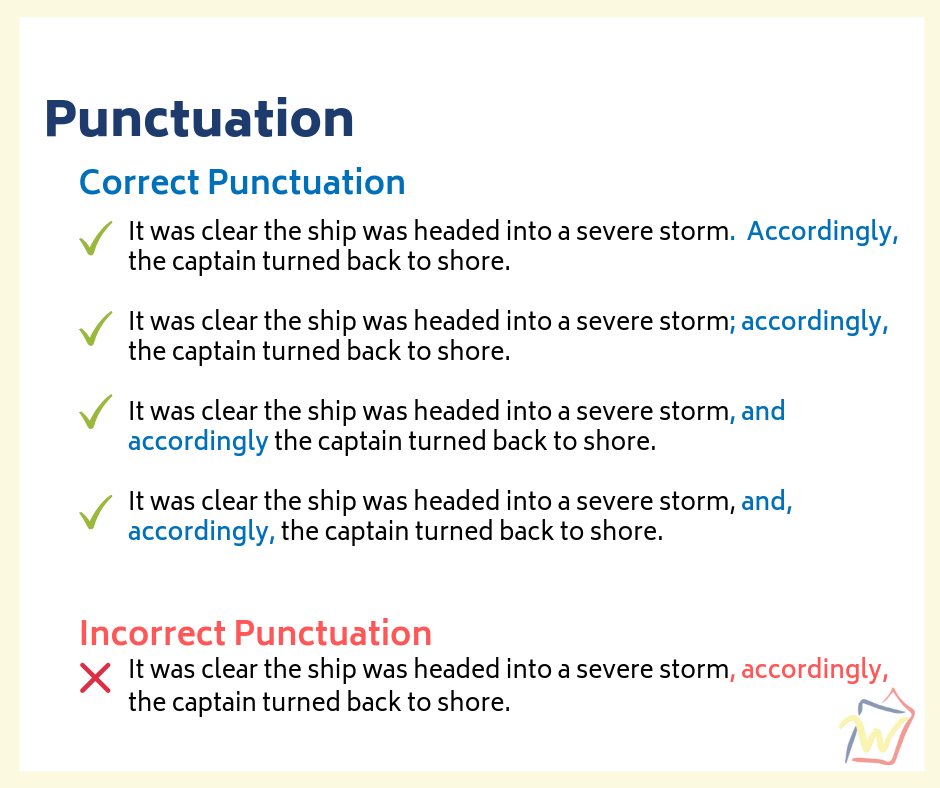
Punctuation
Conjunctive adverbs often begin new sentences and are usually followed by a comma: “Meanwhile, the boys were upstairs sleeping.” “Finally, the passengers were allowed to re-board the plane.” In addition, conjunctive adverbs may directly follow an independent clause ending with a semicolon, as in some of the examples below. Note that a comma rather than a semicolon would be incorrect in punctuating these sentences that use semicolons. This is because a semicolon has the power to link one independent clause with another, while a comma alone does not have that power.
Note the examples with “accordingly” below. The last two correct examples are correct because they contain the conjunction “and” after the comma following the word “storm.” It is that conjunction, not the comma or the conjunctive adverb, that creates the necessary grammatical link between the two clauses.
When conjunctive adverbs follow a conjunction, they can be set off by commas—one comma after the conjunction and one comma after the adverb—as in the final correct example above with “accordingly.” Alternatively, the commas around the adverb can be omitted as in the example that precedes this example. When commas are inserted, they create pauses in the reading and serve to highlight the adverb.
Additional examples of conjunctive adverbs
furthermore All residents are advised to evacuate the building. Furthermore, they are advised not to return to their homes until city officials say it is safe to do so.
moreover The driver of the car was greatly exceeding the speed limit; moreover, he was intoxicated.
therefore They had won nearly every game that season; therefore, they were full of confidence as they headed into the championship.
however They attempted to get into the house through a window. However, the windows were securely locked.
subsequently He decided to donate all his money to one particular charity; but, subsequently, he changed his mind.
consequently The fire broke out while the school was closed. Consequently, no children or staff were in the building and no injuries were sustained.
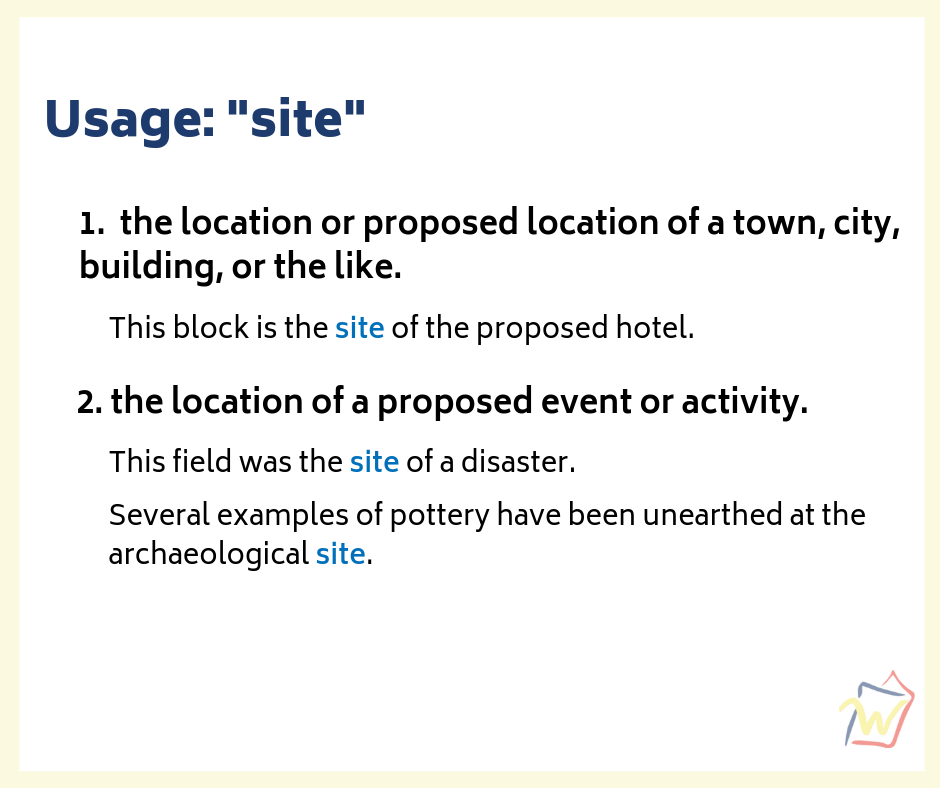
“Cite” and “site” sound alike and are spelled almost the same, but their meanings and functions are quite different. The meanings of “cite” are connected with telling or reporting or documenting. The meanings of “site” are connected with places where things happen. Another important difference between these words, which you’ll see in the following examples, is that “cite” is a verb and “site” is a noun.
Do you have questions about words that sound alike? Curious about grammar and usage? Wordsmyth’s happy to help! Contact us through our Facebook, Twitter, or feedback page.
The word “denote” refers to what a word literally means. For example, the word “beach” denotes an area next to a large body of water, no more and no less. A beach can be a cold, rocky, and windswept place. Often, however, the word “beach” conjures up notions of warm sun, sand, pleasure, and relaxation. These latter things are what the word “beach” connotes to most of us in Western society. Again, the denotation of a word is what it means literally. The connotation of a word refers to the additional images, feelings, or associations we attach to it.
“Number” refers to a quantity of individually countable things, such as “cats,” “books,” “ideas,” and “trees.” It answers the question of “How many?”
The word “amount” generally refers to a quantity of some type of thing considered “uncountable,” such as “flour,” “sand,” “time,” and “water.” It answers the question of “How much?”
The adjectives “adverse and “averse” are often confused. “Adverse” often describes a thing contrary or opposed to what someone wants or plans (“adverse weather,” “adverse circumstances,” “adverse consequences,” “adverse ruling”). “Adverse” also means “producing harmful effects,” as in “an adverse reaction to a medication.”
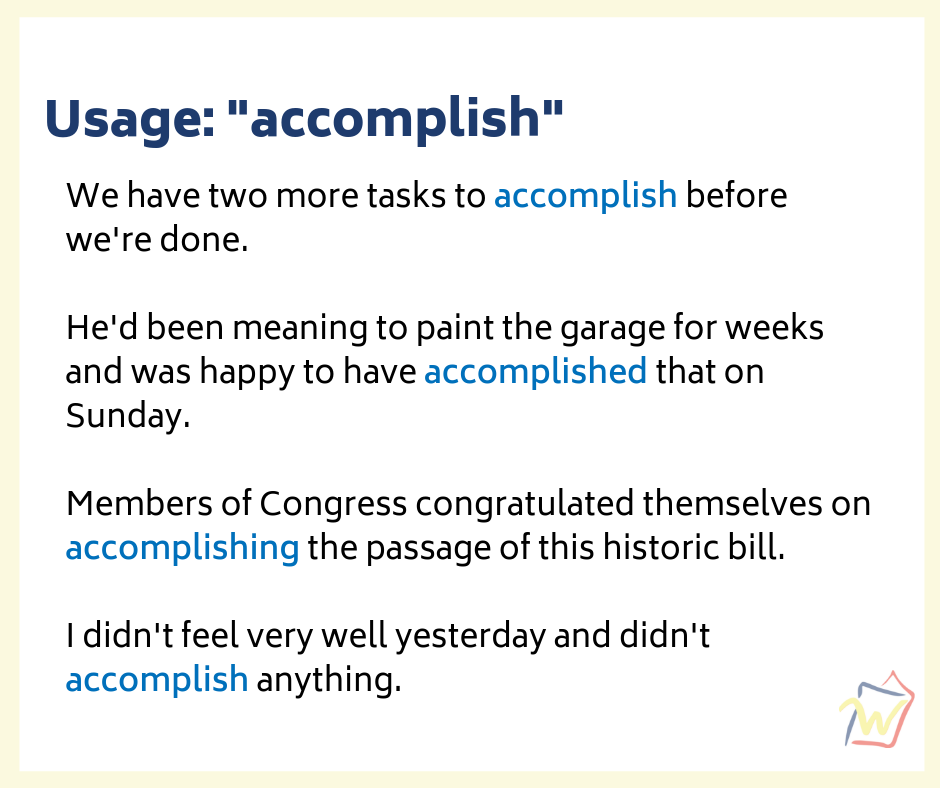
“Accomplish” and “achieve” overlap in meaning. They both convey the idea of successfully completing something. There is often a certain amount of pride or satisfaction attached to both. The words “aim,” “goal,” “purpose,” and “objective” can be used as objects with both of these verbs.
However, “accomplish” has a more concrete feeling to it than “achieve.” In many cases,achieving something suggests notions of pride and honor. If someone asked how someone accomplished a certain goal, their answer would likely include how they actually completed it.
If someone asked how someone achieved a goal, their answer would likely include notions of persistence, dedication, self-discipline, or effort. Schools usually boast about helping students achieve their goals rather than helping students accomplish their goals. Achieving is more abstract and more profound than accomplishing.
We tend to use “accomplish” for both very large or important things, like passing a new law, and rather everyday things, like doing laundry or mowing the lawn. Note that the word “task” is not normally used with “achieve”—we don’t typically say “achieve a task.” We “accomplish a task.” When you “accomplish” something, you complete it. When you “achieve” something, you work toward it with dedication and eventually reach your goal.
In a different, more abstract sense, “achieve” means “to bring about through one’s cumulative efforts.” In this sense, “achieve” is followed by objects such as “excellence,” “success, “greatness,” “equality,” “perfection,” “peace,” and “fame.”
These types of objects are not generally used with “accomplish,” as they are not concrete things one directly achieves. Rather, these tasks that can be accomplished.
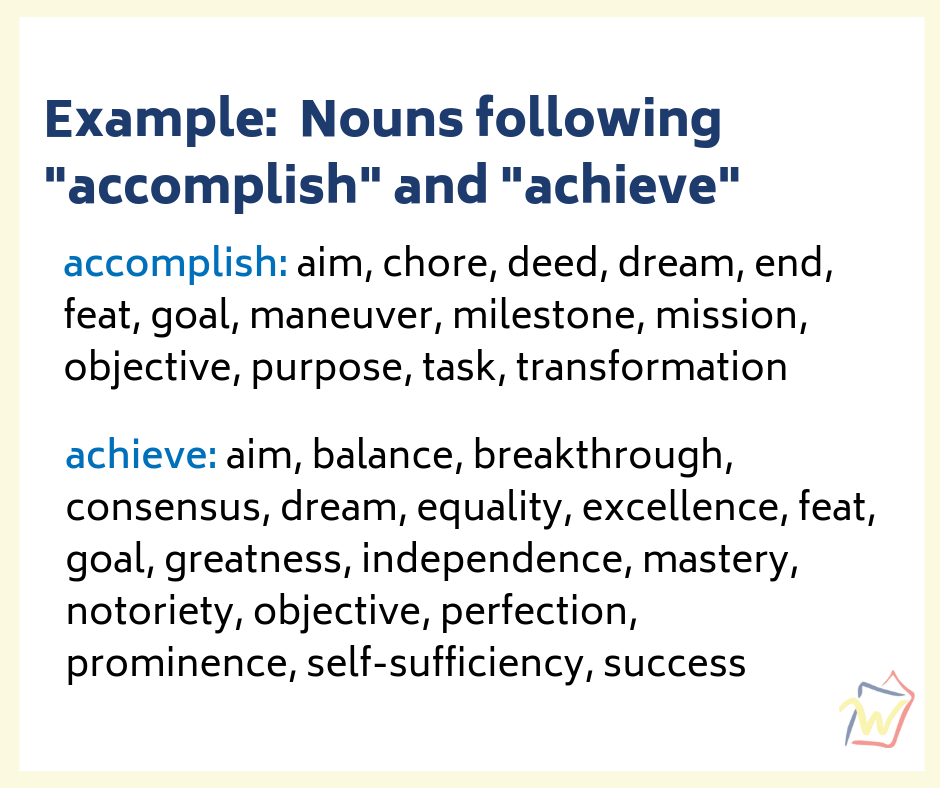
Usage
Below are some of the words that commonly follow the verbs “accomplish” and “achieve.” Looking at these, we can see an overlapping but different pattern of use for the two verbs.
Do you have questions about words that sound alike? Have questions about grammar and usage? We’re happy to help! Contact us through our Facebook, Twitter, or feedback page.
The verb “comprise” means “to be made up of, consist of, or include.” We can say that the nation of Canada comprises ten provinces and three territories. Or we can say that the cinema complex comprises four movie theaters.
“Obtain” and “attain” have similar pronunciations and meanings, but they do not generally overlap in usage. “Attain” has more the idea of achieving a goal or reaching a level or degree. “Obtain” has more the idea of actually getting something, actually taking possession of it.
The terms “transitive” and “intransitive” refer to how verbs operate in a sentence. When we call a verb’s particular meaning “transitive,” we mean that the verb is always followed by a specifically stated direct object. On the other hand, a sense of a verb labeled “intransitive” means that it is never followed by a stated direct object. In the dictionary, all senses (distinct meanings) of a verb are marked as either “transitive” or “intransitive.” Some verbs have only transitive meanings and some have only intransitive meanings, but many verbs have both transitive and intransitive meanings.
A closer look at transitive verbs
Stated in a different way, a transitive verb follows the pattern VERB + DIRECT OBJECT, and an intransitive verb follows the pattern VERB + ZERO OBJECT. If someone said “I like very much” (VERB + ZERO OBJECT), most speakers of English would feel that the sentence was missing something. They might think, “Huh?—like WHAT very much??” Unconsciously, English speakers know that the verb “like” operates transitively and requires some kind of object to follow it.*
Here are some examples of transitive verbs with their direct objects highlighted:
I like cats. I like cooking, but I don’t like cleaning up. What are you doing? They prevented the fire from spreading. We believe that such behavior is wrong.
Object or No Object?
Let’s look at a simple word like “eat.” When “eat” is a transitive verb, it is always followed by its grammatical direct object—“toast” or “dinner,” for example.
With a transitive verb, one can always ask a question like “What are you eating?” or “What did you eat?” and get an answer—even if the answer is just “nothing.” That answer is the “direct object.” Even in the question, there is a stated object—the word “what”—that takes the grammatical place of the specific thing that is eaten.
On the other hand, in the sentence “Don’t talk to him while he’s eating,” the verb “eat” is used intransitively. There is nothing following the verb that tells us what this person is eating. Of course, he has to be eating something if he’s actually eating, but the verb “eat” can be used in this way, intransitively, without any statement of what is being consumed. The fact that “eat” can be used either transitively (with a stated object) or intransitively (without a stated object) is an important quality of this particular verb.
Intransitive Use
Verbs used intransitively often have no object in real life. You can see this in the following examples that use intransitive verbs. (Note that other words can follow an intransitive verb, but no objects.)
Here are examples of the use of intransitive verbs:
The population grew. The spark plugs fired. The wind blew hard. The water is running. The baby is sleeping. She hesitated for a moment. They skate beautifully together.
Notice, though, that with a change in meaning, some of these same verbs can be used transitively, as shown in the first example for each pair below:
The boss firedthe whole team. The spark plugs fired.
We grewtomatoes last year. The population grew.
His daughter is runningthe business now. The water is running.
A Difference in Focus
Let’s look at the verb “eat” again. The actual meaning of the word in the sentence “I’m eating toast” is the same as in the sentence “I’m eating.” There is some activity with food happening in this person’s mouth. However, the focus is different. The transitive sentence focuses on both the action of eating and on the toast being eaten. The intransitive sentence, on the other hand, focuses only on the action and ignores what is actually being consumed. The intransitive sentence answers questions like “What are you doing?” or “Are you busy?” The transitive sentence answers questions such as “What are you eating?” or “Are you eating my donuts again?”
Compare the following examples of a verb being used transitively versus the same verb, with essentially the same meaning, being used intransitively:
I only eattoast in the mornings, so I am pretty hungry by lunch time. I was eating when he called, so I told him I’d call him back.
The boss workedthe employees hard. The boss worked until midnight.
The wind blew the ship off course. The wind blew hard.
Noting whether a verb follows a transitive pattern or an intransitive pattern is important for learners so that they may avoid using a transitive verb without any kind of object (“I like very much”) or using an object directly after an intransitive verb (“I apologized him”). Moreover, intransitive senses of a verb often differ from transitive senses in the general feeling they convey. Even if the meaning of the verb itself is essentially the same (“eat”), the focus when using a verb intransitively differs from when the same verb is used transitively.
Finally, although it’s common practice to speak of “transitive verbs” and “intransitive verbs,” it may be more appropriate to speak of transitive and intransitive senses of individual verbs. As stated earlier, many verbs have both transitive and intransitive senses. In addition, verbs historically used as transitives can develop new, intransitive senses and vice versa. Verbs are not inherently transitive or intransitive. They have tendencies to be used in certain ways for different meanings.
*The verb “like” is typically used transitively, but it does have a less common intransitive sense as in “You can sit here, if you like.”