Category: Language Notes

  • Judging the quantity of quantities

    The actual amounts referred to by expressions of quantity can be vague and hard to pin down.  Below is a chart of quantity expressions listed in a divided continuum from completely negative (“none”) to very positive (“a vast number of”).  Numerous quantity expressions exist other than those shown here, but it is hoped that this chart will show the most important ones and give a feeling for their relative amounts.  Most of these expressions have a wide range in meaning, so this chart should not be considered to show a perfect ordering or a perfect list of equivalents.  Still, it should be a fairly useful guide.  Note that “some” is not included in the chart.  This is because “some” has a very wide range of positive meaning that includes anything from “a tiny bit” to “a lot.”  And, because of this lack of specificity, it is not often used to express a particular quantity of something.

    A ranking of quantity expressions

    NEGATIVE SIDE

    none/
    not any
    Cake? No, sorry. There is none left.
    Cake? No, there isn’t any left.
    very few/ very littleWas it crowded?  No, there were very few people there.  It was almost empty.
    Unfortunately, we had very little time at the museum and couldn’t see what we came to see.
    few/
    little

    Few people will be at the beach today and we’ll have it nearly all to ourselves.
    No, I never found the answer.  There was little information about it on their website.

    POSITIVE SIDE

    one or two
    a couple
    a very few
    a little bit
    a tiny bit
    Yes, one or two people asked about it.
    Yes, there is a little bit of cake left.
    Oh, yes.  There is a tiny bit of spinach between your teeth!
    A very few people came in late, but it wasn’t a problem.
    a few
    a number of
    a bit
    a little
    Yes, there are a few slices of pizza left.  Go ahead and take what you’d like.
    A number of people said they were interested in my paintings. I’m very excited.
    We still have a bit of cheese.  Would you like some?
    We have a little time, so let’s get a cup of coffee.
    a fair number/ a fair amount/ several   Yes, a fair number of people have asked me that question.
    Yes,  we spent a fair amount of time figuring that out.
    Yes.  Several packages came today.  Four or five, I think.
    quite a few/ quite a bit/ several/ a surprising number/ a surprising amountYes,  it cost quite a bit of money.  It certainly wasn’t cheap!
    Yes, a surprising amount of time is needed to fix these small things.
    a good number/ a good deal ofYes, we spent a good deal of time trying to figure out how to get to places we wanted to go to.  It was pretty confusing.
    We were pleased that a good number of young people attended the town meeting.
    many/ a lot/ a great deal of/ muchYes, many friends of theirs came to the wedding.  We hardly got to speak to the newlyweds at all.
    A great deal of effort went into this project and we’re grateful to all those who participated.       
    a vast number of/
    a vast amount of
     A vast number of people, perhaps millions, will be affected by this decision.
    It will take a vast amount of money to fix this problem.

    Just interested in words? Looking for clear dictionary definitions and examples? Join our users and subscribers at wordsmyth.net or kids.wordsmyth.net.

  • The meaning of “some” as a quantity expression

    The meaning of “some” as a quantity expression

    The word “some” indicates a quantity of something, but it doesn’t strongly signal any particular quantity or any particular feeling that the actual quantity is important. There is very little difference, with respect to quantity, between “There are people in the dining room” and “There are some people in the dining room.”  Saying “There are some people” is just saying the opposite of “there are no people.”  The sense of quantity with “no” (or “not any”) is simply negative; the sense of quantity with “some” is simply positive.

    When we use words like “a lot” or “a few,” we are giving some indication as to the quantity of something.  We understand that the quantity is large when we say “a lot” and that it is fairly small when we say “a few.”  We can use these expressions to answer questions with “How many?” or “How much?” But because “some” doesn’t give much indication of the actual number or amount of what it is referring to, it is not often used in answering such questions. If it is used in such situations, it sounds as if the speaker can’t really decide how to describe the quantity.  Still, when we need to interpret “some” as a particular quantity, we assume that it is somewhere between a little bit and a lot.  If someone asks us to put some flour in a bowl, we’d probably put in what we thought would be a moderate amount rather than what seems like a little or a lot.

    Examples:

    Be careful; there’s some water on the floor. 
    We have some milk, but we don’t have any orange juice.
    There are some movies that just don’t interest me at all. [A proportion of movies just don’t interest me.]
    How many people came?  Well, some, but not many.
    How many people came?  Well, some, but only a few.

    Just interested in words? Looking for clear dictionary definitions and examples? Join our users and subscribers at wordsmyth.net or kids.wordsmyth.net.
  • The meaning of quantity expressions

    The meaning of quantity expressions

    If we really think about it, quantity expressions, other than actual numbers and words like “none,” do not specify exact amounts, and some vary widely in the actual amounts they can refer to.  The choice of any one of them—“several,” “a lot,” “a bit,” “a few,” “many”– depends on how the speaker feels about the amount being referred to, and whether that amount feels small or large or somewhere in between.

    The most specific of the quantity words are probably “a few” and “several”—and, of course, “a couple,” which usually means two, but doesn’t feel very precise.  “A few” usually means two or three, or maybe four.  But it could mean six or eight if one thought there might be sixty. (“A few” is always positive, though.  It may be a small amount, but it is still significant.)  Likewise, “several” means more than two but not so many as to confidently say “many.”  Even though “several” is defined as meaning more than two, and therefore possibly meaning “three,” it is generally felt to signify a quantity larger than “a few.”  Therefore, “several” usually suggests a quantity of more than four, but again, not so many as to make a person say “many.”

    Other quantity expressions are even more vague about numbers and amounts than “a few” and “several.”  The amounts they refer to are highly relative.  “A good number of fish,” for example, could mean four or five if that’s the number of fish an amateur caught in an afternoon, but the phrase could mean several thousand if one is referring to the current number of fish in a lake, and especially if that number is surprising.  These expressions with “good“—“a good number,” “a good deal”—refer to quantities that seem large to the speaker but still seem less than what the speaker would feel comfortable describing as “many,” “a lot,” “a great number” or “a great deal.”

    “Many” is a highly relative term (as is “a lot” and “much”).  It always refers to a number higher than two, but, other than that, it could mean any number from three to infinity, depending on what it is referring to and how the speaker feels about the number.  One could say “many gray hairs” if one found three on one’s head and was very surprised, or annoyed, or just exaggerating.  Or one could say “many stars” if one were actually referring to millions or billions.   The only important thing is that the number feels like a very large one to the speaker.

    “Some” is the most vague and relative quantity expression of all.   In fact, we don’t often use it to answer a question about the specific quantity of something.  If we do use it in such cases,  we may give the impression that we cannot decide how to describe the actual amount.  As a quantity word, “some” is most often used as the positive complement of “any” or “no”  (e.g., “Is there any milk left?” –Yes, there’s some in the fridge.”  “I saw some beautiful birds yesterday, but I saw no birds at all this morning.” “I don’t have any peaches, but I’ve got some apples.)  Whereas  “no” and “any” are used to negate or question the existence of a quantity of something, “some” is used to state or affirm the existence of a quantity of something.  But, again, the actual amount of this thing is pretty much unimportant, except that it’s more than one, if the item is countable. 

    Just interested in words? Looking for clear dictionary definitions and examples? Join our users and subscribers at wordsmyth.net or kids.wordsmyth.net.
  • Idiomatic phrases in Wordsmyth dictionaries

    Characteristics of Wordsmyth’s “phrases”

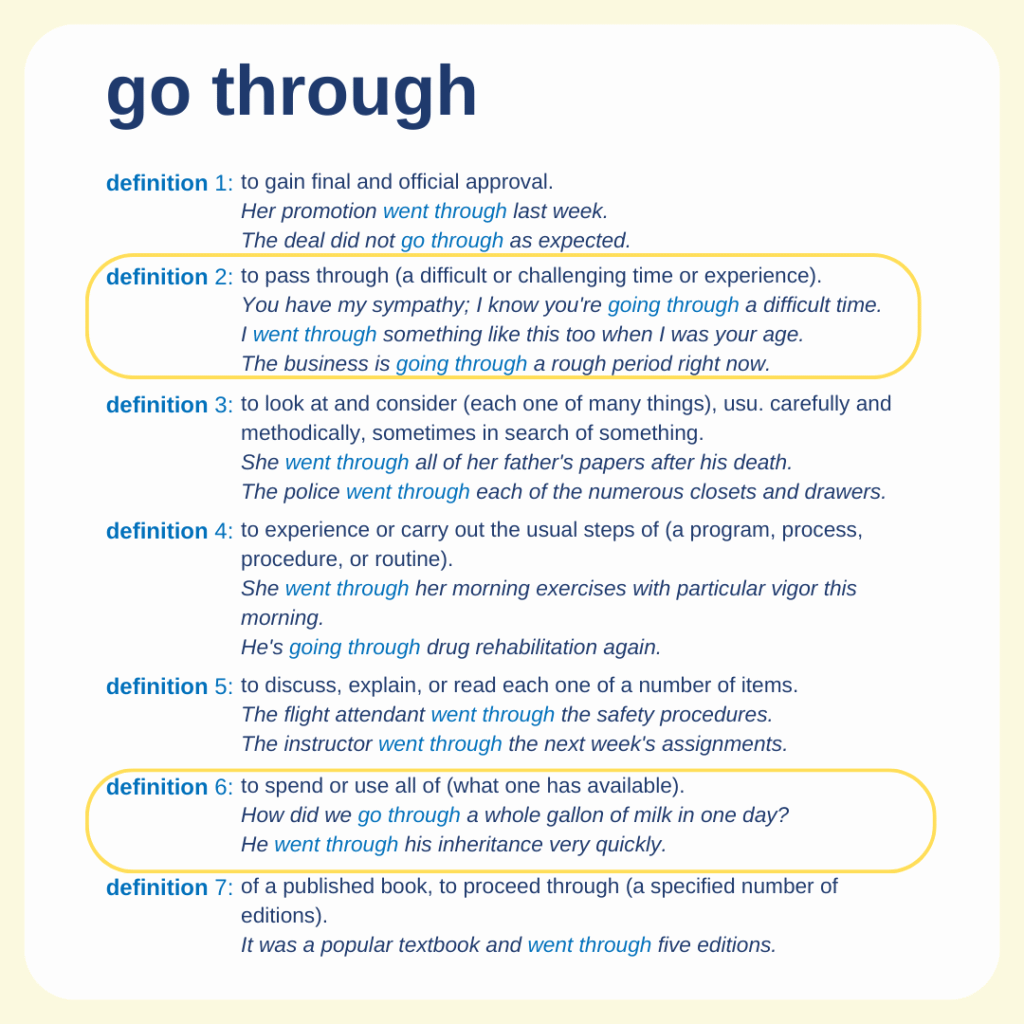
    What Wordsmyth terms “phrases” in its dictionaries are multi-word expressions that range from highly idiomatic expressions (“with a grain of salt“, “sell like hot cakes“) to marginally idiomatic phrasal verbs and expressions (“get off,” “go through,” “do the dishes,” little by little,” “again and again“). These multi-word expressions that may seem only mildly or weakly idiomatic are included as “phrases” in Wordsmyth because they are tightly bound units of meaning with very high frequency. Even though their meaning may not seem difficult to comprehend, at least to a native speaker, their form—their exact necessary parts and ordering—as well as their significance in the language, cannot be predicted by learners, and, consequently, we feel these expressions deserve to be singled out and defined along with traditional “idioms.”  In addition, phrases that seem quite transparent in one sense often have other important senses that are more distinctly idiomatic.  Compare “go through a difficult time” versus “go through a gallon of milk.”

    In many ESL resources, and even in some dictionaries, phrasal verbs tend to be listed with only one basic meaning, sometimes with two or more, but, as most teachers are aware, the most common phrasal verbs tend to have a rather large number of different meanings.  In the Advanced Dictionary, Wordsmyth lists seven definitions for the phrase “go through,” for example.  The phrase “come down” has nine senses listed in Wordsmyth, without including “come down on,” “come down to,” and “come down with,” which have their own separate entries. Because of the large number of senses for many phrases, we recommend using the customization tool (“Customize definition and example”) when creating a Vocabulary Center wordlist that includes phrases, especially two-word phrasal verbs. In this way, you can check for additional senses of the phrases you wish to use.

    In addition to having more senses than in many other resources, Wordsmyth offers far more example sentences for the most common and essential phrases.  And because the examples are created by lexicographers, they are carefully matched to each sense of a phrase.

    Ease of searching for phrases

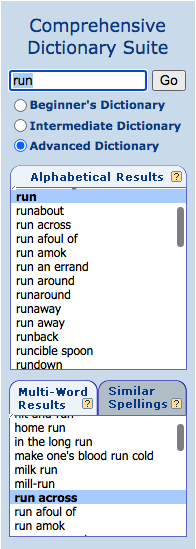
    Individual phrases in Wordsmyth are easy to find because they have their own individual entries, and they can be looked up using the search box just as you would look up any headword.  You do not need to look through the whole entry for “run,” for example, in order to find the expression “run into” or “run out.”  Moreover, if you happen to be in the entry for “run,” you may find phrases that include the word “run” listed at the top of the entry.  (Phrases can also be found by checking the alphabetical results in the sidebar within the entry that you are currently in or by checking the multi-word results listed in the sidebar). Please note that the phrases that are listed at the top of the entry for a particular headword may not be the only phrases that include that headword. Other phrases that include the headword may be linked to a different word in the phrase. For example, the phrase “run amok” is linked with “amok” rather than with “run.” Typically, however, phrases consisting of a verb plus an adverbial particle or preposition (two-word verbs such as “run down,” “run across”) are linked with the verb entry.

    If you’d like to take a closer look at how Wordsmyth treats its phrases, we’ve created a set of 20 essential phrasal verbs for you to review. You may be surprised at the range of meanings you’ll find!

  • create vs. produce

    create vs. produce

    Both “create” and “produce” have the meaning of making a new thing or bringing a new thing into the world.  One might expect the words to be close synonyms, yet, surprisingly, they do not generally overlap in usage.  The first important difference is that creating tends to require imagination, or something like a divine or magical spark, whereas producing tends to come about through a mechanical process or through natural processes that are part of the way plants and animals function biologically:  Chickens produce eggs; they don’t create them.  You produce a loud noise with your tuba; you don’t, in general, create one.  You can, however, create a new and unique sound with your tuba if you’ve been working on it and exploring different possibilities.

    The second difference is that creation tends to focus on a thing being made for the first time ever, while production often suggests making a new thing in just the same way as similar things have been made before, or it suggests multiple things being made at the same time and in the same way as each other.  Consequently, “create” can sometimes have an inspired, even poetic, feeling to it whereas “produce” often has a more prosaic, mechanical feeling to it:  The task of an artist is to create.  The task of a manufacturer is to produce

    “Create” also tends to be used more often in combination with abstract words than “produce.”  With abstract ideas, “create” is a slightly more formal or academic way of saying “make” or “cause,” as when we say “create a dilemma,” “create a disturbance,” “create an illusion,” “create a nurturing environment,” “create a relaxing atmosphere.”  “Produce” can be used instead of “create” in combination with abstract words, but “create” tends to be the more frequent choice.

    One final, and perhaps most important, difference between these words is that “produce” is rather narrowly focused on the sending out of something into the world, the delivery of a thing as a finished product.  It is not very much concerned with the process of making or putting something together, even if a great deal of effort—even creativity– actually goes into a thing’s production.  “Create” is more focused on the piece-by-piece crafting of something, especially when that process requires imagination or a unique set of actions, decisions, and materials.  Looking at artists and manufacturers again, it should be noted that a very fast-working artist can produce more works of art than a slow-working one.  In this example, “produce” is used because the focus is just on the putting out of finished products.  On the other hand, a manufacturer can create a design for a new product.  In this example, “create” is used to focus on the process of putting together a new and unique thing and to suggest the use of thought and imagination going into that process.

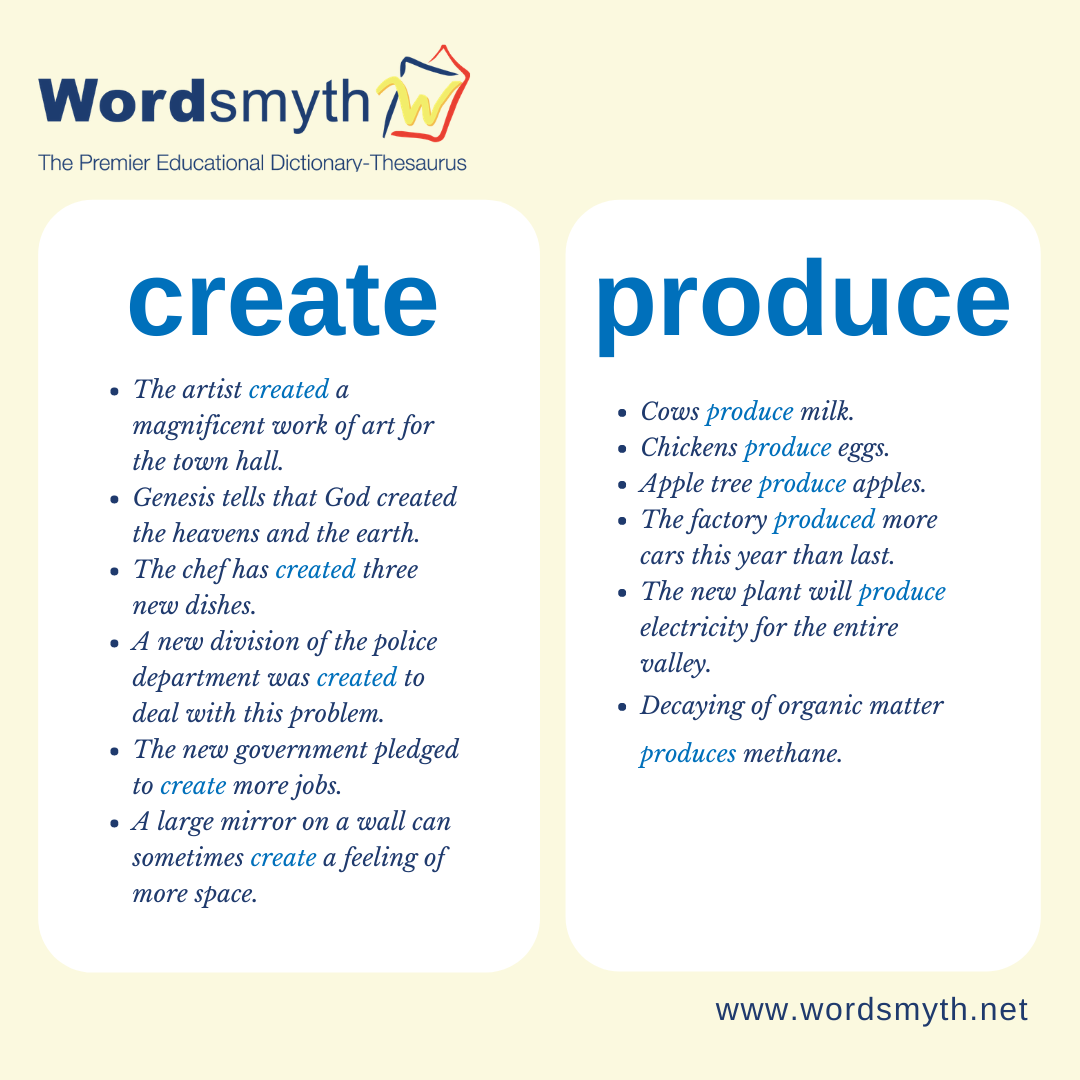
    create

    • The artist created a magnificent work of art for the town hall.
    • Genesis tells that God created the heavens and the earth.
    • The chef has created three new dishes.
    • A new division of the police department was created to deal with this problem.
    • The new government pledged to create more jobs.

    produce

    • Cows produce milk.
    • Chickens produce eggs.
    • Apple trees produce apples.
    • The factory produced more cars this year than last.
    • The new plant will produce electricity for the entire valley.
    • Decaying of organic matter produces methane.

    Just interested in words? Looking for clear dictionary definitions and examples? Join our users and subscribers at wordsmyth.net or kids.wordsmyth.net.
  • aesthetic vs. ascetic

    aesthetic vs. ascetic

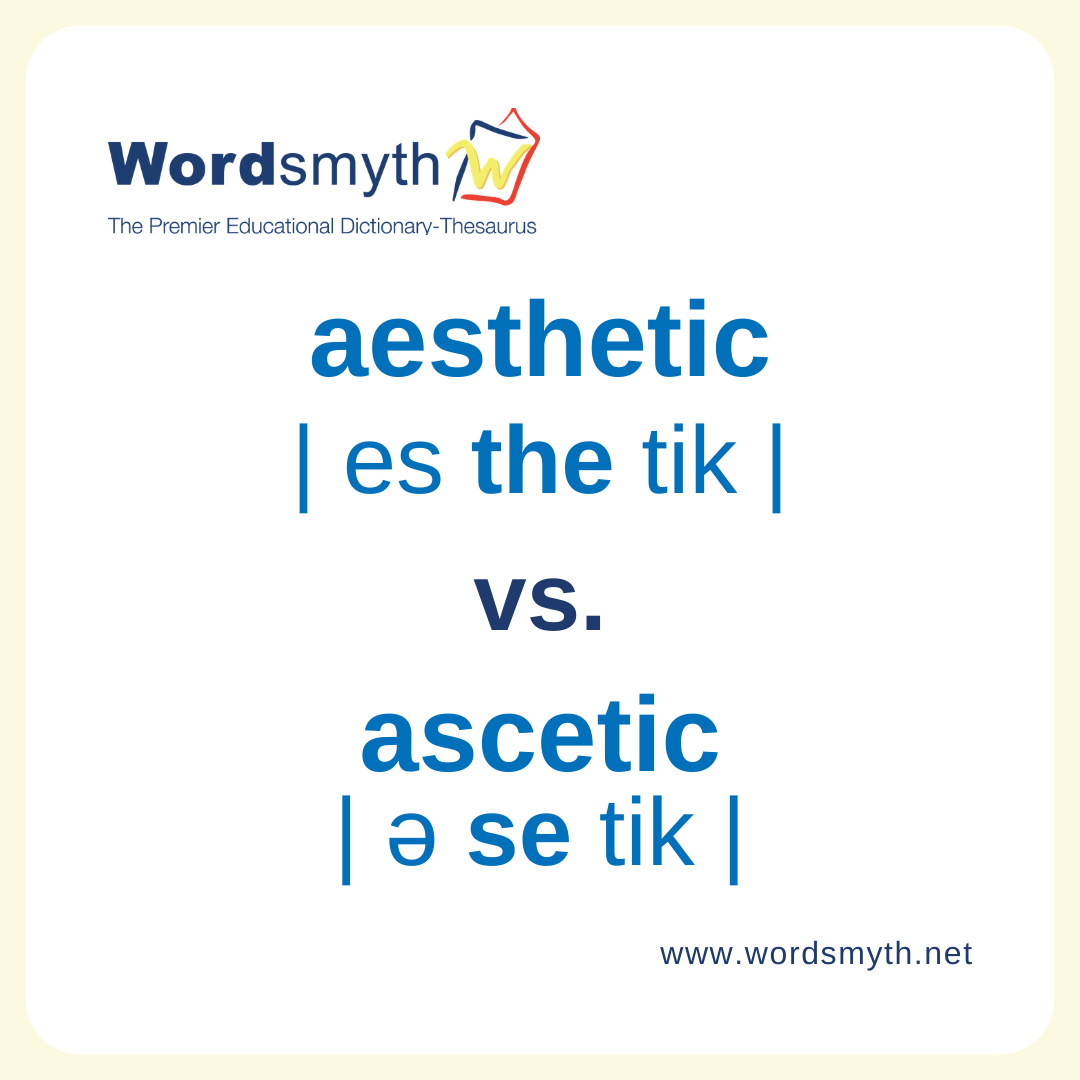
    aesthetic |es the tik|
    vs.
     ascetic | ə se tik|

    These words have similar pronunciations and spellings, but quite different meanings.  The word “aesthetic” –with the “th” sound in the middle–has to do with beauty, so if you’re talking about beauty or the arts, “aesthetic” is probably the word you’d want to use rather than “ascetic.”  “Ascetic” refers to self-denial, self-discipline, and austerity.  It’s a word often used when referring to the monastic life or something similar to it.

    aesthetic:  of or relating to beauty or to the study of beauty and its forms.
    Her aesthetic sensibility was offended by the gaudy decor of the banquet hall.
    Each culture has its own aesthetic traditions.

    ascetic:  rigorously simple and disciplined; austere; self-denying.
    The nuns lead an ascetic life in the convent.
    It was necessary to adopt an ascetic way of life during the war.
    Their new stepfather imposed an ascetic regimen on the family.

    It’s also easy to confuse “aesthetic” or “ascetic” with “acetic,” which refers to acid or vinegar.  Besides the difference in meaning, the pronunciation of “acetic” has the “e” vowel sounding like the “e” in “bee,” whereas the “e” sound in the other two is like the “e” in “pet.”

    Just interested in words? Looking for clear dictionary definitions and examples? Join our users and subscribers at wordsmyth.net or kids.wordsmyth.net.
  • imply vs. infer

    imply vs. infer

    Imply” and “infer” have a relationship that is similar to the one between “talk” and “listen.”  “Imply” corresponds more closely to the talking side of the relationship, and “infer” corresponds more closely to the listening side. A talker can imply; a listener can infer.

    When you imply something, there is a meaning in what you are saying or projecting that may be understood by someone else but is not being communicated in a direct manner by you.  If you say “The floor is wet,” you may be implying that your listener shouldn’t walk across it.  If you say “I know where you went last night,” your tone may be implying that your listener was up to some mischief or even immoral activity.

    Sometimes, of course, we argue about what we said versus what we implied.  We say, “I didn’t say that!” and the other person says, “Yeah, but you implied it!”  It is possible for us to say something that can be interpreted in a way that we do not intend.  What’s really happening in many of these contentious cases, though, is that the listener is inferring a meaning that we did not intend to imply!

    When you infer something, you are on the receiving side of the communication.  Something is expressed to you, and you are finding inexplicit or hinted at meaning in it, or you believe you’ve uncovered some hidden meaning even if, in fact, it isn’t intended by the speaker.

    It should be said that both implication and inference are absolutely essential to communication.  It would be uncomfortable, difficult, or impossible to actually say everything that we mean when we say something.  Instead, we trust in our listener’s ability to understand what we’re implying or to infer information from what we say.   For example, if we say “My flight leaves at seven.  I guess I’ll set my clock for 4:00 a.m.,” we intend our listener to understand the connection between these two statements, and we don’t even question his or her ability to do so.  What we are not saying but that we trust our listener to infer from the above sentences, among other things, is that the flight leaves at seven in the morning, that the clock is an alarm clock, and that we need to wake up at the set time in order to have time to get to the airport for our flight.

    How would we function if we had to actually say everything we mean?!

    Finally, although the discussion here has focused on verbal communication, it should also be noted that both “imply” and “infer” can be used in other contexts.  Either can be used in reference to other ways that meaning can be signaled indirectly or can be deduced, as the following examples will show.

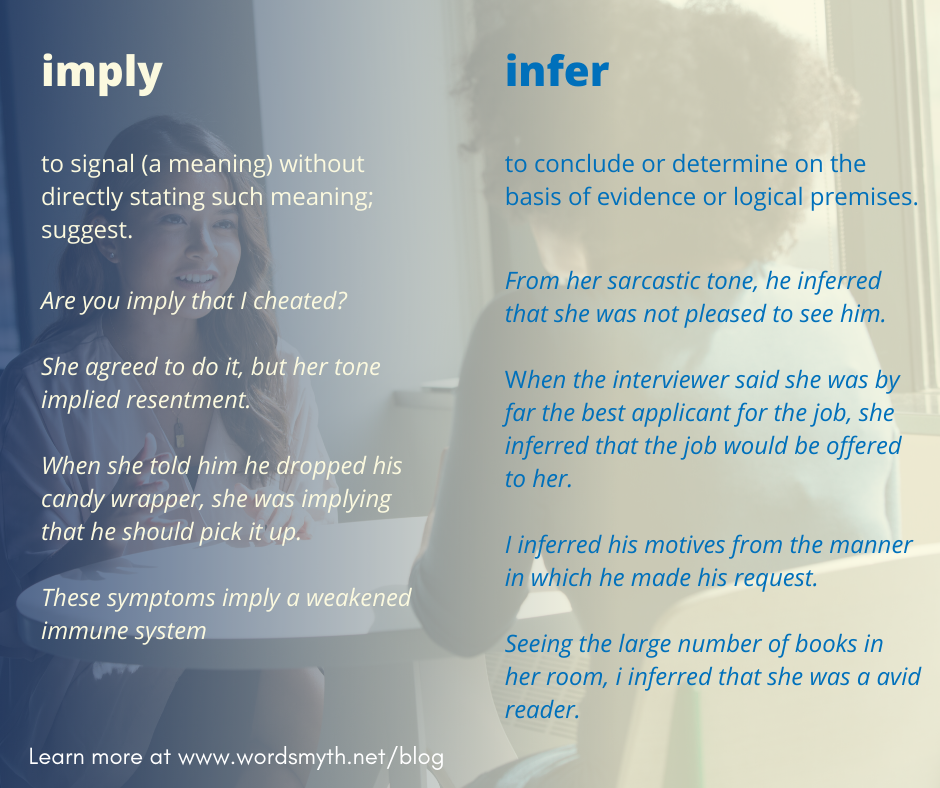
    imply

    to signal (a meaning) without directly stating such meaning; suggest.

    Are you implying that I cheated?

    She agreed to do it, but her tone implied resentment.

    When she told him he dropped his candy wrapper, she was implying that he should pick it up.

    These symptoms imply a weakened immune system.

    infer

    to conclude or determine on the basis of evidence or logical premises.

    From her sarcastic tone, he inferred that she was not pleased to see him.

    When the interviewer said she was by far the best applicant for the job, she inferred that the job would be offered to her.

    I inferred his motives from the manner in which he made his request.

    Seeing the large number of books in her room, I inferred that she was an avid reader.  

    Just interested in words? Looking for clear dictionary definitions and examples? Join our users and subscribers at wordsmyth.net or kids.wordsmyth.net.
  • About the Wordsmyth “Word Combinations” Feature

    The Word Combinations feature in Wordsmyth dictionaries displays words that are frequently used in combination with a particular headword. If you looked up “negotiate,” for example, you would be presented with words such as “accord,” “agreement,” “cease-fire,” “compromise,” “contract,” “deal,” “treaty,” and “truce.” You would also see words such as “actively,” “reportedly,” “safely,” and “successfully.”

    The sets of words that you are shown in the Word Combinations feature can help you find a word that is correct or appropriate to complete a particular meaning that you want to express. In addition, the words can help you refine your understanding of the word you looked up by showing you the pattern of general use for this word. For example, it may help to better understand the meaning of “apocryphal” if you know that it combines with words like “legend,” “tale,” “story,” and “account.”

    Seeing the words that combine with your word can also give you a sense of how this word may be differentiated from words with similar meanings. Even close synonyms combine with other words along different lines. For example, the words “obtain” and “acquire” have very similar meanings but combine with words somewhat differently. “Obtain” combines with “approval,” “patent,” “passport,” and “permission,” for example. “Acquire” does not typically combine with any of these but more often combines with words like “assets,” “wealth,” “competence,” “expertise,” “habit,” and “trait.”

    Combinations of words such as are shown in the Word Combinations feature are referred to by linguists as “collocations.” The term “collocation” actually refers to various types of word combinations ranging from fixed phrases and idioms, in which the words always go together in a certain way and cannot be interchanged with other words, to word combinations that occur frequently but are made up of words that can be easily interchanged with other words. The collocations that we display in the Word Combinations feature tend to be closer to the latter type. Most of them are “medium strength” collocations, such as “cool breeze,” “refreshing breeze,” “soft breeze,” and “gentle breeze.” Some of the collocations that we show, however, are “strong collocations” made up of words that seem to cling to each other, such as “commit” and “crime” and “tell” and “truth.” Some of the combinations that the data-gathering tool brings up in addition, such as “social + security” and “right + angle,” represent unique units of meaning in themselves and may also be found as dictionary headwords that have their own definitions.

    Word Combinations is a Wordsmyth subscription feature. If you are not currently a subscriber, try out the feature with a 15-day trial subscription. Then, under “Display Options” near the top of any entry, select “Word Combinations.” At the same time, why not try out our “Word Parts” or “Spanish support” features? The free subscription will also give you access to WILD, the Wordsmyth Illustrated Learner’s Dictionary designed for very young readers and language learners.

  • damp vs. moist

    damp vs. moist

    Damp” and “moist” are words with similar meaning.  They both describe things that contain a small amount of moisture—not so much moisture as to say something is “wet,” but nonetheless an amount that is tangible, an amount that we can physically feel. 

    Although the two words are close in meaning, they are not exactly the same and tend to be used quite differently.  First of all, “damp” often describes a condition that is unpleasant or unwanted (“damp bedsheets,” “a damp basement.” “a damp hotel room”), whereas “moist” more often describes a pleasant or desired condition (“moist skin,” “moist cake,” “moist soil”).  This is not to say that there are no exceptions to these tendencies, but, in general, when dryness in a thing is something we want, then it is not good when it’s damp (“a damp carpet”).  When dryness in a thing is not what we want, then it’s good when it’s moist (“a moist cupcake”).

    It’s also important to note that a “moist” thing is generally a little more saturated with liquid than something that is just “damp.”   Wiping something with a “moist” cloth would leave tiny droplets of water on it, whereas a “damp” cloth would leave no visible droplets.  Something that is “damp” is not completely dry; something that is “moist” is nearly, but not completely, wet.  

    Another interesting difference is that we rarely, if ever, use “damp” to describe something we can eat.  You can say “moist cookies,” but you can’t say “damp cookies.”  Well, you can, but it’s a little hard to imagine why you would!  This is because we generally feel dampness of an object by touching the outside of it, and we’re generally not interested in how the outside of a cookie feels.  With cookies, we’re mostly interested in what’s inside.  Moreover, dampness is something we sense with the outside of our bodies.  It’s not something we sense with the inside of our mouths!

    One last tendency to mention is that “damp” tends to be linked with coldness in our minds, whereas “moist” tends to be linked with warmth or a neutral temperature.  “Moist climate,” for example, would be linked with places that are warm and rainy, as in “the moist climate of the tropics.”  “Damp weather” is associated with places that get abundant rain along with cool temperatures. “Damp weather,” like many other things that are called “damp,” is often considered uncomfortable and something justifiable to complain about.  “Moist weather,” on the other hand, does not seem to be as common a cause for complaint—either that or it is not experienced as frequently by the majority of English speakers.  In fact, the combination tends to be used mainly in weather forecasting rather than in ordinary conversation.  Interestingly, when we complain about warm weather that has some degree of moisture, it is “humid weather” that gets the gripes.

    The following are some of the most common word combinations for “moist” and “damp”:

    MOIST:  moist cake, moist muffins, moist brownies, moist lips, moist air, moist towelettes, moist soil, moist skin, moist eyes

    DAMP:  damp basement, damp cloth, damp laundry, damp cellar, damp weather, damp fur, damp hair, damp room, damp washcloth, damp sheets, damp mop

  • In addition…. Moreover…, and furthermore…!

    In addition…. Moreover…, and furthermore…!


    All three of these conjunctive adverbs are used to indicate that you have something more to say than what you’ve just said.  They are a little like conversational traffic signs that say “Wait!  I’m not done yet!  I’ve got something more to say on this subject.”  Often, the three expressions are interchangeable.


    JUST ADDING INFORMATION

     “In addition” might be said to be the most neutral and least assertive of the three expressions.  It’s used mainly just to add one piece of information on a subject to another piece of information on the same subject.  “Furthermore” does the same thing, but it is more emphatic in tone.  It sends out a little bit stronger signal to the listener or reader that says:  “Stay with me!  There is more that you need to know!”    

    • The new state park will open next June with numerous hiking trails to explore.  In addition, a boat marina is being constructed at the north end of the lake.
    • All residents are advised to evacuate the building.  Furthermore, they are advised not to return to their homes until city officials say it is safe to do so.
    • India is one of the most populous countries of the world with three official languages and numerous others spoken.  Most of the population are adherents of Hinduism, though there is a large Muslim minority.  Furthermore, a small but significant percentage of Indians are Christians and Sikhs.


    BEING PERSUASIVE

    All three adverbs can be used when trying to persuade the reader or listener of something, to make one’s current argument stronger by adding additional supports.  However, “furthermore” and  “moreover” have a more forceful or authoritative tone than “in addition” and may therefore be preferred for bolstering one’s argument.  In the example below, the argument concerns the need to exercise more.  The second sentence gives two supporting statements for this argument, and the sentence beginning with “furthermore” gives yet another one.

    • It’s clear that we all need to exercise more:  Exercise improves one’s strength and can reduce one’s risk of chronic disease.  Furthermore, new evidence is suggesting that it is important for one’s mental fitness as well.

    The word “moreover” is the most assertive in tone of the three adverbs and may suggest that what follows carries more weight than what the speaker has just said before.  The information in the statement may be something that the speaker feels strongly about or is something that will likely surprise the listener or make a strong impact.  Additionally, the statement introduced by “moreover” tends to contain a different kind of information from what has come before.  “Furthermore,” on the other hand, simply signals that one is about to say something that will give additional support for one’s argument.  It may be information along the same lines or it may be information of a different type.

    • I don’t agree that she’s overrated as a singer.  Moreover, I think you’re just jealous of her talent!
    • I’m not surprised they’re firing him.  His work is substandard, and his attitude is poor; moreover, he’s always late to meetings.
    • There was no way they could have won the battle.  They were outnumbered by thousands of enemy troops.  They were exhausted and demoralized from earlier fighting.  Furthermore, they were insufficiently armed.

    Because of their assertive or authoritative nature, the adverbs “moreover” and “furthermore” tend to be used more often in heated arguments, fiery speeches, and in scolding than the more neutral expression “in addition.”  One can easily imagine hearing “moreover” and “furthermore” during a hard-hitting debate or, say, when a school principal or instructor scolds a group of students for unacceptable behavior.

    • Your deplorable behavior toward this boy will be punished, and, furthermore, you will have to have to apologize both to the boy and his parents.
    • I will accept no more late papers in this class.  Moreover, students who are not in their seats when class begins will be marked absent.

    In speaking, both “moreover” and “furthermore” tend to be pronounced with strong emphasis.  The words are pronounced slightly louder and with higher pitch (on their stressed syllable) than the words coming before or after them.  The expression “in addition” may or may not be pronounced with strong emphasis.

    The three expressions being discussed here can all be used in an extension of the same discussion or argument.  It simply depends on how many additional pieces of information or supports one wants to provide in making one’s point or covering a small topic.  In general, however, whenever “furthermore” is used in conjunction with either or both of the others, it tends to introduce the final element.  In fact, “furthermore,” whenever it is used, tends to bring with it the final piece of information on a subject or final point of an argument.  One can image a lengthy argument that goes like this:

    • Blah, blah, blah.  Blah, blah, blah….  Moreover, blah, blah, blah…  And, furthermore, blah, blah, blah.

    Now that’s a compelling argument!

    Finally, all three expressions share a certain formality of tone. “In addition” and “furthermore,” in particular, have a rather academic or official sound to them.  While all three certainly can be used in informal conversation, they are more often used in relatively formal writing and speaking.  In informal speaking, the expression “not only that, but…” serves the same function as “moreover,” and a strongly stressed “also” at the beginning of one’s sentence can serve the function of any of the three.  The expression “plus” is also gaining ground as an even more informal and emphatic alternative to “also.”

    Just interested in words? Looking for clear dictionary definitions and examples? Join our users and subscribers at wordsmyth.net or kids.wordsmyth.net.