Category: Vocabulary

  • Word Parts IV: Basic prefixes

    Word Parts IV: Basic prefixes

    A prefix is a word part that attaches to the front of a root or to an existing word to create a new word. The prefix “micro,” for example, attached before the root “scope” gives us the word “microscope.” An “existing word,” it may be noted, may already contain a prefix. For example, we can add the prefix “in-” to the word “complete,” which itself is made up of the prefix “com-” attached to the root “plete.” The word “incomplete” then consists of two prefixes attached to a root. Similarly, the word “mistranslate” contains the two prefixes “mis-” and “trans-” standing before the root “lat.”

    The list below contains some of the most common and important prefixes in English. All the prefixes in this list derive from Latin or Greek, except the two “un-” prefixes, which derive from Old English.

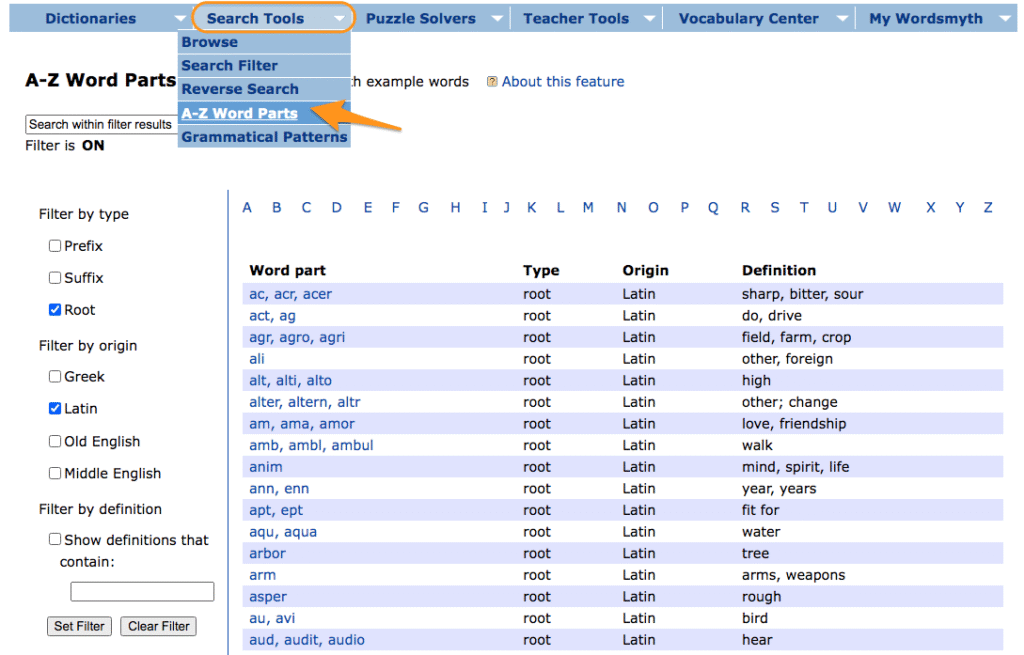
    Additional example words for each prefix in the list below can be found by going to A-Z Word Parts under Search Tools in our dictionary, filtering the list there for “Prefixes” and browsing through the list. One may also use the search box on the A-Z Word Parts page to search the list for a particular prefix. Click here to learn more about how to use the Wordsmyth Word Parts database.

    prefixmeaningexample word
    anti-againstantibacterial, antiwar, antislavery, anticancer drug
    auto-selfautomobile, autobiography, autograph, automatic
    bi-twobicycle, bilingual, bisect, binoculars
    circu-, circum-aroundcircular, circus, circulate, circumnavigate
    com-with; togethercombine, combat, compose, component
    dis-not; apart; reverse, negatedisappear, disagree, dishonest, disbelief
    en-1, em-1to put into; cause to be or haveenjoy, envelope, enlarge, employ
    ex-out, out of, away fromexit, exhaust, exclude, export
    il-2 im-2 in-2  
    ir-2
    not, withoutillegal, impossible  incomplete, incorrect, irregular
    inter-between, amonginternational, internet, interrupt, intersect
    micro- smallmicroscope, microsurgery, microbe, microwave
    mis-bad, badly, wronglymistake, misunderstand, misbehave, mistreat
    multi-manymultiply, multicolored, multitude, multitask 
    non-notnonsense, nonfiction, nondairy, nonessential
    pre-beforepredict, precede, preheat, prejudge
    re-again, back, back againrewrite, review, redo, rebuild, recall 
    sub-under, belowsubway, submarine, subcategory, submerge
    trans-across, over, to the other sidetransport, transit, transatlantic, translate
    un-1notunnecessary, unable, unusual, unequal
    un-2reverse (an action)untie, undo, unbutton, unlock 
    Download, save, or print as PDF

    See also:
    Word Parts I: basic roots
    Word Parts II: basic suffixes
    Word Parts III: Intermediate level suffixes

    Learn more about the Wordsmyth word parts database and how this unique feature can be used in facilitating vocabulary learning and teaching.

  • Word Parts III: Intermediate level suffixes

    Word Parts III: Intermediate level suffixes

    The suffixes in the following list are extremely common suffixes but some have fairly specialized meanings. The suffixes “-ish,” “-en,” and “-less” derive from Old or Middle English. The rest derive from Latin or Greek.

    Additional example words for each suffix in the list below can be found by going to A-Z Word Parts under Search Tools in the Wordsmyth dictionaries, filtering the list there for “Suffixes,” and browsing through the list. One may also use the search box on the A-Z Word Parts page to search the list for a particular suffix. Click here to learn more about how to use our Word Parts database.

    suffixmeaningexample words
    -lessMiddle English adjective-forming suffix that means withoutendless, fearless, wireless
    -ance, -ence Latin noun-forming suffix that means state, quality, or act of;
    The suffix -ance is usually attached to whole English words, whereas -ence is usually attached to roots: compare eloquence and acceptance
    acceptance, admittance, residence, science
    -al Latin adjective-forming suffix that means pertaining tocultural, dental, manual, universal
    -istGreek noun-forming suffix that means person who does or believes in; Many words ending in -ist have a corresponding abstract noun form ending in -ism, and many have a corresponding adjective form ending in -ic (realistic, artistic).artist, chemist, dentist
    -itis Greek noun-forming suffix that means inflammationappendicitis, arthritis, poliomyelitis.
    -logy, -ology Greek noun-forming suffix that means study of, science of; written work; structure or principlebiology, ecology, geology
    -enOld English verb-forming suffix that means to cause to be or become or havedarken, enlighten, strengthen
    -fyLatin verb-forming suffix that means make, cause to be, becomeclarify, justify, satisfy
    -ize, -iseGreek verb-forming suffix that means to turn into or cause to becivilize, immunize, recognize
    -ous, iousLatin adjective-forming suffix that means full of, characterized bygracious, joyous, spacious
    -icsGreek noun-forming suffix that means science, study, or practice of; properties of; practices pertaining toeconomics, physics, politics
    -ishOld English adjective-forming suffix that means of, resembling; somewhatchildish, ticklish, foolish
    Download, save or print as PDF

    See the full list of roots, prefixes, and suffixes in the A to Z Word Parts feature at wordsmyth.net.

    See also:
    Word Parts I: basic roots
    Word Parts II: basic suffixes
    Word Parts IV: basic prefixes

    Learn more about the Wordsmyth word parts database and how this unique feature can be used in facilitating vocabulary learning and teaching.

  • Wordsmyth’s Word Parts Database

    Wordsmyth’s Word Parts Database

    The importance of learning Word Parts (roots, prefixes, and suffixes)

    Studying word parts equips us to do the following:

    • Identify the meaningful elements that make up words.
    • Learn the characteristics of roots and of affixes, their origin, meaning, and grammatical function.
    • Guess (or recall) the meaning of unfamiliar words from the clues given by word parts.
    • Recognize the relationship among words that share a common root or affix.
    • Recognize patterns among changing word forms (e.g., -cept, -ceive).
    • Improve spelling by gaining awareness of the internal logic of words.
    • Increase vocabulary, cultivate morphological awareness, and have fun discovering some of the interesting ways the English language works.

    For a general introduction to the terms and concepts used in our Word Parts database, see this downloadable pdf . Access to the Word Parts feature comes with your Wordsmyth subscription or a 15-day free trial.

    Three ways to view the Word Parts data

    1. Dictionary entries:

    More than 8000 Wordsmyth dictionary entries now display information about the word parts that make up the headword. In the new Word Parts section of the entry, the headword is broken down into its roots and affixes.

    Each significant word part is identified, and its origin, type, and meaning are provided. The user can also view here a list of other example words containing the word part and jump to those words’ dictionary entries to explore further. “More about this word part” notes explain in more detail how particular affixes combine with bases to form words.

    abstain wp

    2. A-Z Word Parts Page:

    In addition to the Word Parts feature appearing in individual dictionary entries, where the composition of a word can be studied in the context of looking up a particular word, the user can search, sort, and browse more than 600 roots and affixes on the A-Z Word Parts page. This page can be accessed from the Search Tools menu.

    3. Search Filters:

    Finally, for a list of all the words in the dictionary that contain word parts information, the user can go to the Search Filter page (under the Search Tools menu), select “Word parts information” under “Entries with special features,” and click “Set filter.”  This takes the user to a page that displays the list of words in an alphabetical, browsable format. 

    Word Parts Data in the Word Explorer Children’s Dictionary

    Users of the Word Explorer Children’s Dictionary have these same three modes of access to roots and affixes information but with the example words limited to the headwords in the Children’s Dictionary. To maximize flexibility, there are links to the complete Word Parts Database from any point in the Children’s Word Parts data. In the case of roots and affixes that have no example words in the Children’s Dictionary, the word part and information about it can still be found in the Children’s Dictionary A-Z Word Parts look-up. 

    See also:
    Word Parts I: basic roots
    Word Parts II: basic suffixes
    Word Parts III: Intermediate level suffixes
    Word Parts IV: basic prefixes

  • right away vs. right now

    Both of these expressions mean “immediately,“ but “right away” means “without delay” and tends to be used in situations where there is fear or worry, in situations where there is really not a moment to lose before some bad thing might happen.  

    We took him to the hospital right away.
    My grandmother said she was coming over in a few minutes, so I had to clean up right away.  

    “Right now,” on the other hand, is often used in angry imperatives, as in:  “Come here right now!”  If one said “Come here right away!” there would only be a sense of urgency implied, not a sense of annoyance. 

    Another very important difference between these expressions is that “right away” can be used for actions in the past or future whereas “right now” really means “right now.”  It wouldn’t make sense to say “We took him to the hospital right now.”  or “When you get to Boston tomorrow, please call me right now.”  These sentences would be illogical and incorrect.  However, both of these sentences would make perfect sense using “right away.”

    Sometimes “right away” and “right now” can overlap.  For example, it would be fine to say either “I have to go right now!”  or “I have to go right away!”  There is still a slight feeling of difference, though.  If we say “I have to go right now,” the emphasis is on the exact point in time when the leaving is necessary; i.e., NOW.  If we say “I have to go right away,” there is a sense of not being able to do some other thing before leaving or not being able to spend any more time doing what one is doing.  “Right now” also tends to be more argumentative, assertive, or insistent in tone.  “Right away” is more simply informative.

    I have to go right now or I’ll miss the bus.
    Oh, I’m so late!  I have to go right now!
    I have to go right away.  My son had a bad fall at school, and I have to pick him up.
    Thanks.  I’d love to stay, but I really have to go right away.

    Just interested in words? Looking for clear dictionary definitions and examples? Join our users and subscribers at wordsmyth.net or kids.wordsmyth.net.

  • few vs. a few / little vs. a little

    few vs. a few / little vs. a little

    The difference between “few” and “a few”

    Both “few” and “a few” indicate a small number of something. However, use of the little word “a” before the word “few” makes a very important difference in meaning.  Basically, “a few” communicates a positive idea concerning quantity, and “few,” without that little word, communicates a negative one.  If you say you have few friends, it sounds a bit sad because you consider the number of your friends to be very small, perhaps near zero.  If you say you have a few friends, the listener is given the impression that, although you may not have many friends, you have some friends at least. It’s probably not a sad situation.  Note, though, that the actual number of friends might in fact be the same. Choice of “few” or “a few” depends on the attitude of the speaker toward the quantity.

    Notice how “yes” and “no” are used with “few” and “a few” in answers to questions.  You can see that answering with “few” goes along with the basic answer of “no.”

    Did the students ask many questions about your presentation?
    No, they asked few questions.  They didn’t seem very interested.

    Did the students ask many questions about your presentation?
    Yes, they asked a few.  Generally they seemed pretty interested.

    Does your brother have pots and pans in the new apartment?
    No, he has few pots and pans, so I’m bringing him some for tonight’s dinner.

    Does your brother have pots and pans in the new apartment?
    Yes, he has a few.  He has enough for tonight at least.

     “Few” without “a” is somewhat close in feeling to “no” and “none.” So, for example, “They made few complaints” gives almost the same impression as “They made no complaints.”  By contrast, “a few” is somewhat close in feeling to “some” or  “a number of.”  It’s a small amount, but it has some significance.  So, for example, “There are a few forks on the table already” gives almost the same impression as “There are a number of forks on the table already.” 

    Note that “very few” intensifies the negative feeling of quantity of “few”: 

    • She made very few mistakes on her exam; in fact, it was almost perfect.
    • There were very few complaints about the service, so the banquet manager was pleased with her staff’s performance.

    In contrast, “a very few” is still on the plus side.  It’s a very small amount, even smaller than “a few,” but it still has some significance.  It cannot be ignored.

    • I’ve told this secret to only a very few people, but I still worry that others will find out.
    • Yes, it’s true that a very few people have complained, but we’re handling the problem now. 

    The difference between  “little” and “a little”

    The difference between “little” and “a little” is exactly the same as between “few” and “a few.”  Although both expressions refer to a small amount of something, “little” is basically a negative expression of quantity (close in feeling to zero) and “a little” is a completely positive expression.  (Both “little” and “a little” are used with uncountable nouns only.)

    • Do we ever go out for lunch?  No, we have little time for lunch so we eat at the office.
    • We have little money left in our savings, so we have to be very careful with our spending now.
    • There is very little gas in the car so we’d better stop and get some before we get on the highway.
    • Yes, I do have a little material left over from my project. You are welcome to it if you’d like.
    • My wife speaks a little Hindi, and it was very helpful when we were traveling in India.
    • The situation looks bad, but I still have a little hope that everything will be all right.

    It should be noted that if either of the expressions “a little ” or “a few” is modified by “only” or “just,” the expressions take on a slightly more negative feeling because these words signify an expectation that there could be or should be more. However, despite the possibility of being modified in this way, the two expressions remain positive rather than negative.

    • I was disappointed that only a few students showed up for my presentation. [Some showed up, but I wish there had been more.]
    • Was there any rain today? Well, I think we had just a little around noontime. [I feel as if it didn’t rain today, but I can’t deny that there was some rain around noontime.]

    Just interested in words? Looking for clear dictionary definitions and examples? Join our users and subscribers at wordsmyth.net or kids.wordsmyth.net.

  • fewer vs. less

    “Fewer” is traditionally used when comparing quantities of individually countable things or people—as for example, when we say “There are fewer shops downtown nowadays,” or “I eat fewer salads in the winter,” or “There were fewer people in the audience than I expected.” “Less” is traditionally used when comparing quantities of things that are considered uncountable, such as “flour,” “water,” “land,” “space,” and “convenience.”  We say “You should use less water” or “This machine makes less noise than the old one.”  

    Many consider it an error to use “less” rather than “fewer” when referring to nouns that are countable.  For example, some might criticize the use of “You bought less bananas this week” or “She has a lot less problems than I do.”  However, the reality is that the word “less” is beginning to take over the function of “fewer,” and many people do not feel that there is anything wrong when one says “I worked less hours last week than this week.”  Still, if you are writing in a formal style or want to sound traditionally “correct” in speaking, it’s probably best to stick with “fewer” if you are referring to countable nouns.

    Just interested in words? Looking for clear dictionary definitions and examples? Join our users and subscribers at wordsmyth.net or kids.wordsmyth.net.

  • Judging the quantity of quantities

    The actual amounts referred to by expressions of quantity can be vague and hard to pin down.  Below is a chart of quantity expressions listed in a divided continuum from completely negative (“none”) to very positive (“a vast number of”).  Numerous quantity expressions exist other than those shown here, but it is hoped that this chart will show the most important ones and give a feeling for their relative amounts.  Most of these expressions have a wide range in meaning, so this chart should not be considered to show a perfect ordering or a perfect list of equivalents.  Still, it should be a fairly useful guide.  Note that “some” is not included in the chart.  This is because “some” has a very wide range of positive meaning that includes anything from “a tiny bit” to “a lot.”  And, because of this lack of specificity, it is not often used to express a particular quantity of something.

    A ranking of quantity expressions

    NEGATIVE SIDE

    none/
    not any
    Cake? No, sorry. There is none left.
    Cake? No, there isn’t any left.
    very few/ very littleWas it crowded?  No, there were very few people there.  It was almost empty.
    Unfortunately, we had very little time at the museum and couldn’t see what we came to see.
    few/
    little

    Few people will be at the beach today and we’ll have it nearly all to ourselves.
    No, I never found the answer.  There was little information about it on their website.

    POSITIVE SIDE

    one or two
    a couple
    a very few
    a little bit
    a tiny bit
    Yes, one or two people asked about it.
    Yes, there is a little bit of cake left.
    Oh, yes.  There is a tiny bit of spinach between your teeth!
    A very few people came in late, but it wasn’t a problem.
    a few
    a number of
    a bit
    a little
    Yes, there are a few slices of pizza left.  Go ahead and take what you’d like.
    A number of people said they were interested in my paintings. I’m very excited.
    We still have a bit of cheese.  Would you like some?
    We have a little time, so let’s get a cup of coffee.
    a fair number/ a fair amount/ several   Yes, a fair number of people have asked me that question.
    Yes,  we spent a fair amount of time figuring that out.
    Yes.  Several packages came today.  Four or five, I think.
    quite a few/ quite a bit/ several/ a surprising number/ a surprising amountYes,  it cost quite a bit of money.  It certainly wasn’t cheap!
    Yes, a surprising amount of time is needed to fix these small things.
    a good number/ a good deal ofYes, we spent a good deal of time trying to figure out how to get to places we wanted to go to.  It was pretty confusing.
    We were pleased that a good number of young people attended the town meeting.
    many/ a lot/ a great deal of/ muchYes, many friends of theirs came to the wedding.  We hardly got to speak to the newlyweds at all.
    A great deal of effort went into this project and we’re grateful to all those who participated.       
    a vast number of/
    a vast amount of
     A vast number of people, perhaps millions, will be affected by this decision.
    It will take a vast amount of money to fix this problem.

    Just interested in words? Looking for clear dictionary definitions and examples? Join our users and subscribers at wordsmyth.net or kids.wordsmyth.net.

  • The meaning of “some” as a quantity expression

    The meaning of “some” as a quantity expression

    The word “some” indicates a quantity of something, but it doesn’t strongly signal any particular quantity or any particular feeling that the actual quantity is important. There is very little difference, with respect to quantity, between “There are people in the dining room” and “There are some people in the dining room.”  Saying “There are some people” is just saying the opposite of “there are no people.”  The sense of quantity with “no” (or “not any”) is simply negative; the sense of quantity with “some” is simply positive.

    When we use words like “a lot” or “a few,” we are giving some indication as to the quantity of something.  We understand that the quantity is large when we say “a lot” and that it is fairly small when we say “a few.”  We can use these expressions to answer questions with “How many?” or “How much?” But because “some” doesn’t give much indication of the actual number or amount of what it is referring to, it is not often used in answering such questions. If it is used in such situations, it sounds as if the speaker can’t really decide how to describe the quantity.  Still, when we need to interpret “some” as a particular quantity, we assume that it is somewhere between a little bit and a lot.  If someone asks us to put some flour in a bowl, we’d probably put in what we thought would be a moderate amount rather than what seems like a little or a lot.

    Examples:

    Be careful; there’s some water on the floor. 
    We have some milk, but we don’t have any orange juice.
    There are some movies that just don’t interest me at all. [A proportion of movies just don’t interest me.]
    How many people came?  Well, some, but not many.
    How many people came?  Well, some, but only a few.

    Just interested in words? Looking for clear dictionary definitions and examples? Join our users and subscribers at wordsmyth.net or kids.wordsmyth.net.

  • The meaning of quantity expressions

    The meaning of quantity expressions

    If we really think about it, quantity expressions, other than actual numbers and words like “none,” do not specify exact amounts, and some vary widely in the actual amounts they can refer to.  The choice of any one of them—“several,” “a lot,” “a bit,” “a few,” “many”– depends on how the speaker feels about the amount being referred to, and whether that amount feels small or large or somewhere in between.

    The most specific of the quantity words are probably “a few” and “several”—and, of course, “a couple,” which usually means two, but doesn’t feel very precise.  “A few” usually means two or three, or maybe four.  But it could mean six or eight if one thought there might be sixty. (“A few” is always positive, though.  It may be a small amount, but it is still significant.)  Likewise, “several” means more than two but not so many as to confidently say “many.”  Even though “several” is defined as meaning more than two, and therefore possibly meaning “three,” it is generally felt to signify a quantity larger than “a few.”  Therefore, “several” usually suggests a quantity of more than four, but again, not so many as to make a person say “many.”

    Other quantity expressions are even more vague about numbers and amounts than “a few” and “several.”  The amounts they refer to are highly relative.  “A good number of fish,” for example, could mean four or five if that’s the number of fish an amateur caught in an afternoon, but the phrase could mean several thousand if one is referring to the current number of fish in a lake, and especially if that number is surprising.  These expressions with “good“—“a good number,” “a good deal”—refer to quantities that seem large to the speaker but still seem less than what the speaker would feel comfortable describing as “many,” “a lot,” “a great number” or “a great deal.”

    “Many” is a highly relative term (as is “a lot” and “much”).  It always refers to a number higher than two, but, other than that, it could mean any number from three to infinity, depending on what it is referring to and how the speaker feels about the number.  One could say “many gray hairs” if one found three on one’s head and was very surprised, or annoyed, or just exaggerating.  Or one could say “many stars” if one were actually referring to millions or billions.   The only important thing is that the number feels like a very large one to the speaker.

    “Some” is the most vague and relative quantity expression of all.   In fact, we don’t often use it to answer a question about the specific quantity of something.  If we do use it in such cases,  we may give the impression that we cannot decide how to describe the actual amount.  As a quantity word, “some” is most often used as the positive complement of “any” or “no”  (e.g., “Is there any milk left?” –Yes, there’s some in the fridge.”  “I saw some beautiful birds yesterday, but I saw no birds at all this morning.” “I don’t have any peaches, but I’ve got some apples.)  Whereas  “no” and “any” are used to negate or question the existence of a quantity of something, “some” is used to state or affirm the existence of a quantity of something.  But, again, the actual amount of this thing is pretty much unimportant, except that it’s more than one, if the item is countable. 

    Just interested in words? Looking for clear dictionary definitions and examples? Join our users and subscribers at wordsmyth.net or kids.wordsmyth.net.

  • Word Parts II: basic suffixes

    Word Parts II: basic suffixes

    Suffixes are word parts that are added to a root to create a word (e.g., “dent” + “-al” = “dental”) or to a root word to create a new word (e.g., “soft” + “ness” = “softness”). Suffixes often change a root word’s part of speech and sometimes they make a significant change in the meaning too. For example, the suffix “-less” changes a noun to an adjective and also changes the meaning a great deal. Compare “tooth” and “toothless,” for instance! Some suffixes add grammatical information to a root word without changing the part of speech. The past tense marker “-ed” is an example of this type of suffix. “Talk” and “talked” are both still verbs despite the change in forms.

    The suffixes listed below are very basic suffixes that, when added to a root word, change its part of speech. In this list are included a number of suffixes—“-y,” “-th,” “-ly,” and “-ful”—that come from Old English. As the suffixes become more specialized in their meaning, or if they tend to combine with more sophisticated words, they are more likely to derive from Latin or Greek.

    Additional example words for each suffix in the list below can be found by going to A-Z Word Parts under Search Tools in our dictionary, filtering the list there for “Suffixes,” and browsing through the list. One may also use the search box on the A-Z Word Parts page to search the list for a particular suffix. Click here to learn more about how to use the Wordsmyth Word Parts database.

    Rudimentary suffixes:

    suffixmeaningexample words
    -ationLatin noun-forming suffix that means the act, process, or result ofeducation, translation, vacation
    -ion (tion, sion) Latin noun-forming suffix that means the act, process, or result ofaction, permission, confusion
    -er, -or, -arLatin noun-forming suffix that means a person or thing that doesdriver, actor, computer, liar
    -ableLatin adjective-forming suffix that means capable of being, doing, or undergoingadorable, movable, drinkable
    -abilityLatin noun-forming suffix that means ability to do, be, or undergocapability, reliability
    -mentLatin noun-forming suffix that means act, process, or instance ofmovement, agreement, measurement
    -fulOld English adjective-forming suffix that means full ofbeautiful, successful, useful
    -nessOld English noun-forming suffix that means state or quality offitness, kindness, business
    -th Old English adjective- and noun-forming suffix that means in the position in a series indicated by the base numberfourth, fifth, sixth
    -y Old English adjective-forming suffix that means characterized by; full of; tending tochewy, itchy, lucky, messy
    -anLatin adjective- and noun-forming suffix that means 
    in adjectives: from (a place) or pertaining to or following (a figure or school of thought);
    in nouns: person or thing from (a place) or associated with (an activity or school of thought).
    American, European, historian
    Download, save or print as PDF

    See Word Parts I: basic roots

    See also:
    Word Parts I: basic roots
    Word Parts III: Intermediate level suffixes
    Word Parts IV: basic prefixes

    Learn more about the Wordsmyth word parts database and how this unique feature can be used in facilitating vocabulary learning and teaching.