Category: Vocabulary

  • Word Parts I: A handy list for introducing Greek and Latin roots to your students

    Word Parts I: A handy list for introducing Greek and Latin roots to your students

    As educators, we are all aware that learning words parts, particularly Greek and Latin roots, prefixes, and suffixes can help students guess the meaning of new words as well as help them recall the meaning of words that they have previously been exposed to.  Such learning can be of vast benefit to vocabulary acquisition. In addition, learning suffixes, such as the Latin suffixes “-ness” and “-ment” and the suffix “-ly” from Old English, can help students understand the grammatical meanings attached to words and see how different forms of words are related to each other.

    As you may know, Wordsmyth has a word parts database integrated within its dictionaries. The Word Parts feature is displayed within relevant dictionary entries and is designed to support both native-speaking students and English Language Learners in their understanding of roots and affixes and to help them make use of word parts information to expand their vocabulary.  The word parts data as a whole can be viewed by looking under Search Tools in our dictionary and clicking on A-Z Word Parts. Here you will find a comprehensive, alphabetical listing of roots and affixes that is searchable. (Word Parts can be accessed with your Wordsmyth subscription or with a 15-day free trial. Don’t forget to turn on the feature in your settings.)

    Below is a special list we’ve created from information in our word parts database that teachers may find helpful in introducing Greek and Latin roots in grades 3 to 5. (Download as PDF). Additional example words for each root in the list below can easily be found by going to A-Z Word Parts, filtering the list there for “Roots,” and browsing through the list. One may also use the search box on the A-Z Word Parts page to search the list for a particular root. The A-Z Word Parts list contains, of course, many more roots (as well as other affixes) than are listed below.

    rootsmeaningexample words
    agrisoil, earth, fieldagriculture, agronomy
    aquwateraquarium, aqua, aquaculture
    astrostarastronaut, astronomy, astrology
    autoselfautomatic, autograph, autobiography
    centhundredcentury, cent, centipede
    capheadcaptain, capital, capitalize
    dentteethdentist, dental
    dicttelldictionary, predict, dictator
    gramwritetelegram, diagram, grammar
    graphwritetelegraph, geography, graphics
    mob, motmovemobile, motion, motor
    pedfootpedal, pedestrian, centipede
    phonsoundtelephone, microphone, symphony
    photlightphotograph, photosynthesis
    portcarrytransport, import, portable
    ruptbreakerupt, interrupt, disrupt
    scrib, scriptwritescribble, prescription, script
    solsunsolar system, parasol
    solalonesolo, solitaire
    spectlookinspect, spectator, spectacles
    spherballspherical, hemisphere
    stellstarconstellation, stellar
    structbuildconstruct, structure
    teledistancetelephone, telescope, television
    Download, save, or print as PDF

    See also:
    Word Parts II: basic suffixes
    Word Parts III: Intermediate level suffixes
    Word Parts IV: basic prefixes

    Learn more about the Wordsmyth word parts database and how this unique feature can be used in facilitating vocabulary learning and teaching.

  • WILD for PreK-2 Vocabulary learning

    WILD for PreK-2 Vocabulary learning

    The Wordsmyth Illustrated Learner’s Dictionary (WILD) is organized into four components that facilitate children’s vocabulary learning in two ways: (a) learning new words for concepts the child already has, and (b) learning new concepts and new words that add new ways of organizing the child’s thinking.  During the crucial early years, this process changes children’s understanding of how meanings work — their concept of definition. WILD’s unique organization reflects the challenges involved in these changes and provides the resources a child needs to move among the new words and new concepts.  Each section of WILD focuses on a particular type of word and concept learning. The components of WILD–and the word learning focus for each of them–are the following:

    1. PICTURE DICTIONARY: for word-object naming;
    2. WORLD: for thematic relations among things in their usual environments;
    3. COLLECTIONS: for topical relations (“loose categories”) and taxonomic categories;
    4. BOOK: for an alphabetical organization of words, outside of their connections with the world.

    Word learning and concept learning are linked together at the core of early learning and literacy. To learn a word, we need to know how and when the word is used. To learn a concept, we need to know why it is used in a particular way.  This how and why of word learning creates a relationship between word learning and the conceptual organization of thought.  And according to Tanya Kaefer and Susan B. Neuman, this relationship is bidirectional: “Increases in word learning lead to increases in taxonomic [conceptual] organization, which in turn leads to further increases in word learning. (Tanya Kaefer and Susan B. Neuman, “A Bidirectional Relationship between Concept Organization and word learning” in Child Development Research, (2013)).  WILD is designed to facilitate this bidirectional relationship by linking the different aspects of word learning and conceptual organization.

    The first phase of word learning involves naming things — the word-object naming relation. In this process, the first learning challenge is to distinguish between proper names and categories — between this animal’s name (“Fido” or “Rover”) and “dog”. “Fido” is a particular individual; but the child learns that while Fido is a dog, the word “dog” includes other individuals.  In the Picture Dictionary section, WILD provides multiple images without context to facilitate this process of learning the word “dog.” (The WILD entry for “dog” has 5 images.)

    The second phase of vocabulary learning involves thematic relations. In thematic learning, children begin to recognize the associations between objects and the places — settings and situations — in which they are found.  Thematic relations provide important information about associations in the real world — things that typically go together.  The second section of WILD is the WORLD, with multiple settings and situations and the objects that are typically found in those settings.  Each WILD dictionary entry shows the places in WORLD a child will find an object.

    The third phase of vocabulary learning involves learning categories. In WILD, the section called COLLECTIONS contains lists of words that identify both “loose categories” or topical relations and  “taxonomic categories” or categorical relations.   The loosely connected categories — such as “Things people do”, “Indoor Activities” or “Baseball words” — are categories in which the boundaries aren’t strictly or logically defined.  Taxonomic categories are also introduced.  In this phase, children are introduced to the power of classification with abstract concepts.  Logical relations such as “Kinds of” something and “Parts of” something are introduced.  The dictionary entry for each word shows a list of the different collections a word appears in.

    And finally, the BOOK section presents an alphabetical organization of words, outside their connections with the world.  The alphabet — letters and their sounds — are a key to learning the abstract process of pronouncing a string of letters in reading, before you have heard the word pronounced. In WILD and our other online dictionaries, there is an audio pronunciation to listen to, as well as three different text pronunciation systems — ways of transcribing the sound of a word.

    The task of academic literacy is to help the child navigate among these ways of understanding meaning — these different versions of the “concept of definition.”  The task is not merely to learn how to use abstract meanings in grammatically correct sentences, but also to learn how words and abstract concepts emerge from and relate to the real world.  In WILD the child can begin in the concrete world of objects, and move gradually through different settings in the WORLD, to topical and taxonomic concepts in COLLECTIONS, culminating in the alphabetical presentation of the dictionary as a BOOK.

  • WILD Word Learner App

    WILD Word Learner App

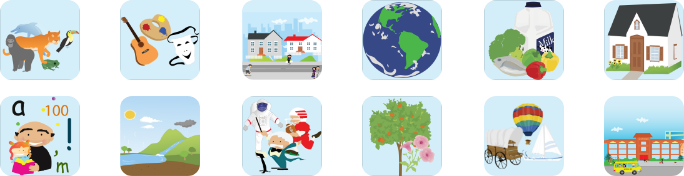
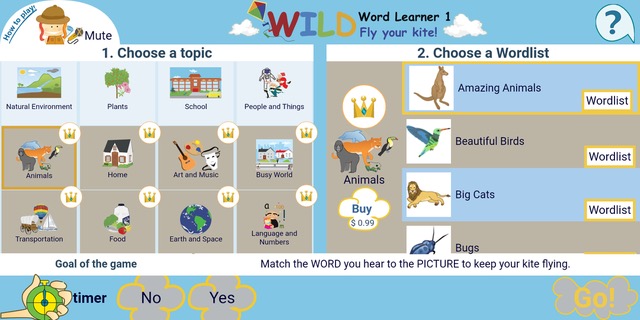
    WILD Word Learner is a companion app to the Wordsmyth Illustrated Learner’s Dictionary (WILD). This educational game app gives young learners the opportunity to learn close to 1000 carefully selected words from WILD.  These words are distributed over twelve kid-friendly topics and nearly 200 wordlists and make a delightful introduction to the world of English words.

    In WILD Word Learner, children choose a topic and a wordlist and start off on a fun word-learning mission!

    The WILD Word Learner app, based on the Wordsmyth Illustrated Learner’s Dictionary, is designed to help young native speakers and non-native speakers (K to 2) build their vocabulary through engaging word games. WILD Word Learner 1 (Fly Your Kite) is the first app in the WILD Word Learner series. With this app, kids drag and drop icons to match a word’s sound with its picture. Future apps will focus on matching spelling to picture and sound to spelling.

    Carefully selected words

    Words chosen for the games are those most relevant to children’s everyday lives or to subjects children often study in school—things such as animals, land forms, types and parts of plants, foods, actions and activities, parts of the body, musical instruments, numbers, and shapes. In addition, the “Earth and Space” topic covers different planets in the solar system as well as named regions and geographical features of our Earth, such as its continents, major deserts, mountain ranges, and seas. In the “Language” topic, concepts described by prepositions and verbs are addressed. For fun as well as for enhanced understanding of the concepts involved, all words that are verbs or prepositions under this topic have animated illustrations.

    Every word in the Word Learner game is paired with a charming and child-friendly illustration, and all words have human-voiced pronunciation. Simple definitions and example sentences from the Wordsmyth Illustrated Learner’s Dictionary can also be accessed, at the child’s choosing, by clicking on the entry icon . This additional data makes the app a rich resource for the understanding of specific concepts as well as for the expansion of general knowledge. It also allows for greater adult-child interaction if the child needs or wishes to have the information read aloud by an adult. It can also serve as a source of simple and enjoyable reading practice and language-learning input.

    Engaging game design with positive feedback

    Based on the latest educational theory and research, the game app is designed so that young children can actively engage in their learning process. Kids can choose what they want to learn, which cultivates their motivation for further learning. Positive feedback at every interaction creates an encouraging learning environment that helps children persist with an activity even when they encounter difficulties.

    The game’s audio instructions, which can be turned on or off, gently guide kids in their understanding of how the game functions. The instructions can be heard in three languages: English, Chinese, and Spanish.

    Safe environment for kids

    No log-in is required, and we do not collect any personal data through the app. However, we would like to encourage parents and educators to use our website, kids.wordsmyth.net/wild, to expand their children’s learning through exploration of our 4000-word dictionary for young children—the Wordsmyth Illustrated Learner’s Dictionary (WILD). This interactive and highly engaging vocabulary learning resource includes all the data from the app and much, much more.

  • Word Explorer: Explore the world of the words

    Word Explorer: Explore the world of the words

    Unique to our Children’s Dictionary Suite is the Word Explorer:  a word-finding and knowledge-exploration feature. It is an index of related words spread throughout the dictionaries that allows a child to find words connected with multiple topics and to explore whole networks of words and their meanings.  The dictionary entries also contain an integrated thesaurus of synonyms and antonyms. The addition of our Word Explorer creates a fun and uniquely valuable educational resource.

    The Word Explorer allows the child or teacher to navigate the dictionary using topics, their keywords, and words related to the keywords called “related words.” The Word Explorer is like a map built into the dictionary that allows the user to find and explore interesting paths through the dictionary. With the help of the Word Explorer, children can make many of these words part of their vocabulary and start to discover how words can help them make sense of the world.

    Approximately 200 of the entry words in this dictionary are Word Explorer keywords. These words are called “keywords” because they are links (or keys) to over 7,000 other dictionary entry words. Almost half the entry words in the Children’s Dictionary belong to the Word Explorer.

    Dictionary entries for keywords note their Word Explorer feature near the end of their entries. So, for example, under the Word Explorer Topic “Communication,” the keyword “art” is listed. Clicking on “art” under Communication (or looking up “art” in the regular search box) leads the child to discover words that describe types of art, people who make art, things used in art, places where art can be found, and many other categories of information relating to the notion of art. The Word Explorer can be particularly useful in helping students with writing, serving as inspiration and assisting them in finding the words they need. With the help of the Word Explorer, a child is aided in learning new concepts and making new connections among ideas.

  • Animated vocabulary instruction for kids!

    Animated vocabulary instruction for kids!

    Having trouble making basic, essential concepts clear to your young students? WILD animations can help!

    In addition to thousands of colorful static images created by our artists, the Wordsmyth Illustrated Learner’s Dictionary (WILD) offers animated illustrations for some of the most difficult words to explain and conceptualize.

    Check out our animated prepositions and verbs!

    WILD’s Language collection has animated illustrations for all of the most important English prepositions as well as for the most common action verbs. Each animation demonstrates the meaning of these types of words both clearly and entertainingly. Have fun taking a look!

  • Coronavirus glossary:  a guide to the meaning of the most common terms

    Coronavirus glossary: a guide to the meaning of the most common terms

    The following is a small collection of terms that have been in the news in connection with the pandemic that is now affecting us all.  These terms can be confusing, and we hope this short glossary will help to clarify the meanings of these items and sort out the puzzling aspects.

    coronavirus

    A coronavirus is technically a type of virus.  The term does not refer specifically to the virus causing the current pandemic, although the term is being used in this way as a shorthand for the term “novel coronavirus,” the specific name of the virus we are dealing with now.  Viruses that have infected populations in the recent past such as SARS and MERS are also coronaviruses.  Coronaviruses are so-named because the outer perimeter of each round virus particle resembles a spiky crown similar in shape to the sun’s corona.  (“Corona” comes from a Latin word meaning “garland” or “crown.”)

    novel coronavirus

    The current virus that humans are grappling with is called the “novel coronavirus.”  The adjective “novel” differentiates this particular, NEW virus from previous coronaviruses.  Typical symptoms of the virus include fever, cough, shortness of breath, and loss of taste and smell.  The virus spreads very easily from person to person through droplets expelled into the air by a person who is infected.  If the droplets are breathed in by another person or taken into the nose, mouth, or eyes in some other way, this new person can become infected.  Currently there is no cure for the disease caused by the novel coronavirus and no vaccine to prevent people from becoming infected.  The majority of people who catch the virus may become ill but will recover on their own, similar to the way many people recover from the flu.  Hospital treatment for the disease focuses on helping patients with severe symptoms to survive while fighting the disease with their own immune systems.

    Covid-19

    The term Covid-19 (or “COVID-19”) refers to the disease caused by the novel coronavirus. “Co” in Covid stands for “corona,” “vi” stands for “virus,” and “d” stands for “disease.” The number 19 refers to the year 2019, the year in which the initial outbreak of the disease occurred. 

    respirator

    In the current crisis, the term “respirator” refers to a type of face mask used to both protect the wearer from breathing in droplets of the virus expelled by someone with Covid-19 and to protect other people from catching the virus if the wearer is infected.  However, the term is most often used in connection with protecting doctors, nurses, and other medical personnel from the possibility of catching the virus from infected patients.  The term “respirator mask” is also used.

    The word “respirator” has another meaning, which refers to a mechanical device.  This type of “respirator” is a machine that assists a patient with breathing.  In this sense, the word is similar to the word “ventilator.”  (See below.)  Currently, the term “respirator” seems to be used exclusively to refer to the protective face masks rather than breathing machines.  The term “ventilator” refers only to the mechanical device.

    ventilator

    A ventilator is a machine used in hospitals to help patients breathe.  Because the coronavirus can cause severe damage to the lungs, ventilators may be required to assist patients in breathing. 

    intubation

    “Intubation” refers to the process of inserting a tube through a patient’s mouth and into their upper respiratory tract so that they can be put on a ventilator.

    PPE

    PPE stands for “personal protective equipment.”  This is equipment that helps protect medical personnel from catching illnesses from patients.  Because the novel coronavirus spreads very easily from person to person, use of personal protective equipment is particularly critical at this time.  PPE typically includes face masks, gloves, goggles, and surgical gowns.  “Face shields” are also PPE.  These are clear plastic shields that extend from the forehead over the entire face.

    epidemic

    An epidemic is an outbreak of a disease wherein many individuals become infected over a wide area.

    pandemic

    A pandemic is a type of epidemic.  It is an epidemic that has spread to various parts of the world.  “Pan” is a word part that means “all.”  The term “Pan-American,” for example, refers to all the Americas—South America, North America, and Central America.  A “pantheon” is a temple dedicated to all the gods of a people.

    community spread

    During the early days of the coronavirus outbreak in the United States, the virus was being seen only in people who had visited other countries where there was an ongoing outbreak of the virus or in persons who had close contact with such people.  However, the virus quickly began to be seen in people who had not been overseas and who had not had close contact with such persons.  The original source of these new infections could not be discovered.  “Community spread” refers to the spread of a disease in a community where the source of the infection is not known.

    asymptomatic

    When a person is asymptomatic for Covid-19, they are carrying the coronavirus but they are not displaying any of the symptoms.  Although an asymptomatic person does not feel sick at all, they are capable of passing the disease on to other people.

  • create vs. produce

    create vs. produce

    Both “create” and “produce” have the meaning of making a new thing or bringing a new thing into the world.  One might expect the words to be close synonyms, yet, surprisingly, they do not generally overlap in usage.  The first important difference is that creating tends to require imagination, or something like a divine or magical spark, whereas producing tends to come about through a mechanical process or through natural processes that are part of the way plants and animals function biologically:  Chickens produce eggs; they don’t create them.  You produce a loud noise with your tuba; you don’t, in general, create one.  You can, however, create a new and unique sound with your tuba if you’ve been working on it and exploring different possibilities.

    The second difference is that creation tends to focus on a thing being made for the first time ever, while production often suggests making a new thing in just the same way as similar things have been made before, or it suggests multiple things being made at the same time and in the same way as each other.  Consequently, “create” can sometimes have an inspired, even poetic, feeling to it whereas “produce” often has a more prosaic, mechanical feeling to it:  The task of an artist is to create.  The task of a manufacturer is to produce

    “Create” also tends to be used more often in combination with abstract words than “produce.”  With abstract ideas, “create” is a slightly more formal or academic way of saying “make” or “cause,” as when we say “create a dilemma,” “create a disturbance,” “create an illusion,” “create a nurturing environment,” “create a relaxing atmosphere.”  “Produce” can be used instead of “create” in combination with abstract words, but “create” tends to be the more frequent choice.

    One final, and perhaps most important, difference between these words is that “produce” is rather narrowly focused on the sending out of something into the world, the delivery of a thing as a finished product.  It is not very much concerned with the process of making or putting something together, even if a great deal of effort—even creativity– actually goes into a thing’s production.  “Create” is more focused on the piece-by-piece crafting of something, especially when that process requires imagination or a unique set of actions, decisions, and materials.  Looking at artists and manufacturers again, it should be noted that a very fast-working artist can produce more works of art than a slow-working one.  In this example, “produce” is used because the focus is just on the putting out of finished products.  On the other hand, a manufacturer can create a design for a new product.  In this example, “create” is used to focus on the process of putting together a new and unique thing and to suggest the use of thought and imagination going into that process.

    create

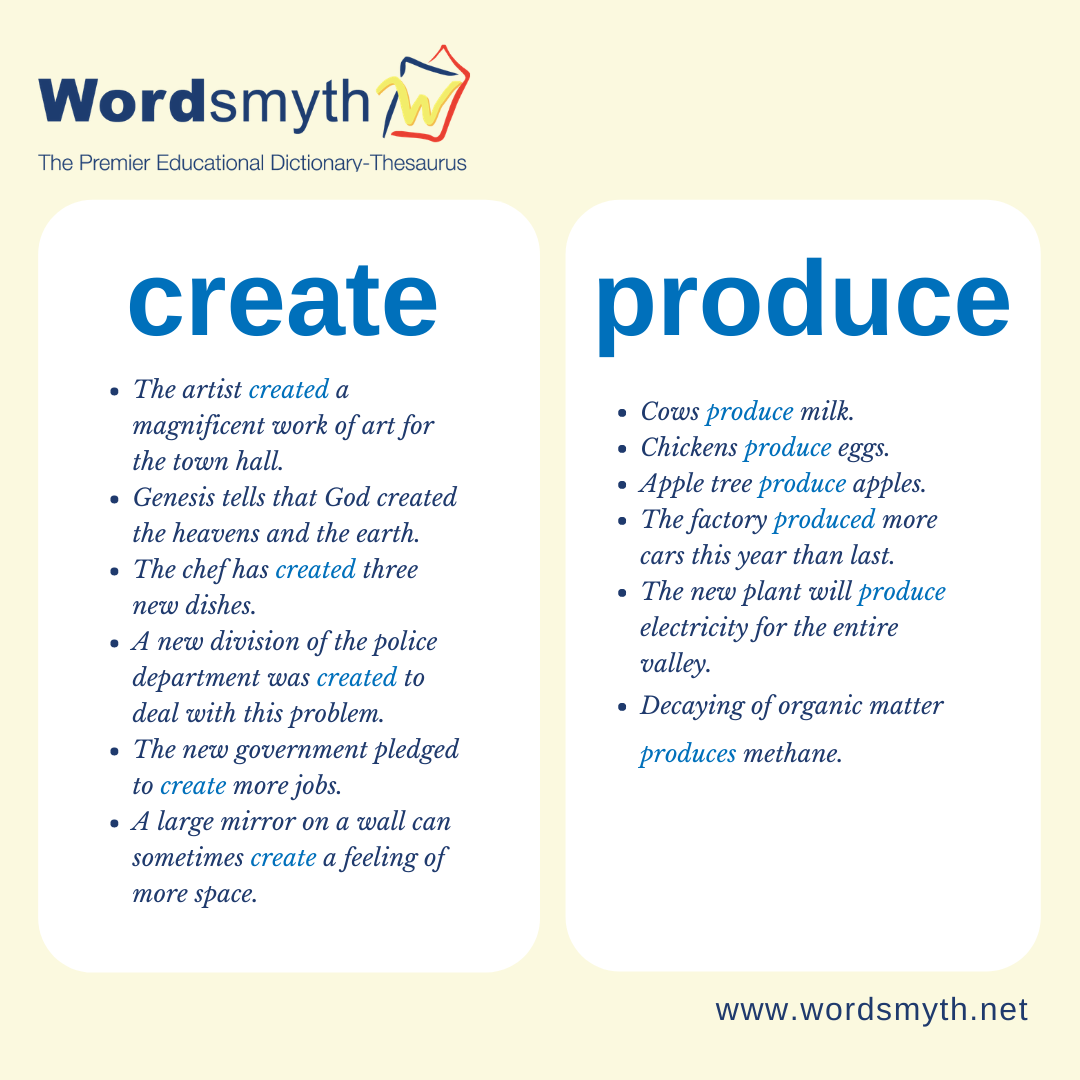
    • The artist created a magnificent work of art for the town hall.
    • Genesis tells that God created the heavens and the earth.
    • The chef has created three new dishes.
    • A new division of the police department was created to deal with this problem.
    • The new government pledged to create more jobs.

    produce

    • Cows produce milk.
    • Chickens produce eggs.
    • Apple trees produce apples.
    • The factory produced more cars this year than last.
    • The new plant will produce electricity for the entire valley.
    • Decaying of organic matter produces methane.

    Just interested in words? Looking for clear dictionary definitions and examples? Join our users and subscribers at wordsmyth.net or kids.wordsmyth.net.

  • aesthetic vs. ascetic

    aesthetic vs. ascetic

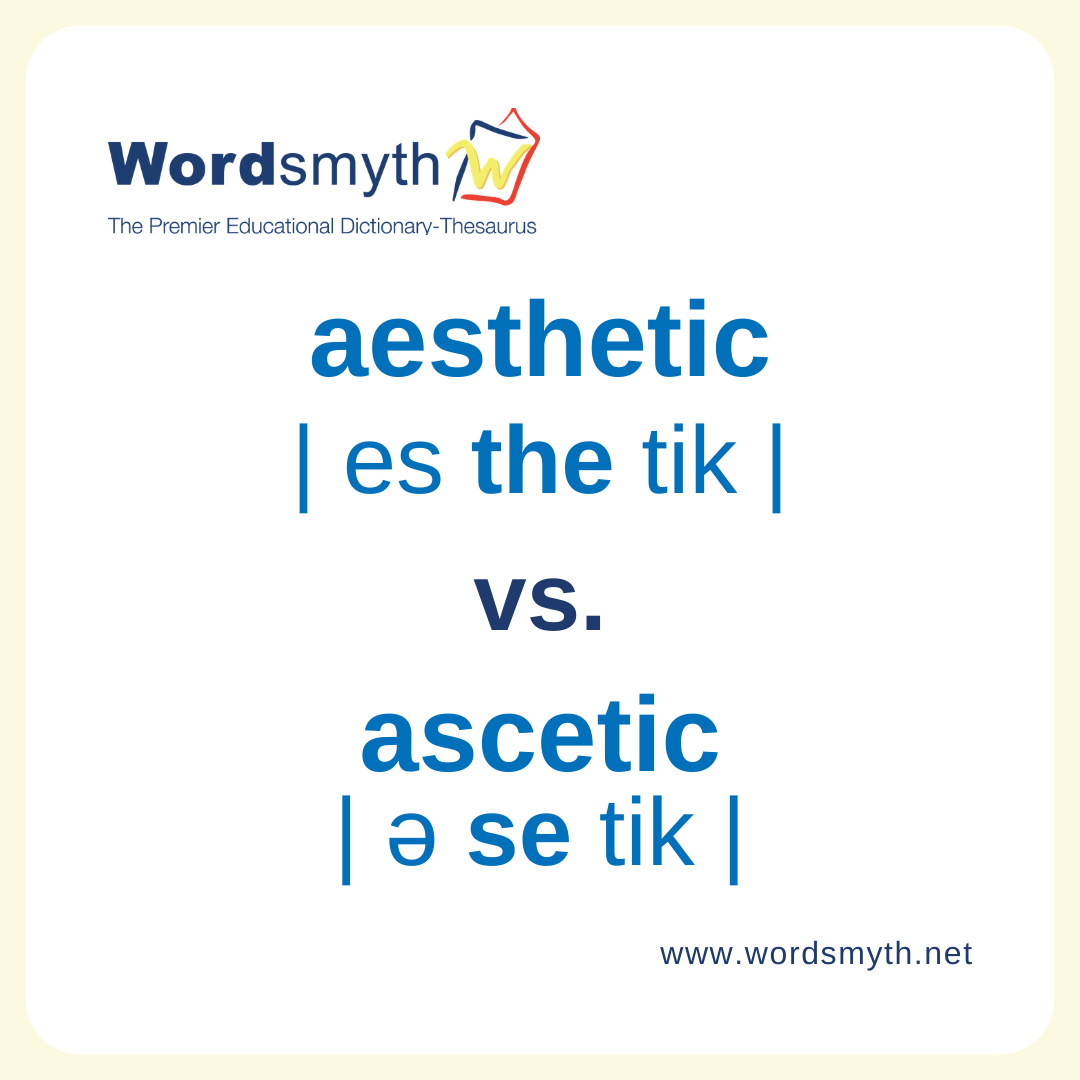
    aesthetic |es the tik|
    vs.
     ascetic | ə se tik|

    These words have similar pronunciations and spellings, but quite different meanings.  The word “aesthetic” –with the “th” sound in the middle–has to do with beauty, so if you’re talking about beauty or the arts, “aesthetic” is probably the word you’d want to use rather than “ascetic.”  “Ascetic” refers to self-denial, self-discipline, and austerity.  It’s a word often used when referring to the monastic life or something similar to it.

    aesthetic:  of or relating to beauty or to the study of beauty and its forms.
    Her aesthetic sensibility was offended by the gaudy decor of the banquet hall.
    Each culture has its own aesthetic traditions.

    ascetic:  rigorously simple and disciplined; austere; self-denying.
    The nuns lead an ascetic life in the convent.
    It was necessary to adopt an ascetic way of life during the war.
    Their new stepfather imposed an ascetic regimen on the family.

    It’s also easy to confuse “aesthetic” or “ascetic” with “acetic,” which refers to acid or vinegar.  Besides the difference in meaning, the pronunciation of “acetic” has the “e” vowel sounding like the “e” in “bee,” whereas the “e” sound in the other two is like the “e” in “pet.”

    Just interested in words? Looking for clear dictionary definitions and examples? Join our users and subscribers at wordsmyth.net or kids.wordsmyth.net.

  • imply vs. infer

    imply vs. infer

    Imply” and “infer” have a relationship that is similar to the one between “talk” and “listen.”  “Imply” corresponds more closely to the talking side of the relationship, and “infer” corresponds more closely to the listening side. A talker can imply; a listener can infer.

    When you imply something, there is a meaning in what you are saying or projecting that may be understood by someone else but is not being communicated in a direct manner by you.  If you say “The floor is wet,” you may be implying that your listener shouldn’t walk across it.  If you say “I know where you went last night,” your tone may be implying that your listener was up to some mischief or even immoral activity.

    Sometimes, of course, we argue about what we said versus what we implied.  We say, “I didn’t say that!” and the other person says, “Yeah, but you implied it!”  It is possible for us to say something that can be interpreted in a way that we do not intend.  What’s really happening in many of these contentious cases, though, is that the listener is inferring a meaning that we did not intend to imply!

    When you infer something, you are on the receiving side of the communication.  Something is expressed to you, and you are finding inexplicit or hinted at meaning in it, or you believe you’ve uncovered some hidden meaning even if, in fact, it isn’t intended by the speaker.

    It should be said that both implication and inference are absolutely essential to communication.  It would be uncomfortable, difficult, or impossible to actually say everything that we mean when we say something.  Instead, we trust in our listener’s ability to understand what we’re implying or to infer information from what we say.   For example, if we say “My flight leaves at seven.  I guess I’ll set my clock for 4:00 a.m.,” we intend our listener to understand the connection between these two statements, and we don’t even question his or her ability to do so.  What we are not saying but that we trust our listener to infer from the above sentences, among other things, is that the flight leaves at seven in the morning, that the clock is an alarm clock, and that we need to wake up at the set time in order to have time to get to the airport for our flight.

    How would we function if we had to actually say everything we mean?!

    Finally, although the discussion here has focused on verbal communication, it should also be noted that both “imply” and “infer” can be used in other contexts.  Either can be used in reference to other ways that meaning can be signaled indirectly or can be deduced, as the following examples will show.

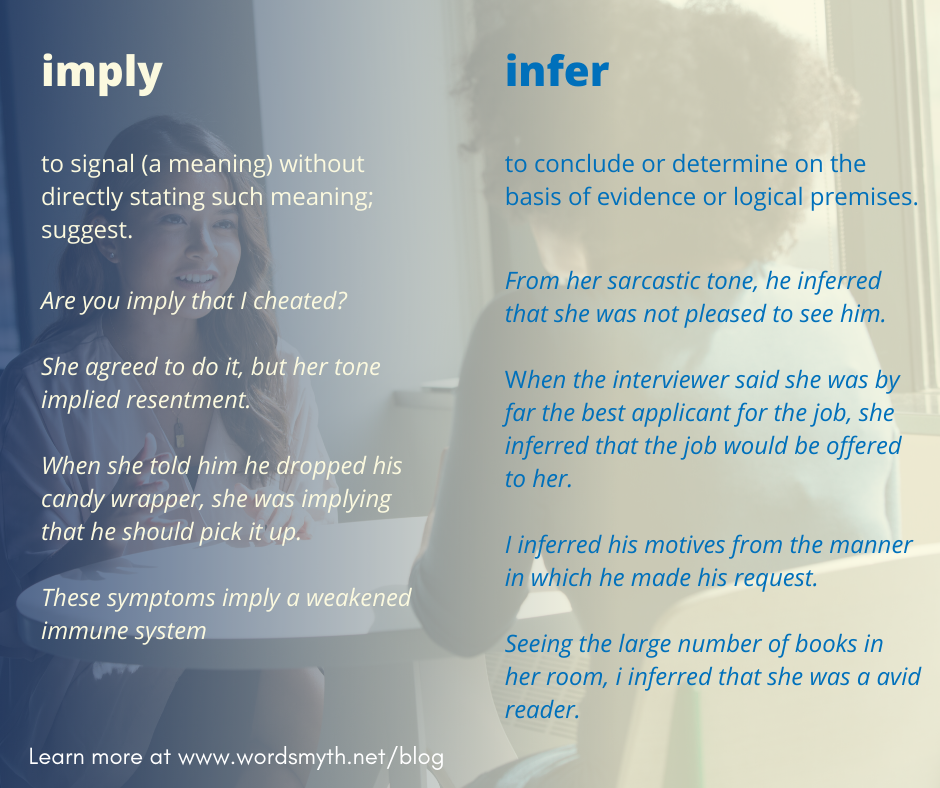
    imply

    to signal (a meaning) without directly stating such meaning; suggest.

    Are you implying that I cheated?

    She agreed to do it, but her tone implied resentment.

    When she told him he dropped his candy wrapper, she was implying that he should pick it up.

    These symptoms imply a weakened immune system.

    infer

    to conclude or determine on the basis of evidence or logical premises.

    From her sarcastic tone, he inferred that she was not pleased to see him.

    When the interviewer said she was by far the best applicant for the job, she inferred that the job would be offered to her.

    I inferred his motives from the manner in which he made his request.

    Seeing the large number of books in her room, I inferred that she was an avid reader.  

    Just interested in words? Looking for clear dictionary definitions and examples? Join our users and subscribers at wordsmyth.net or kids.wordsmyth.net.

  • damp vs. moist

    damp vs. moist

    Damp” and “moist” are words with similar meaning.  They both describe things that contain a small amount of moisture—not so much moisture as to say something is “wet,” but nonetheless an amount that is tangible, an amount that we can physically feel. 

    Although the two words are close in meaning, they are not exactly the same and tend to be used quite differently.  First of all, “damp” often describes a condition that is unpleasant or unwanted (“damp bedsheets,” “a damp basement.” “a damp hotel room”), whereas “moist” more often describes a pleasant or desired condition (“moist skin,” “moist cake,” “moist soil”).  This is not to say that there are no exceptions to these tendencies, but, in general, when dryness in a thing is something we want, then it is not good when it’s damp (“a damp carpet”).  When dryness in a thing is not what we want, then it’s good when it’s moist (“a moist cupcake”).

    It’s also important to note that a “moist” thing is generally a little more saturated with liquid than something that is just “damp.”   Wiping something with a “moist” cloth would leave tiny droplets of water on it, whereas a “damp” cloth would leave no visible droplets.  Something that is “damp” is not completely dry; something that is “moist” is nearly, but not completely, wet.  

    Another interesting difference is that we rarely, if ever, use “damp” to describe something we can eat.  You can say “moist cookies,” but you can’t say “damp cookies.”  Well, you can, but it’s a little hard to imagine why you would!  This is because we generally feel dampness of an object by touching the outside of it, and we’re generally not interested in how the outside of a cookie feels.  With cookies, we’re mostly interested in what’s inside.  Moreover, dampness is something we sense with the outside of our bodies.  It’s not something we sense with the inside of our mouths!

    One last tendency to mention is that “damp” tends to be linked with coldness in our minds, whereas “moist” tends to be linked with warmth or a neutral temperature.  “Moist climate,” for example, would be linked with places that are warm and rainy, as in “the moist climate of the tropics.”  “Damp weather” is associated with places that get abundant rain along with cool temperatures. “Damp weather,” like many other things that are called “damp,” is often considered uncomfortable and something justifiable to complain about.  “Moist weather,” on the other hand, does not seem to be as common a cause for complaint—either that or it is not experienced as frequently by the majority of English speakers.  In fact, the combination tends to be used mainly in weather forecasting rather than in ordinary conversation.  Interestingly, when we complain about warm weather that has some degree of moisture, it is “humid weather” that gets the gripes.

    The following are some of the most common word combinations for “moist” and “damp”:

    MOIST:  moist cake, moist muffins, moist brownies, moist lips, moist air, moist towelettes, moist soil, moist skin, moist eyes

    DAMP:  damp basement, damp cloth, damp laundry, damp cellar, damp weather, damp fur, damp hair, damp room, damp washcloth, damp sheets, damp mop