The term “indicative” refers to the grammatical “mood” of a verb in a clause. The indicative mood could be described as the ordinary, everyday mood expressed in most statements. It is used for what is or what we see as reality, so it is the mood that most verbs take when we speak or write. It is not very meaningful, however, to explain the meaning of “indicative” without comparing it with the term “subjunctive.” Both these words refer to grammatical “mood” as expressed by the verb in a particular clause. For example, the sentence “I know that he sees a doctor about it” contains two clauses that are both in the indicative mood—1) “I know” and 2) “he sees a doctor about it.” In the sentence “I insist that he see a doctor about it,” there is one clause in the indicative (“I insist”), and there is a second clause in the subjunctive (“he see a doctor about it”). Notice the form of the verb in the subjunctive clause. It is grammatically correct but it does not end with “-s” as one would normally expect in standard English. The subjunctive mood of the verb shows that the action is not real or under the speaker’s control. It refers to some action that is purely hypothetical. Again, most statements we make in English use verbs in the indicative mood. The use of the subjunctive mood is much more limited. Please see further discussion under SUBJUNCTIVE.
Category: Language Notes
-
Grammar glossary: gerund
A gerund is a word that contains the idea of a verb but functions in a sentence as a noun. The words “escaping,” “coughing,” “being,” and “laughing” are all in the form of gerunds. Gerunds are made by adding “-ing” to the end of any verb (sometimes with a small spelling modification to the original word). Take the word “swim,” for example. If we say “I swim every day” or “I swam at the pool yesterday,” we are using “swim” as a verb, but if we add “-ing” and use the word as the subject of a sentence, for example, we turn the verb into a noun, as in the sentence “Swimming is great exercise” or “Swimming makes me tired.” Similarly, if we say “I love swimming” or “I hate swimming,” we are taking a verbal notion and turning it into a noun, grammatically the same as any other noun, such as “potato chips,” “tigers,” or “basketball.”
In the following sentences, we can see again how gerunds function grammatically as nouns. In the first sentence, we see it as a subject, and, in the second sentence, as an object.
Escaping is impossible. [“Escaping” is the SUBJECT]
We heard that awful drilling all morning. [“We” is the subject. “Drilling” is the OBJECT]
Like ordinary nouns, gerunds can be modified by adjectives, as in “awful drilling,” “tedious filling out of forms,” and “ridiculous arguing over nothing.” In addition, like typical nouns, gerunds can follow words that are prepositions (for example, words like “on,” “to,” “with,” “for,” and “of”). By contrast, verbs themselves cannot follow prepositions.
We’re planning on going to the beach this Saturday. [gerund form, CORRECT] *We’re planning on go to the beach this Saturday. [infinitive of verb, INCORRECT] I look forward to meeting you next week. [gerund form, CORRECT] *I look forward to meet you next week. [infinitive of verb, INCORRECT] Both gerund forms and infinitive verb forms can directly follow other verbs in a clause, but some verbs, such as “enjoy” and “deny” allow only the gerund form to follow them, while some verbs allow either form, and some allow only the infinitive form.
Only the gerund is correct:
I enjoy listening to music. [gerund form, CORRECT] He denied trying to cheat. [gerund form, CORRECT] *I enjoy to listen to music. [infinitive of verb, INCORRECT] *He denied to cheat [infinitive of verb, INCORRECT] Either is correct:
I like dancing. [gerund form, CORRECT] I like to dance. [infinitive of verb, CORRECT] Only the infinitive is correct:
I want to go next week. [infinitive of verb, CORRECT] *I want going next week. [gerund form, INCORRECT] Click here for further discussion of the difference between the use of the gerund versus the infinitive.
-
Grammar glossary: indirect object
When one object follows directly after another in a clause, as in the statement “I showed him (1) my collection (2),” the first is the indirect object (“him”) and the second is the direct object (“my collection”). The indirect object is typically the person or thing to whom the action of the verb is directed or for whom it is done.
She bought him a sweater. [him = indirect object; a sweater = direct object] I gave my sister a present. [my sister = indirect object; a present = direct object] He told the police the truth. [the police = indirect object; the truth = direct object] She handed the man sitting next to her the salad bowl.
They gave that old apartment a good cleaning.
[the man sitting next to her = indirect object; the salad bowl = direct object]
[that old apartment = indirect object; a good cleaning = direct object]
The meaning conveyed by an indirect object can generally be expressed in a prepositional phrase including the words “to” or “for.” (“He bought her flowers” > “He bought flowers for her.”) When a prepositional phrase is used, it usually follows the direct object, although it is not grammatically incorrect to insert the phrase (with “to” or “for”) before the direct object or elsewhere in the sentence (e.g., “To her daughter she gave her house and her property.”)
She bought him a sweater. > She bought a sweater for him.
I gave my sister a present. > I gave a present to my sister.
He told the police the truth. > He told the truth to the police.
She handed the man sitting next to her the salad bowl. > She handed the salad bowl to the man sitting next to her.
She handed the clerk her key. > She handed her key to the clerk. > To the clerk she handed her key.
Putting the indirect object into a prepositional phrase highlights that information, making the indirect object of equal prominence with, or of greater prominence than, the direct object.
Some verbs allow two objects to follow one another in a clause and yet the first object cannot be paraphrased using “to” or “for.” We cannot paraphrase the sentence “I envy you your confidence,” for example, as “I envy your confidence to you” or “I envy your confidence for you.” Below are examples of verbs that employ indirect objects whose meanings cannot be paraphrased with prepositional phrases that use “to” or “for.” The function of the indirect object with verbs like these is unique. These verbs tend to express some kind of reaction on the part of one person, the subject of the sentence, to what another person possesses or has done. With these verbs (“excuse,” “forgive,” “envy,” etc.), the indirect object represents this other person, the person causing the reaction. The information given by the indirect object tends to be redundant in these sentences, however, as it is often implicit in the direct object: “excused him his flaws,” “envy you your talent.” In fact, these indirect objects could, in many instances, simply be omitted from these types of sentences without loss of meaning. For example, “I envy you your talent” could be reduced to “I envy your talent” with little alteration to meaning. As odd as this particular type of indirect object may seem, it continues to be used in conjunction with these particular verbs (those in Group 1 below) to a fair degree.
Verb Group 1
excuse: His mother excuses him all his flaws.
forgive: She did all these awful things, yet we forgave her everything!
envy: I envy you your confidence in social situations.
begrudge: She begrudged him this rare opportunity.
pardon: The governor pardoned him his crimes.
The second group of verbs, below, contains indirect objects that are more like typical indirect objects; that is, they represent entities that are affected by the action of the verbs. Still, the indirect objects following these verbs are not paraphrased with “to” or “for.” We do not say, for example, “I bet to you a dollar.”Verb Group 2
bet: I’ll bet you a dollar.
cost: That accident cost him his life.
fine: They fined him a hundred dollars.
-
Grammar glossary: direct object
The direct object is an element in a sentence that provides information that completes the idea introduced by certain verbs. We can say that it receives the action of the verb or that it is the thing acted upon by the verb. Let’s say a person says simply, “I brought.” The likely confused response from the listener would be: “You brought?? You brought what?“ The confusion comes from the fact that the verb “bring” requires a direct object.
Perhaps the best way to understand the functioning of a direct object is just to look at some sentences that have direct objects. The direct object in each of the following sentences is shown in bold print.
The dog is chasing its tail.
I brought the donuts.
She understood what he was trying to say.
I left my umbrella at the restaurant.
He kissed her in front of everyone.
She painted the sky before she painted the mountains.
Elvis left the building while the fans still filled the auditorium.
I believe that he’s telling the truth.
You can see from the above examples that the direct object does not have to be just one word, and you can see that it often follows directly after a verb in a clause. You can also see that the direct object functions as a noun.
In English, the grammatical slot of the direct object does not have to be filled by a simple, ordinary noun like ”the donuts” or a noun phrase or clause like “what he was trying to say.” The direct object position can often be filled by a verb in either the gerund or infinitive form; that is a verb that is functioning as a noun. Therefore, in the following examples, the gerund “dancing” and the infinitive “to quit” fill the slot for the direct object.
I enjoy dancing. [GERUND] [What do you enjoy?– Dancing.] I’m planning to quit. [INFINITIVE] [What are you planning?– To quit.] For further discussion, please see OBJECT.
-
Grammar glossary: clause
Clauses are the large building blocks of sentences. An individual clause is a group of words that contains, at least, a subject and a verb that operate together (e.g., “she knows,” “he left”). Clauses can be very short (e.g, “I fell,” “I forgot”) or quite long (e.g., “I completely forgot about the surprise party last Saturday night for Alex’s birthday.”) Some sentences contain only one clause, while other sentences contain two or more clauses that are linked together with words like “because,” “so,” “and,” “but,” “when,” “while,” “that,” and “if.”
A clause always contains a subject and a verb that operate together, but other words can be part of the clause too. In the first example below, the words “late for the meeting” are part of the clause. The entire sentence “The lawyer was late for the meeting” is a clause.
SUBJECT VERB The lawyer was late for the meeting. SUBJECT 1 VERB 1 SUBJECT 2 VERB 2 The lawyer was late for the meeting because the elevator jammed. The second example above is a sentence with two clauses. The first is “The lawyer was late for the meeting,” and the second is “the elevator jammed.” The word “because” is a word that links the two clauses together. A word that functions in this way is called a CONJUNCTION. It is not part of either of the clauses.
-
Word Parts IV: Basic prefixes
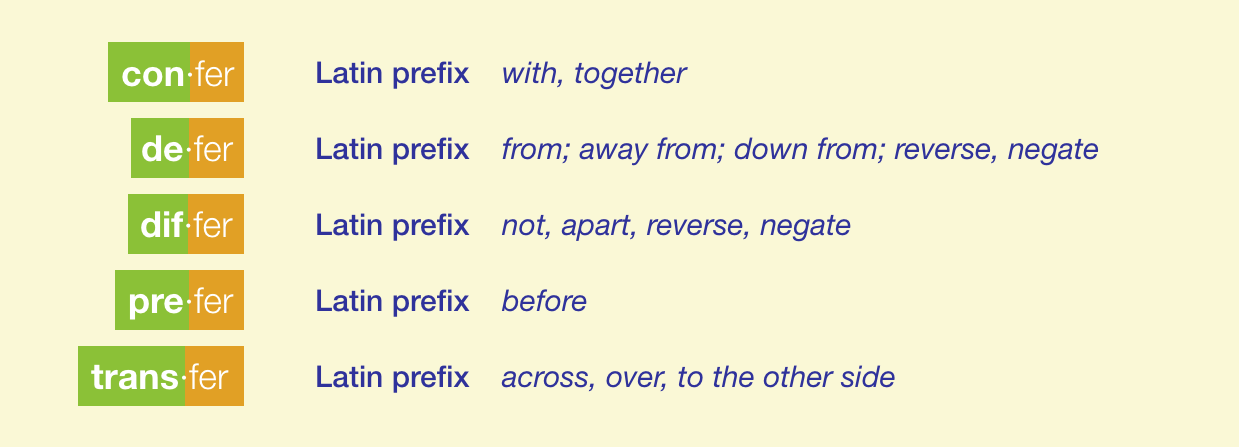
A prefix is a word part that attaches to the front of a root or to an existing word to create a new word. The prefix “micro,” for example, attached before the root “scope” gives us the word “microscope.” An “existing word,” it may be noted, may already contain a prefix. For example, we can add the prefix “in-” to the word “complete,” which itself is made up of the prefix “com-” attached to the root “plete.” The word “incomplete” then consists of two prefixes attached to a root. Similarly, the word “mistranslate” contains the two prefixes “mis-” and “trans-” standing before the root “lat.”
The list below contains some of the most common and important prefixes in English. All the prefixes in this list derive from Latin or Greek, except the two “un-” prefixes, which derive from Old English.
Additional example words for each prefix in the list below can be found by going to A-Z Word Parts under Search Tools in our dictionary, filtering the list there for “Prefixes” and browsing through the list. One may also use the search box on the A-Z Word Parts page to search the list for a particular prefix. Click here to learn more about how to use the Wordsmyth Word Parts database.
prefix meaning example word anti- against antibacterial, antiwar, antislavery, anticancer drug auto- self automobile, autobiography, autograph, automatic bi- two bicycle, bilingual, bisect, binoculars circu-, circum- around circular, circus, circulate, circumnavigate com- with; together combine, combat, compose, component dis- not; apart; reverse, negate disappear, disagree, dishonest, disbelief en-1, em-1 to put into; cause to be or have enjoy, envelope, enlarge, employ ex- out, out of, away from exit, exhaust, exclude, export il-2 im-2 in-2
ir-2not, without illegal, impossible incomplete, incorrect, irregular inter- between, among international, internet, interrupt, intersect micro- small microscope, microsurgery, microbe, microwave mis- bad, badly, wrongly mistake, misunderstand, misbehave, mistreat multi- many multiply, multicolored, multitude, multitask non- not nonsense, nonfiction, nondairy, nonessential pre- before predict, precede, preheat, prejudge re- again, back, back again rewrite, review, redo, rebuild, recall sub- under, below subway, submarine, subcategory, submerge trans- across, over, to the other side transport, transit, transatlantic, translate un-1 not unnecessary, unable, unusual, unequal un-2 reverse (an action) untie, undo, unbutton, unlock Download, save, or print as PDF See also:
Word Parts I: basic roots
Word Parts II: basic suffixes
Word Parts III: Intermediate level suffixesLearn more about the Wordsmyth word parts database and how this unique feature can be used in facilitating vocabulary learning and teaching.
-

Word Parts III: Intermediate level suffixes
The suffixes in the following list are extremely common suffixes but some have fairly specialized meanings. The suffixes “-ish,” “-en,” and “-less” derive from Old or Middle English. The rest derive from Latin or Greek.
Additional example words for each suffix in the list below can be found by going to A-Z Word Parts under Search Tools in the Wordsmyth dictionaries, filtering the list there for “Suffixes,” and browsing through the list. One may also use the search box on the A-Z Word Parts page to search the list for a particular suffix. Click here to learn more about how to use our Word Parts database.
suffix meaning example words -less Middle English adjective-forming suffix that means without endless, fearless, wireless -ance, -ence Latin noun-forming suffix that means state, quality, or act of;
The suffix -ance is usually attached to whole English words, whereas -ence is usually attached to roots: compare eloquence and acceptanceacceptance, admittance, residence, science -al Latin adjective-forming suffix that means pertaining to cultural, dental, manual, universal -ist Greek noun-forming suffix that means person who does or believes in; Many words ending in -ist have a corresponding abstract noun form ending in -ism, and many have a corresponding adjective form ending in -ic (realistic, artistic). artist, chemist, dentist -itis Greek noun-forming suffix that means inflammation appendicitis, arthritis, poliomyelitis. -logy, -ology Greek noun-forming suffix that means study of, science of; written work; structure or principle biology, ecology, geology -en Old English verb-forming suffix that means to cause to be or become or have darken, enlighten, strengthen -fy Latin verb-forming suffix that means make, cause to be, become clarify, justify, satisfy -ize, -ise Greek verb-forming suffix that means to turn into or cause to be civilize, immunize, recognize -ous, ious Latin adjective-forming suffix that means full of, characterized by gracious, joyous, spacious -ics Greek noun-forming suffix that means science, study, or practice of; properties of; practices pertaining to economics, physics, politics -ish Old English adjective-forming suffix that means of, resembling; somewhat childish, ticklish, foolish Download, save or print as PDF See the full list of roots, prefixes, and suffixes in the A to Z Word Parts feature at wordsmyth.net.
See also:
Word Parts I: basic roots
Word Parts II: basic suffixes
Word Parts IV: basic prefixesLearn more about the Wordsmyth word parts database and how this unique feature can be used in facilitating vocabulary learning and teaching.
-
right away vs. right now
Both of these expressions mean “immediately,“ but “right away” means “without delay” and tends to be used in situations where there is fear or worry, in situations where there is really not a moment to lose before some bad thing might happen.
We took him to the hospital right away.
My grandmother said she was coming over in a few minutes, so I had to clean up right away.“Right now,” on the other hand, is often used in angry imperatives, as in: “Come here right now!” If one said “Come here right away!” there would only be a sense of urgency implied, not a sense of annoyance.
Another very important difference between these expressions is that “right away” can be used for actions in the past or future whereas “right now” really means “right now.” It wouldn’t make sense to say “We took him to the hospital right now.” or “When you get to Boston tomorrow, please call me right now.” These sentences would be illogical and incorrect. However, both of these sentences would make perfect sense using “right away.”
Sometimes “right away” and “right now” can overlap. For example, it would be fine to say either “I have to go right now!” or “I have to go right away!” There is still a slight feeling of difference, though. If we say “I have to go right now,” the emphasis is on the exact point in time when the leaving is necessary; i.e., NOW. If we say “I have to go right away,” there is a sense of not being able to do some other thing before leaving or not being able to spend any more time doing what one is doing. “Right now” also tends to be more argumentative, assertive, or insistent in tone. “Right away” is more simply informative.
I have to go right now or I’ll miss the bus.
Oh, I’m so late! I have to go right now!
I have to go right away. My son had a bad fall at school, and I have to pick him up.
Thanks. I’d love to stay, but I really have to go right away.Just interested in words? Looking for clear dictionary definitions and examples? Join our users and subscribers at wordsmyth.net or kids.wordsmyth.net.
-

few vs. a few / little vs. a little
The difference between “few” and “a few”
Both “few” and “a few” indicate a small number of something. However, use of the little word “a” before the word “few” makes a very important difference in meaning. Basically, “a few” communicates a positive idea concerning quantity, and “few,” without that little word, communicates a negative one. If you say you have few friends, it sounds a bit sad because you consider the number of your friends to be very small, perhaps near zero. If you say you have a few friends, the listener is given the impression that, although you may not have many friends, you have some friends at least. It’s probably not a sad situation. Note, though, that the actual number of friends might in fact be the same. Choice of “few” or “a few” depends on the attitude of the speaker toward the quantity.
Notice how “yes” and “no” are used with “few” and “a few” in answers to questions. You can see that answering with “few” goes along with the basic answer of “no.”
Did the students ask many questions about your presentation?
—No, they asked few questions. They didn’t seem very interested.
Did the students ask many questions about your presentation?
—Yes, they asked a few. Generally they seemed pretty interested.Does your brother have pots and pans in the new apartment?
—No, he has few pots and pans, so I’m bringing him some for tonight’s dinner.
Does your brother have pots and pans in the new apartment?
—Yes, he has a few. He has enough for tonight at least.“Few” without “a” is somewhat close in feeling to “no” and “none.” So, for example, “They made few complaints” gives almost the same impression as “They made no complaints.” By contrast, “a few” is somewhat close in feeling to “some” or “a number of.” It’s a small amount, but it has some significance. So, for example, “There are a few forks on the table already” gives almost the same impression as “There are a number of forks on the table already.”
Note that “very few” intensifies the negative feeling of quantity of “few”:
- She made very few mistakes on her exam; in fact, it was almost perfect.
- There were very few complaints about the service, so the banquet manager was pleased with her staff’s performance.
In contrast, “a very few” is still on the plus side. It’s a very small amount, even smaller than “a few,” but it still has some significance. It cannot be ignored.
- I’ve told this secret to only a very few people, but I still worry that others will find out.
- Yes, it’s true that a very few people have complained, but we’re handling the problem now.
The difference between “little” and “a little”
The difference between “little” and “a little” is exactly the same as between “few” and “a few.” Although both expressions refer to a small amount of something, “little” is basically a negative expression of quantity (close in feeling to zero) and “a little” is a completely positive expression. (Both “little” and “a little” are used with uncountable nouns only.)
- Do we ever go out for lunch? No, we have little time for lunch so we eat at the office.
- We have little money left in our savings, so we have to be very careful with our spending now.
- There is very little gas in the car so we’d better stop and get some before we get on the highway.
- Yes, I do have a little material left over from my project. You are welcome to it if you’d like.
- My wife speaks a little Hindi, and it was very helpful when we were traveling in India.
- The situation looks bad, but I still have a little hope that everything will be all right.
It should be noted that if either of the expressions “a little ” or “a few” is modified by “only” or “just,” the expressions take on a slightly more negative feeling because these words signify an expectation that there could be or should be more. However, despite the possibility of being modified in this way, the two expressions remain positive rather than negative.
- I was disappointed that only a few students showed up for my presentation. [Some showed up, but I wish there had been more.]
- Was there any rain today? Well, I think we had just a little around noontime. [I feel as if it didn’t rain today, but I can’t deny that there was some rain around noontime.]
Just interested in words? Looking for clear dictionary definitions and examples? Join our users and subscribers at wordsmyth.net or kids.wordsmyth.net.
-
fewer vs. less
“Fewer” is traditionally used when comparing quantities of individually countable things or people—as for example, when we say “There are fewer shops downtown nowadays,” or “I eat fewer salads in the winter,” or “There were fewer people in the audience than I expected.” “Less” is traditionally used when comparing quantities of things that are considered uncountable, such as “flour,” “water,” “land,” “space,” and “convenience.” We say “You should use less water” or “This machine makes less noise than the old one.”
Many consider it an error to use “less” rather than “fewer” when referring to nouns that are countable. For example, some might criticize the use of “You bought less bananas this week” or “She has a lot less problems than I do.” However, the reality is that the word “less” is beginning to take over the function of “fewer,” and many people do not feel that there is anything wrong when one says “I worked less hours last week than this week.” Still, if you are writing in a formal style or want to sound traditionally “correct” in speaking, it’s probably best to stick with “fewer” if you are referring to countable nouns.
Just interested in words? Looking for clear dictionary definitions and examples? Join our users and subscribers at wordsmyth.net or kids.wordsmyth.net.