Category: Wordsmyth Features

  • Introducing the Wordsmyth Word Explorer Children’s Dictionary Suite

    At Wordsmyth.net, we are dedicated to empowering young learners with tools that enhance their understanding of language and the world around them. Our latest addition, the Elementary Children’s Dictionary, has transformed our original Children’s Dictionary into a comprehensive leveled suite designed for students from elementary school through middle school. This blog post introduces the suite and highlights its features, benefits, and educational value.

    What is the Wordsmyth Children’s Dictionary Suite?

    The Wordsmyth Children’s Dictionary Suite is a multi-level dictionary system tailored to meet the needs of learners across different age groups and grade levels. It provides a seamless experience for children to explore words at a level appropriate to their vocabulary skills while offering flexibility to move between levels for deeper understanding.

    Here’s an overview of the suite:

    • Elementary Children’s Dictionary: Ideal for grades 3-5, this newly released dictionary features simple, full-sentence, explanatory definitions; child-friendly example sentences; vibrant illustrations; and photos.
    • Intermediate Children’s Dictionary: Perfect for grades 6-8, this dictionary includes over 35,000 entries covering essential vocabulary across subjects like science, social studies, emotions, and everyday life.
    • If a word is not found in these dictionaries, learners can access entries from the Wordsmyth Advanced Dictionary, which contains over 100,000 entries, and which are filtered for age appropriateness using a parental control feature.

    Key Features of the Elementary Children’s Dictionary

    The newly released Elementary Children’s Dictionary is a key addition to Wordsmyth’s leveled dictionaries. Specifically designed for students in grades 3 to 5, it becomes the elementary level of the Word Explorer Children’s Dictionary Suite. Below are its standout features:

    1. Simple, Full-Sentence Definitions
      Word meanings are explained to children using clear, full sentences that are easy for children to understand, making it ideal for learning both basic and academic vocabulary.
    2. Child-Friendly Example Sentences
      Each definition in an entry includes examples that put the vocabulary word in contexts that children can relate to, reinforcing meaning and helping young learners grasp usage effectively.
    3. Visual Enhancements 
      Entries feature engaging illustrations and/or photos to support comprehension and keep students visually engaged.
    4. Support for Multiple Meanings
      The dictionary provides explanations for each of the fundamental meanings of headwords, ensuring comprehensive understanding of words with a wide range of senses.
    5. Integrated Learning Across Levels 
      Students can seamlessly navigate between the Elementary and Intermediate levels within the dictionary suite to explore definitions that match their learning needs.
    6. Word Explorer Feature
      A unique tool that allows children to discover words associated with specific topics (e.g., “art,” “technology,” “culture”) through keyword-based exploration, fostering curiosity and knowledge expansion.

    This dictionary is an invaluable resource for elementary school students, combining readability, visual support, and interactive features to enhance vocabulary learning.

    Benefits of the Multi-Level Dictionary System for Different Grade Levels

    The leveled approach of the Wordsmyth Children’s Dictionary Suite ensures that every child can learn at their own pace while having access to content that grows with them. Whether one is an educator looking for classroom tools or a parent seeking resources for one’s child’s development, Wordsmyth provides an unparalleled experience in vocabulary learning.

    The Wordsmyth Children’s Dictionary Suite, with its multi-level design, offers a range of benefits that cater to the diverse needs of students across different grade levels. Here’s how this system supports learners at various stages:

    1. Tailored Learning for Different Age Groups

    The suite provides dictionaries designed specifically for distinct grade levels:

    • Elementary Children’s Dictionary: For grades 3-5, offering highly comprehensible and relatable definitions and examples for both basic and academic words.
    • Intermediate Children’s Dictionary: For grades 6-8, offering more advanced vocabulary and greater comprehensiveness within entries.
    • Advanced Dictionary: providing a hidden level of support for the vocabulary needs and interests of more advanced readers.

    This ensures that each student engages with content that matches their developmental stage, reading ability, and curiosity.

    2. Seamless Transition Between Levels

    Students can move between dictionary levels as their vocabulary grows, or when they encounter words at at a different level of complexity in their reading. For example:

    • Just as a younger student using our K-2 dictionary, WILD, can explore definitions in the Elementary level of the suite if WILD doesn’t provide enough depth, a student using the Elementary level of the Children’s Suite can look to the Intermediate level of the suite for additional support.
    • Older students can refer back to simpler definitions when encountering challenging concepts in the Intermediate level.

    3. Inclusivity for learners at all levels of ability

    The multi-level system accommodates students with varying abilities within the same classroom or age group. For instance:

    •   Advanced learners in lower grades can explore higher-level dictionaries.
    •   Struggling learners in higher grades can access simpler definitions without feeling excluded.

    4. Encouragement of Independent Exploration

    The leveled approach allows students to independently explore words at their own pace, fostering curiosity and confidence. Younger learners can enjoy the extra support of visual aids and audio pronunciations, while older students can delve into more detailed explanations and examples.

    5. Support for Cross-Curricular Learning

    The suite includes general academic vocabulary from across all areas as well as more specific vocabulary used in areas such as science, social studies, language arts, and everyday life. This helps students across grade levels build subject-specific language skills while reinforcing general literacy.

    6. Motivation Through Progress Tracking

    As students find themselves advancing through dictionary levels, they gain a sense of accomplishment by knowing they are mastering increasingly complex vocabulary. This gradual progression motivates continued learning.

    7. A Resource for Diverse Classrooms

    In classrooms with mixed-grade or mixed-ability students, the multi-level system provides a unified tool that meets individual needs without requiring separate resources for each learner.

    By providing age-appropriate content and fostering flexibility and inclusivity, the Wordsmyth multi-level dictionary system ensures that every student has access to meaningful language learning experiences tailored to their unique needs and abilities.

  • Sorting your lists on the Wordsmyth site

    Sorting your lists on the Wordsmyth site

    When you select words for your wordlist in the customization process, you may want to sort the list to help with your selection. (To learn more about wordlist maker, please check out the Wordlist Maker User Guide.)

    1. Click anywhere on the head of the list to open the sorting option:

    2. Click the upward or downward triangle to sort the list by ascending or descending, respectively. “Ascending” means counting up for numbers (1,2,3…) and starting from A and moving down toward Z for letters. “Descending” means the opposite sequence. Click “apply” when you are satisfied with your sorting options.

    3. You can sort multiple columns in your table at the same time. The order of sorting priority will be marked by the number inside the triangle. For example, if you set the level for “WVI” (Wordsmyth Vocabulary Inventory) as the first sorting priority and “Word” as the second, you will get all words sorted by WVI level from high to low. And within the same WVI levels, words you will get words sorted alphabetically.

    Please note, the same sorting function is also applied to other lists on the Wordsmyth site–for example, in Teacher Tools, you can sort your lists of students, classes, lessons, and assignments using the method above.

  • Using the Reverse Search Tool

    Using the Reverse Search Tool

    What is reverse search?

    Reverse search” is an advanced search tool that allows you to search within the full text of the dictionary for words, word parts, or phrases that may be useful to you, either in finding a word for a meaning you have in mind or in finding a pool of words for writing inspiration or assignments. A typical way of using the reverse search feature in Search Tools is to search for words that have the search term in their definitions or example sentences. Just type the word in the search box provided and choose between the listed options for searching. Typing in “oil,” for example, can help you find words like “anoint,” “cottonseed,” “crude,” “deep-fry,” “diesel,” and “pesto.” Or let’s say you type in “Latin.” This can help you find all the examples of Latin phrases included in the dictionary (as well as other words with definitions and examples that simply include the word “Latin.”) Next to each item in the search results is its definition, or the first of its definitions. This can help you evaluate the usefulness of your search results. Moreover, you can click on any item in the results list to go to its entry. This can be very helpful in finding additional synonyms and related words.

    Why do I need reverse search?

    “Hmm… I know the idea I want to express, but I can’t think of what the word for it is.”

    You probably have moments like this now and then when you are writing. Reverse search can be useful for finding the word that matches the idea you have in mind. Let’s say you are thinking of a meaning that is a special type of happiness. You could look up the word “happiness” in the regular dictionary search box and find synonyms, of course, but the word you’re looking for might be somewhat more specialized. Instead of using just the thesaurus, you could broaden your search using reverse search so that you could find all definitions that contain the word “happiness,” AND, by selecting additional fields in which to search, you could find a great number of words that relate to the idea of happiness. Perhaps the word you were looking for was the word “mirth” or “beatitude,” or “seventh heaven.” Reverse search would be the way to find these items.

    For teachers, reverse search can be a great tool for coming up with a pool of words to organize a lesson around or to help students write about a particular topic. Let’s say the students are learning about volcanoes. You could use reverse search to find words like “magma,” “lava,” “erupt,” “dormant,” “extinct,” “active,” “explode,” “caldera,” “crater,” “cinder,” “tsunami,” and many others. (These words were found by entering “volcano” and “volcanic” into the search box and then clicking on “definition” and “example.”)

    How do I use reverse search?

    If you click on Reverse Search under Search Tools, you’ll be taken to a special page. The Reverse Search page contains explanations of all the kinds of searches you can perform.

    The reverse search tool lets you search for any word, part of a word, or set of words within the text of definitions or other dictionary fields. In addition to searching within definitions and example sentences, you can find words within the synonym, similar, antonym or “related words” fields. Moreover, you can choose which dictionary or dictionaries you wish to search within. Choosing one of the lower level dictionaries is probably best for younger students, as the Advanced Dictionary may bring up far too many words to sift through, including words that are homographs with completely unrelated meanings to your search term. (For creating a pool of words for younger children, we might suggest using the Word Explorer tool rather than reverse search, however. Words listed under Word Explorer topics have been specially selected because they are, in fact, related to the topic, and they are related in clearly specified ways. They are not selected by an automated process as is reverse search.)

    Reverse Search works best when the search parameters are not too limited. For example, if you want to find words related to sharks (the fish), you may be disappointed if your search term is only “shark.” This is because there are not too many words in the dictionary that have “shark” in their definition, and there may not be a large number of example sentences that use the word “shark” either (not as a fish at least). Moreover, few, if any, words have “shark” as a synonym or antonym. It would be better to search for a more general concept like “fish” or expand the search terms to something like “fish shark” and set the tool simply at “Word(s)” so that it will look for either the word “shark” or “fish.” Moreover, it can be helpful to click “example” because this will bring up useful additional words that have the search terms in their example sentences. By using the search terms “fish shark” and clicking on “example,” you will allow the tool to bring up words like “bony,” “hunt,” “saltwater,” “scaly,” “deepwater,” “reel, and “prey,” which do not contain either “fish” or “shark” in their definitions. Notice that this type of search also includes a greater number of words of a different part of speech from the search terms.

    Reverse search is just one of the tools that Wordsmyth offers its users to help them find the right word or the particular set of words they are looking for. We know it can be helpful for certain types of searches, but we are also aware that it has its limitations. If you can think of ways that we might improve the tool, or, on the other hand, if you discover ways that the tool has been uniquely helpful to you, we’d appreciate your feedback.

  • Wordsmyth’s Word Parts Database

    Wordsmyth’s Word Parts Database

    The importance of learning Word Parts (roots, prefixes, and suffixes)

    Studying word parts equips us to do the following:

    • Identify the meaningful elements that make up words.
    • Learn the characteristics of roots and of affixes, their origin, meaning, and grammatical function.
    • Guess (or recall) the meaning of unfamiliar words from the clues given by word parts.
    • Recognize the relationship among words that share a common root or affix.
    • Recognize patterns among changing word forms (e.g., -cept, -ceive).
    • Improve spelling by gaining awareness of the internal logic of words.
    • Increase vocabulary, cultivate morphological awareness, and have fun discovering some of the interesting ways the English language works.

    For a general introduction to the terms and concepts used in our Word Parts database, see this downloadable pdf . Access to the Word Parts feature comes with your Wordsmyth subscription or a 15-day free trial.

    Three ways to view the Word Parts data

    1. Dictionary entries:

    More than 8000 Wordsmyth dictionary entries now display information about the word parts that make up the headword. In the new Word Parts section of the entry, the headword is broken down into its roots and affixes.

    Each significant word part is identified, and its origin, type, and meaning are provided. The user can also view here a list of other example words containing the word part and jump to those words’ dictionary entries to explore further. “More about this word part” notes explain in more detail how particular affixes combine with bases to form words.

    abstain wp

    2. A-Z Word Parts Page:

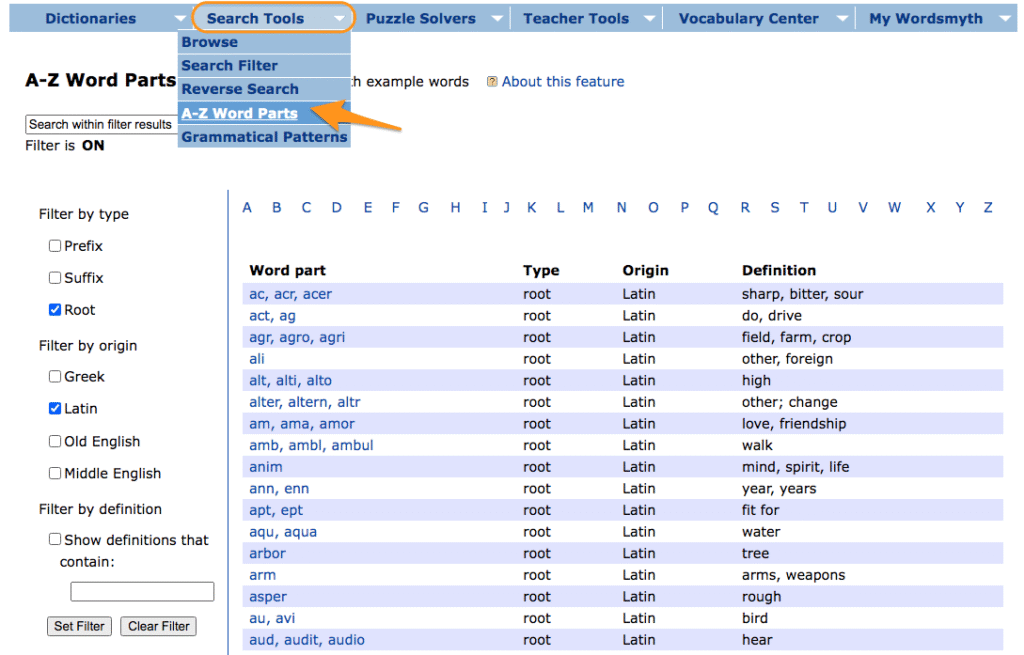
    In addition to the Word Parts feature appearing in individual dictionary entries, where the composition of a word can be studied in the context of looking up a particular word, the user can search, sort, and browse more than 600 roots and affixes on the A-Z Word Parts page. This page can be accessed from the Search Tools menu.

    3. Search Filters:

    Finally, for a list of all the words in the dictionary that contain word parts information, the user can go to the Search Filter page (under the Search Tools menu), select “Word parts information” under “Entries with special features,” and click “Set filter.”  This takes the user to a page that displays the list of words in an alphabetical, browsable format. 

    Word Parts Data in the Word Explorer Children’s Dictionary

    Users of the Word Explorer Children’s Dictionary have these same three modes of access to roots and affixes information but with the example words limited to the headwords in the Children’s Dictionary. To maximize flexibility, there are links to the complete Word Parts Database from any point in the Children’s Word Parts data. In the case of roots and affixes that have no example words in the Children’s Dictionary, the word part and information about it can still be found in the Children’s Dictionary A-Z Word Parts look-up. 

    See also:
    Word Parts I: basic roots
    Word Parts II: basic suffixes
    Word Parts III: Intermediate level suffixes
    Word Parts IV: basic prefixes

  • How do I print my wordlist?

    How do I print my wordlist?

    You can print any wordlist with the Glossary Maker activity.

    1. Select the list you want to print

      You can click the list from the Recent Wordlists sidebar. If you don’t see your desired list there, go to “My wordlist” under “My Wordsmyth.”

    2. Find the list you want to print and go back to the Activities page

      On the “My Wordlists” page, select the list you are looking for and then click the “more” option icon. From the options shown there, click on “Activities” to go back to Activities page with your target list selected.

    3. Choose Glossary on the Activities page

      The Glossary will be opened in a separate tab. Make sure the list is the one you want and click “GO”. Note here you can also decide how simple or detailed you want to make your glossary and what fields in the entries you would like to print out. If you would like a detailed glossary with example sentences and synonyms, for example, click “Custom Glossary” and then mark those items you’d like to see shown.

    4. Click the “Print” button inside the Glossary activity

      Your list will be downloaded as a PDF file. Now you can save it as a PDF and print it out with a printer anytime.

  • School URL and Class URL Explained

    With your Group Educational Subscription, Wordsmyth provides 2 services for you:

    (1) School URL: for example, www.wordsmyth.net/school/your_school_name/

    The school URL is an access point for dictionary services for your students. Using this URL, your students have access to all subscriber features available (including Ad Free pages). No login is required.

    (2) Class URL: for example, www.wordsmyth.net/school/your_school_name/class/class_name

    The class URL is used by students only to have access to activities assigned by the Teacher. Each student has to be logged in to the Class. But registration in a Class is much easier than normal Wordsmyth user registration. Only the name is a required field. Students can easily implement this kind of registration by themselves.


    The School URL is your students’ access point for all Wordsmyth dictionaries

    Each Wordsmyth Education Group subscription comes with a unique School URL, which will look similar to www.wordsmyth.net/school/your_school_name. This School URL is where you and all your students get access to full Wordsmyth premium features, ad-free.

    The school URL allows young students to use Wordsmyth to its full potential without requiring registration with an email address. This means that students are not required to log in on your School URL, and Wordsmyth doesn’t collect your students’ personal information. Only teachers need to register with Wordsmyth, in order to get access to the Teacher Tools.

    Please note:

    • Be sure to stay on your school URL all the time. When you or your students go to the main Wordsmyth URL (www.wordsmyth.net) instead of your school URL, you won’t have access to subscriber privileges.
    • For teachers, your personal data are all saved with your Wordsmyth account. When you are logged in, your look-up history and your wordlists are available for you wherever you are, on the main Wordsmyth website (www.wordsmyth.net) or on your school URL. If you move to a new school, your personal data will still be available on your new school URL as soon as you log in to your Wordsmyth account.

    The Class URL is for students to access their vocabulary assignments

    When you create a class, a Class URL is created. This Class URL is to be shared with your students. Please see this help document – Teacher Tools: classes – for more information about class creation. The Class URL is where your students view and complete their assignments. If you are a teacher using Teacher Tools on your school URL, your class URL will look something like this:

    www.wordsmyth.net/school/your_school_name/class/class_name

    Students have to log in to their respective classes. But registration for a class is very simple, and does not require an email address. The name is the only required field. If you want to register your students, please read this help document – Teacher Tools: Students – for more information.

    You can also share this Quick Start Guide for students to help your students to register themselves and get started on their assignments. The guide is written in simple language, with screenshots. Your students should be able to read it without too much trouble. 

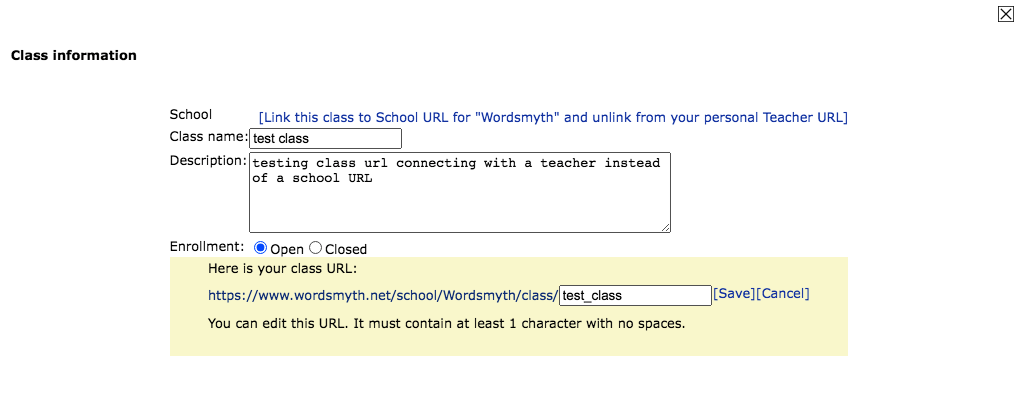
    Relink class URLs to School URL

    Individual subscribers also have access to teacher Tools, which are often used by parents with their children. If an individual user creates a class on the Wordsmyth URL (www.wordsmyth.net), the class URL looks different:

    www.wordsmyth.net/teacher/your_user_name/class/class_name

    Sometimes, a teacher may try out Wordsmyth Teacher Tools with an individual subscription, and later decide to upgrade to an Education Group subscription. Sometimes, a teacher with an existing group subscription accidentally creates a class on the Wordsmyth URL, since the interface looks the same. In those cases, you can easily move your class to your school URL.

    1. Be sure you are on your school URL, logged in to your account.
    2. Go to the “Classes” page, clear the filter to see all the classes you created.
    3. click on the class you want to move to your school URL; inside the popup class information window click [edit]
    4. Click the blue prompt text on the top: [Link the class to school URL for “Wordsmyth” and unlink from your personal Teacher URL], and your class will be moved to your school URL.

  • Where’s the Thesaurus?

    Where’s the Thesaurus?

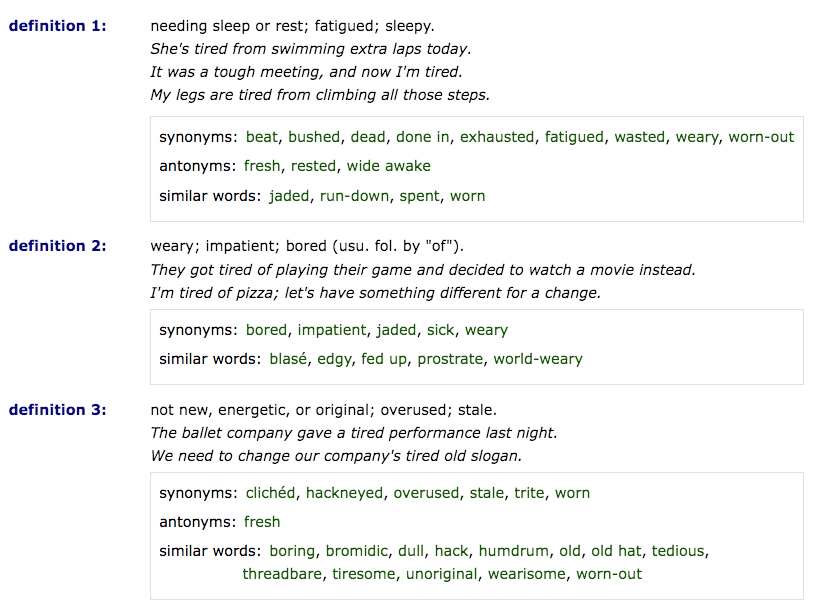
    We’re often asked “Where’s the thesaurus in your dictionary?” What some users don’t recognize right away is that synonyms, similar words, and antonyms are matched with each sense of a word and appear directly under the appropriate definition for a particular headword.  A user doesn’t need to click anywhere to get thesaurus information and doesn’t need to leave the page in order to see it.  In other words, the thesaurus is not a separate entity, but something built into the dictionary entries themselves. This is why we call it an “integrated thesaurus.”

    Being integrated into the dictionary entries means that, if you look up the word “tired,” for example, you will see, in the resulting entry, synonyms, antonyms, and similar words listed right under each individual definition. For example, you’ll see that the definition of “tired” meaning “needing sleep” has synonyms including “exhausted,” “fatigued,” and “weary.” The definition meaning “not new, energetic, or original” (as in “a tired performance”), on the other hand, has synonyms including “hackneyed,” “stale,” and “worn-out.”

    Occasionally when a user asks about the thesaurus, that person is looking at an entry that simply contains no synonyms, similar words, or antonyms.  This can happen because the meaning of the particular word simply does not invite these concepts, or because related words do not meet our criteria to be included in the thesaurus.  What would share the same meaning or be the opposite of a “pencil,” for example?  Is “pen” an antonym for “pencil”?  Is it a synonym? We don’t think it’s either.  (To find words like “pen” that relate to the concept of a pencil, however, one can use our Word Explorer feature.  By clicking on the keyword “art” in the Word Explorer feature for “pencil” and then clicking on the highlighted word “pencil” in the Word Explorer listings for “art,” one can find words such as “brush,” “crayon,” “charcoal,” “enamel,” “pen,” “ink,” and “paint.”  Clicking on the keyword “tool” will also bring up words like “pencil,” “pen,” and many other words denoting implements.)

    Not finding thesaurus information for a particular word can also occur because our projects for adding synonyms, similars, and antonyms are still ongoing, and not every word that deserves this information has it yet.  In particular, words that are derived from other words, such as “paradoxical” from “paradox,” may be empty of thesaurus information because past projects focused on root forms only.  Despite our limitations, our built-in thesaurus has synonym coverage for over 16,000 academic and high-frequency words, and the fact that thesaurus information is matched with individual senses of each of these words rather than just headwords, makes the Wordsmyth thesaurus a particularly useful resource for writers and anyone looking for a better word or a better understanding of a word’s meaning and usage.

  • Lookup by Spanish or Chinese in WILD

    Lookup by Spanish or Chinese in WILD

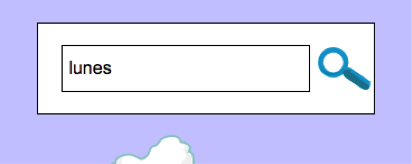
    To help young learners whose native language is Spanish or Chinese, WILD allows some level of lookup by Spanish or Chinese directly in the lookup box.

    For example, if you type in the Spanish word “lunes” and click the search button, the equivalent English entry will be displayed:

    The same lookup method works for Chinese support as well.

    Please note:

    1. Cognates in Spanish could trigger a spelling check in English. In other words, when a user tries to type in a Spanish word that has a similar spelling to an English word, the system will display auto-correct suggestions.

    2.  False cognates could also cause some confusion, but we hope that, in WILD, these kinds of words are rare.  

  • Idiomatic phrases in Wordsmyth dictionaries

    Characteristics of Wordsmyth’s “phrases”

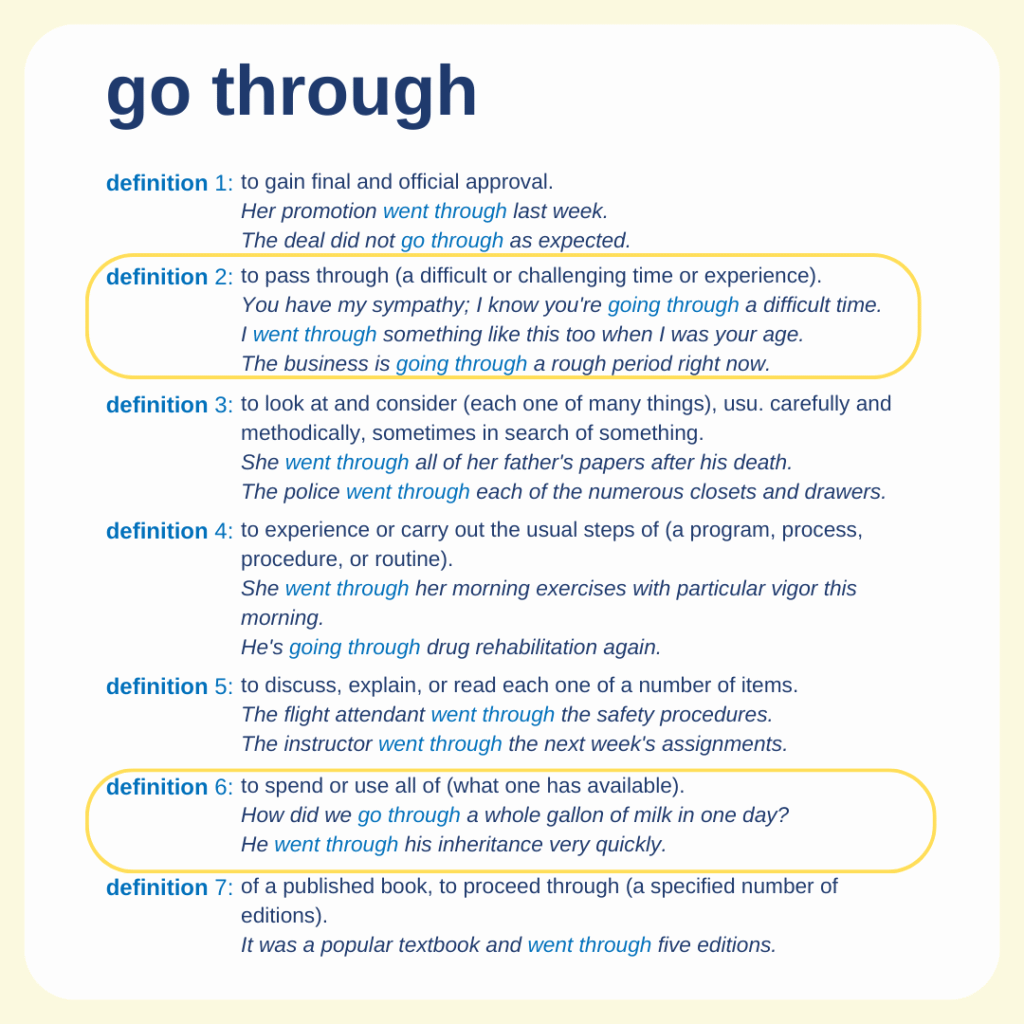
    What Wordsmyth terms “phrases” in its dictionaries are multi-word expressions that range from highly idiomatic expressions (“with a grain of salt“, “sell like hot cakes“) to marginally idiomatic phrasal verbs and expressions (“get off,” “go through,” “do the dishes,” little by little,” “again and again“). These multi-word expressions that may seem only mildly or weakly idiomatic are included as “phrases” in Wordsmyth because they are tightly bound units of meaning with very high frequency. Even though their meaning may not seem difficult to comprehend, at least to a native speaker, their form—their exact necessary parts and ordering—as well as their significance in the language, cannot be predicted by learners, and, consequently, we feel these expressions deserve to be singled out and defined along with traditional “idioms.”  In addition, phrases that seem quite transparent in one sense often have other important senses that are more distinctly idiomatic.  Compare “go through a difficult time” versus “go through a gallon of milk.”

    In many ESL resources, and even in some dictionaries, phrasal verbs tend to be listed with only one basic meaning, sometimes with two or more, but, as most teachers are aware, the most common phrasal verbs tend to have a rather large number of different meanings.  In the Advanced Dictionary, Wordsmyth lists seven definitions for the phrase “go through,” for example.  The phrase “come down” has nine senses listed in Wordsmyth, without including “come down on,” “come down to,” and “come down with,” which have their own separate entries. Because of the large number of senses for many phrases, we recommend using the customization tool (“Customize definition and example”) when creating a Vocabulary Center wordlist that includes phrases, especially two-word phrasal verbs. In this way, you can check for additional senses of the phrases you wish to use.

    In addition to having more senses than in many other resources, Wordsmyth offers far more example sentences for the most common and essential phrases.  And because the examples are created by lexicographers, they are carefully matched to each sense of a phrase.

    Ease of searching for phrases

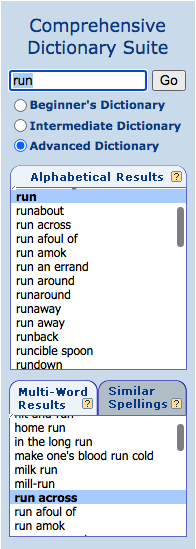
    Individual phrases in Wordsmyth are easy to find because they have their own individual entries, and they can be looked up using the search box just as you would look up any headword.  You do not need to look through the whole entry for “run,” for example, in order to find the expression “run into” or “run out.”  Moreover, if you happen to be in the entry for “run,” you may find phrases that include the word “run” listed at the top of the entry.  (Phrases can also be found by checking the alphabetical results in the sidebar within the entry that you are currently in or by checking the multi-word results listed in the sidebar). Please note that the phrases that are listed at the top of the entry for a particular headword may not be the only phrases that include that headword. Other phrases that include the headword may be linked to a different word in the phrase. For example, the phrase “run amok” is linked with “amok” rather than with “run.” Typically, however, phrases consisting of a verb plus an adverbial particle or preposition (two-word verbs such as “run down,” “run across”) are linked with the verb entry.

    If you’d like to take a closer look at how Wordsmyth treats its phrases, we’ve created a set of 20 essential phrasal verbs for you to review. You may be surprised at the range of meanings you’ll find!

  • Word Parts II: basic suffixes

    Word Parts II: basic suffixes

    Suffixes are word parts that are added to a root to create a word (e.g., “dent” + “-al” = “dental”) or to a root word to create a new word (e.g., “soft” + “ness” = “softness”). Suffixes often change a root word’s part of speech and sometimes they make a significant change in the meaning too. For example, the suffix “-less” changes a noun to an adjective and also changes the meaning a great deal. Compare “tooth” and “toothless,” for instance! Some suffixes add grammatical information to a root word without changing the part of speech. The past tense marker “-ed” is an example of this type of suffix. “Talk” and “talked” are both still verbs despite the change in forms.

    The suffixes listed below are very basic suffixes that, when added to a root word, change its part of speech. In this list are included a number of suffixes—“-y,” “-th,” “-ly,” and “-ful”—that come from Old English. As the suffixes become more specialized in their meaning, or if they tend to combine with more sophisticated words, they are more likely to derive from Latin or Greek.

    Additional example words for each suffix in the list below can be found by going to A-Z Word Parts under Search Tools in our dictionary, filtering the list there for “Suffixes,” and browsing through the list. One may also use the search box on the A-Z Word Parts page to search the list for a particular suffix. Click here to learn more about how to use the Wordsmyth Word Parts database.

    Rudimentary suffixes:

    suffixmeaningexample words
    -ationLatin noun-forming suffix that means the act, process, or result ofeducation, translation, vacation
    -ion (tion, sion) Latin noun-forming suffix that means the act, process, or result ofaction, permission, confusion
    -er, -or, -arLatin noun-forming suffix that means a person or thing that doesdriver, actor, computer, liar
    -ableLatin adjective-forming suffix that means capable of being, doing, or undergoingadorable, movable, drinkable
    -abilityLatin noun-forming suffix that means ability to do, be, or undergocapability, reliability
    -mentLatin noun-forming suffix that means act, process, or instance ofmovement, agreement, measurement
    -fulOld English adjective-forming suffix that means full ofbeautiful, successful, useful
    -nessOld English noun-forming suffix that means state or quality offitness, kindness, business
    -th Old English adjective- and noun-forming suffix that means in the position in a series indicated by the base numberfourth, fifth, sixth
    -y Old English adjective-forming suffix that means characterized by; full of; tending tochewy, itchy, lucky, messy
    -anLatin adjective- and noun-forming suffix that means 
    in adjectives: from (a place) or pertaining to or following (a figure or school of thought);
    in nouns: person or thing from (a place) or associated with (an activity or school of thought).
    American, European, historian
    Download, save or print as PDF

    See Word Parts I: basic roots

    See also:
    Word Parts I: basic roots
    Word Parts III: Intermediate level suffixes
    Word Parts IV: basic prefixes

    Learn more about the Wordsmyth word parts database and how this unique feature can be used in facilitating vocabulary learning and teaching.