Author: Wordsmyth

  • Judging the quantity of quantities

    The actual amounts referred to by expressions of quantity can be vague and hard to pin down.  Below is a chart of quantity expressions listed in a divided continuum from completely negative (“none”) to very positive (“a vast number of”).  Numerous quantity expressions exist other than those shown here, but it is hoped that this chart will show the most important ones and give a feeling for their relative amounts.  Most of these expressions have a wide range in meaning, so this chart should not be considered to show a perfect ordering or a perfect list of equivalents.  Still, it should be a fairly useful guide.  Note that “some” is not included in the chart.  This is because “some” has a very wide range of positive meaning that includes anything from “a tiny bit” to “a lot.”  And, because of this lack of specificity, it is not often used to express a particular quantity of something.

    A ranking of quantity expressions

    NEGATIVE SIDE

    none/
    not any
    Cake? No, sorry. There is none left.
    Cake? No, there isn’t any left.
    very few/ very littleWas it crowded?  No, there were very few people there.  It was almost empty.
    Unfortunately, we had very little time at the museum and couldn’t see what we came to see.
    few/
    little

    Few people will be at the beach today and we’ll have it nearly all to ourselves.
    No, I never found the answer.  There was little information about it on their website.

    POSITIVE SIDE

    one or two
    a couple
    a very few
    a little bit
    a tiny bit
    Yes, one or two people asked about it.
    Yes, there is a little bit of cake left.
    Oh, yes.  There is a tiny bit of spinach between your teeth!
    A very few people came in late, but it wasn’t a problem.
    a few
    a number of
    a bit
    a little
    Yes, there are a few slices of pizza left.  Go ahead and take what you’d like.
    A number of people said they were interested in my paintings. I’m very excited.
    We still have a bit of cheese.  Would you like some?
    We have a little time, so let’s get a cup of coffee.
    a fair number/ a fair amount/ several   Yes, a fair number of people have asked me that question.
    Yes,  we spent a fair amount of time figuring that out.
    Yes.  Several packages came today.  Four or five, I think.
    quite a few/ quite a bit/ several/ a surprising number/ a surprising amountYes,  it cost quite a bit of money.  It certainly wasn’t cheap!
    Yes, a surprising amount of time is needed to fix these small things.
    a good number/ a good deal ofYes, we spent a good deal of time trying to figure out how to get to places we wanted to go to.  It was pretty confusing.
    We were pleased that a good number of young people attended the town meeting.
    many/ a lot/ a great deal of/ muchYes, many friends of theirs came to the wedding.  We hardly got to speak to the newlyweds at all.
    A great deal of effort went into this project and we’re grateful to all those who participated.       
    a vast number of/
    a vast amount of
     A vast number of people, perhaps millions, will be affected by this decision.
    It will take a vast amount of money to fix this problem.

    Just interested in words? Looking for clear dictionary definitions and examples? Join our users and subscribers at wordsmyth.net or kids.wordsmyth.net.

  • The meaning of “some” as a quantity expression

    The meaning of “some” as a quantity expression

    The word “some” indicates a quantity of something, but it doesn’t strongly signal any particular quantity or any particular feeling that the actual quantity is important. There is very little difference, with respect to quantity, between “There are people in the dining room” and “There are some people in the dining room.”  Saying “There are some people” is just saying the opposite of “there are no people.”  The sense of quantity with “no” (or “not any”) is simply negative; the sense of quantity with “some” is simply positive.

    When we use words like “a lot” or “a few,” we are giving some indication as to the quantity of something.  We understand that the quantity is large when we say “a lot” and that it is fairly small when we say “a few.”  We can use these expressions to answer questions with “How many?” or “How much?” But because “some” doesn’t give much indication of the actual number or amount of what it is referring to, it is not often used in answering such questions. If it is used in such situations, it sounds as if the speaker can’t really decide how to describe the quantity.  Still, when we need to interpret “some” as a particular quantity, we assume that it is somewhere between a little bit and a lot.  If someone asks us to put some flour in a bowl, we’d probably put in what we thought would be a moderate amount rather than what seems like a little or a lot.

    Examples:

    Be careful; there’s some water on the floor. 
    We have some milk, but we don’t have any orange juice.
    There are some movies that just don’t interest me at all. [A proportion of movies just don’t interest me.]
    How many people came?  Well, some, but not many.
    How many people came?  Well, some, but only a few.

    Just interested in words? Looking for clear dictionary definitions and examples? Join our users and subscribers at wordsmyth.net or kids.wordsmyth.net.
  • The meaning of quantity expressions

    The meaning of quantity expressions

    If we really think about it, quantity expressions, other than actual numbers and words like “none,” do not specify exact amounts, and some vary widely in the actual amounts they can refer to.  The choice of any one of them—“several,” “a lot,” “a bit,” “a few,” “many”– depends on how the speaker feels about the amount being referred to, and whether that amount feels small or large or somewhere in between.

    The most specific of the quantity words are probably “a few” and “several”—and, of course, “a couple,” which usually means two, but doesn’t feel very precise.  “A few” usually means two or three, or maybe four.  But it could mean six or eight if one thought there might be sixty. (“A few” is always positive, though.  It may be a small amount, but it is still significant.)  Likewise, “several” means more than two but not so many as to confidently say “many.”  Even though “several” is defined as meaning more than two, and therefore possibly meaning “three,” it is generally felt to signify a quantity larger than “a few.”  Therefore, “several” usually suggests a quantity of more than four, but again, not so many as to make a person say “many.”

    Other quantity expressions are even more vague about numbers and amounts than “a few” and “several.”  The amounts they refer to are highly relative.  “A good number of fish,” for example, could mean four or five if that’s the number of fish an amateur caught in an afternoon, but the phrase could mean several thousand if one is referring to the current number of fish in a lake, and especially if that number is surprising.  These expressions with “good“—“a good number,” “a good deal”—refer to quantities that seem large to the speaker but still seem less than what the speaker would feel comfortable describing as “many,” “a lot,” “a great number” or “a great deal.”

    “Many” is a highly relative term (as is “a lot” and “much”).  It always refers to a number higher than two, but, other than that, it could mean any number from three to infinity, depending on what it is referring to and how the speaker feels about the number.  One could say “many gray hairs” if one found three on one’s head and was very surprised, or annoyed, or just exaggerating.  Or one could say “many stars” if one were actually referring to millions or billions.   The only important thing is that the number feels like a very large one to the speaker.

    “Some” is the most vague and relative quantity expression of all.   In fact, we don’t often use it to answer a question about the specific quantity of something.  If we do use it in such cases,  we may give the impression that we cannot decide how to describe the actual amount.  As a quantity word, “some” is most often used as the positive complement of “any” or “no”  (e.g., “Is there any milk left?” –Yes, there’s some in the fridge.”  “I saw some beautiful birds yesterday, but I saw no birds at all this morning.” “I don’t have any peaches, but I’ve got some apples.)  Whereas  “no” and “any” are used to negate or question the existence of a quantity of something, “some” is used to state or affirm the existence of a quantity of something.  But, again, the actual amount of this thing is pretty much unimportant, except that it’s more than one, if the item is countable. 

    Just interested in words? Looking for clear dictionary definitions and examples? Join our users and subscribers at wordsmyth.net or kids.wordsmyth.net.
  • Idiomatic phrases in Wordsmyth dictionaries

    Characteristics of Wordsmyth’s “phrases”

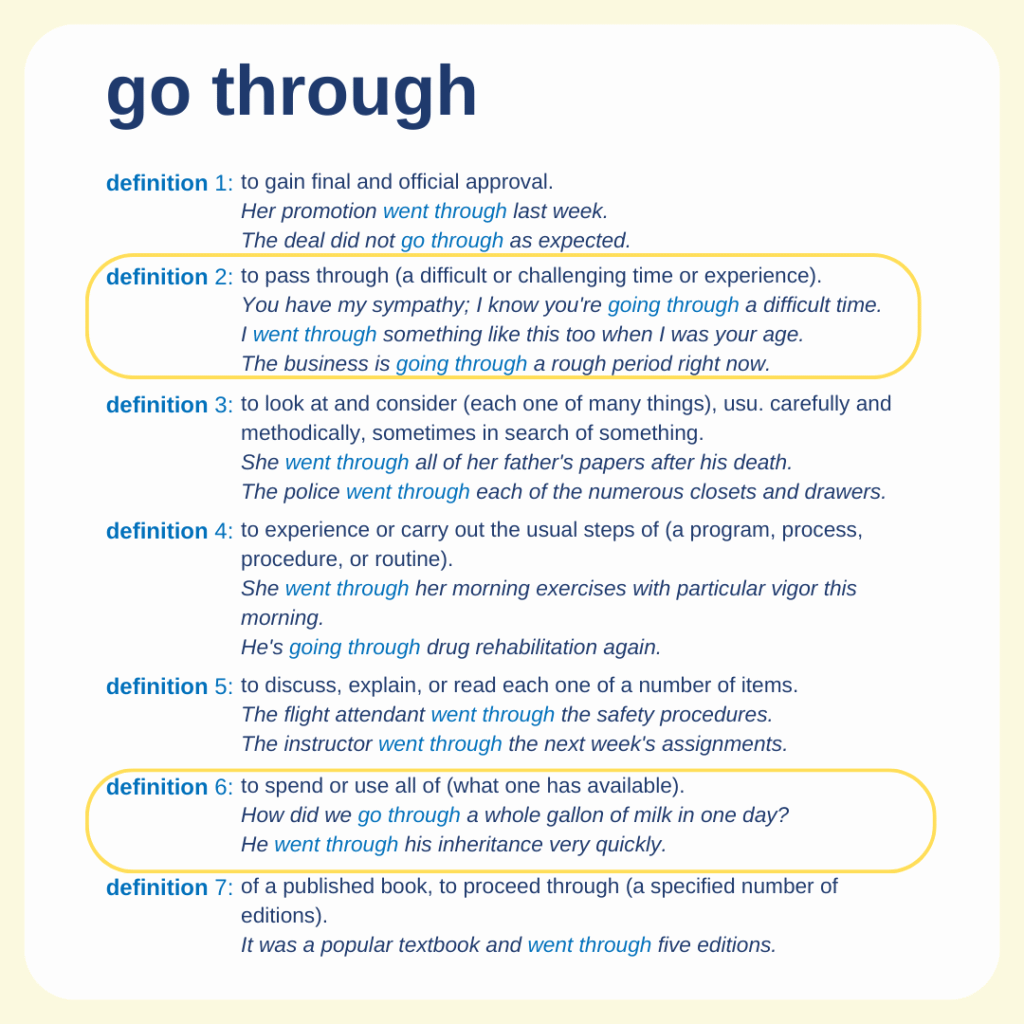
    What Wordsmyth terms “phrases” in its dictionaries are multi-word expressions that range from highly idiomatic expressions (“with a grain of salt“, “sell like hot cakes“) to marginally idiomatic phrasal verbs and expressions (“get off,” “go through,” “do the dishes,” little by little,” “again and again“). These multi-word expressions that may seem only mildly or weakly idiomatic are included as “phrases” in Wordsmyth because they are tightly bound units of meaning with very high frequency. Even though their meaning may not seem difficult to comprehend, at least to a native speaker, their form—their exact necessary parts and ordering—as well as their significance in the language, cannot be predicted by learners, and, consequently, we feel these expressions deserve to be singled out and defined along with traditional “idioms.”  In addition, phrases that seem quite transparent in one sense often have other important senses that are more distinctly idiomatic.  Compare “go through a difficult time” versus “go through a gallon of milk.”

    In many ESL resources, and even in some dictionaries, phrasal verbs tend to be listed with only one basic meaning, sometimes with two or more, but, as most teachers are aware, the most common phrasal verbs tend to have a rather large number of different meanings.  In the Advanced Dictionary, Wordsmyth lists seven definitions for the phrase “go through,” for example.  The phrase “come down” has nine senses listed in Wordsmyth, without including “come down on,” “come down to,” and “come down with,” which have their own separate entries. Because of the large number of senses for many phrases, we recommend using the customization tool (“Customize definition and example”) when creating a Vocabulary Center wordlist that includes phrases, especially two-word phrasal verbs. In this way, you can check for additional senses of the phrases you wish to use.

    In addition to having more senses than in many other resources, Wordsmyth offers far more example sentences for the most common and essential phrases.  And because the examples are created by lexicographers, they are carefully matched to each sense of a phrase.

    Ease of searching for phrases

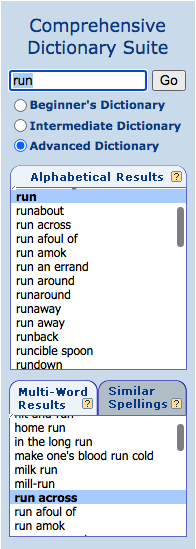
    Individual phrases in Wordsmyth are easy to find because they have their own individual entries, and they can be looked up using the search box just as you would look up any headword.  You do not need to look through the whole entry for “run,” for example, in order to find the expression “run into” or “run out.”  Moreover, if you happen to be in the entry for “run,” you may find phrases that include the word “run” listed at the top of the entry.  (Phrases can also be found by checking the alphabetical results in the sidebar within the entry that you are currently in or by checking the multi-word results listed in the sidebar). Please note that the phrases that are listed at the top of the entry for a particular headword may not be the only phrases that include that headword. Other phrases that include the headword may be linked to a different word in the phrase. For example, the phrase “run amok” is linked with “amok” rather than with “run.” Typically, however, phrases consisting of a verb plus an adverbial particle or preposition (two-word verbs such as “run down,” “run across”) are linked with the verb entry.

    If you’d like to take a closer look at how Wordsmyth treats its phrases, we’ve created a set of 20 essential phrasal verbs for you to review. You may be surprised at the range of meanings you’ll find!

  • Word Parts II: basic suffixes

    Word Parts II: basic suffixes

    Suffixes are word parts that are added to a root to create a word (e.g., “dent” + “-al” = “dental”) or to a root word to create a new word (e.g., “soft” + “ness” = “softness”). Suffixes often change a root word’s part of speech and sometimes they make a significant change in the meaning too. For example, the suffix “-less” changes a noun to an adjective and also changes the meaning a great deal. Compare “tooth” and “toothless,” for instance! Some suffixes add grammatical information to a root word without changing the part of speech. The past tense marker “-ed” is an example of this type of suffix. “Talk” and “talked” are both still verbs despite the change in forms.

    The suffixes listed below are very basic suffixes that, when added to a root word, change its part of speech. In this list are included a number of suffixes—“-y,” “-th,” “-ly,” and “-ful”—that come from Old English. As the suffixes become more specialized in their meaning, or if they tend to combine with more sophisticated words, they are more likely to derive from Latin or Greek.

    Additional example words for each suffix in the list below can be found by going to A-Z Word Parts under Search Tools in our dictionary, filtering the list there for “Suffixes,” and browsing through the list. One may also use the search box on the A-Z Word Parts page to search the list for a particular suffix. Click here to learn more about how to use the Wordsmyth Word Parts database.

    Rudimentary suffixes:

    suffixmeaningexample words
    -ationLatin noun-forming suffix that means the act, process, or result ofeducation, translation, vacation
    -ion (tion, sion) Latin noun-forming suffix that means the act, process, or result ofaction, permission, confusion
    -er, -or, -arLatin noun-forming suffix that means a person or thing that doesdriver, actor, computer, liar
    -ableLatin adjective-forming suffix that means capable of being, doing, or undergoingadorable, movable, drinkable
    -abilityLatin noun-forming suffix that means ability to do, be, or undergocapability, reliability
    -mentLatin noun-forming suffix that means act, process, or instance ofmovement, agreement, measurement
    -fulOld English adjective-forming suffix that means full ofbeautiful, successful, useful
    -nessOld English noun-forming suffix that means state or quality offitness, kindness, business
    -th Old English adjective- and noun-forming suffix that means in the position in a series indicated by the base numberfourth, fifth, sixth
    -y Old English adjective-forming suffix that means characterized by; full of; tending tochewy, itchy, lucky, messy
    -anLatin adjective- and noun-forming suffix that means 
    in adjectives: from (a place) or pertaining to or following (a figure or school of thought);
    in nouns: person or thing from (a place) or associated with (an activity or school of thought).
    American, European, historian
    Download, save or print as PDF

    See Word Parts I: basic roots

    See also:
    Word Parts I: basic roots
    Word Parts III: Intermediate level suffixes
    Word Parts IV: basic prefixes

    Learn more about the Wordsmyth word parts database and how this unique feature can be used in facilitating vocabulary learning and teaching.

  • Word Parts I: A handy list for introducing Greek and Latin roots to your students

    Word Parts I: A handy list for introducing Greek and Latin roots to your students

    As educators, we are all aware that learning words parts, particularly Greek and Latin roots, prefixes, and suffixes can help students guess the meaning of new words as well as help them recall the meaning of words that they have previously been exposed to.  Such learning can be of vast benefit to vocabulary acquisition. In addition, learning suffixes, such as the Latin suffixes “-ness” and “-ment” and the suffix “-ly” from Old English, can help students understand the grammatical meanings attached to words and see how different forms of words are related to each other.

    As you may know, Wordsmyth has a word parts database integrated within its dictionaries. The Word Parts feature is displayed within relevant dictionary entries and is designed to support both native-speaking students and English Language Learners in their understanding of roots and affixes and to help them make use of word parts information to expand their vocabulary.  The word parts data as a whole can be viewed by looking under Search Tools in our dictionary and clicking on A-Z Word Parts. Here you will find a comprehensive, alphabetical listing of roots and affixes that is searchable. (Word Parts can be accessed with your Wordsmyth subscription or with a 15-day free trial. Don’t forget to turn on the feature in your settings.)

    Below is a special list we’ve created from information in our word parts database that teachers may find helpful in introducing Greek and Latin roots in grades 3 to 5. (Download as PDF). Additional example words for each root in the list below can easily be found by going to A-Z Word Parts, filtering the list there for “Roots,” and browsing through the list. One may also use the search box on the A-Z Word Parts page to search the list for a particular root. The A-Z Word Parts list contains, of course, many more roots (as well as other affixes) than are listed below.

    rootsmeaningexample words
    agrisoil, earth, fieldagriculture, agronomy
    aquwateraquarium, aqua, aquaculture
    astrostarastronaut, astronomy, astrology
    autoselfautomatic, autograph, autobiography
    centhundredcentury, cent, centipede
    capheadcaptain, capital, capitalize
    dentteethdentist, dental
    dicttelldictionary, predict, dictator
    gramwritetelegram, diagram, grammar
    graphwritetelegraph, geography, graphics
    mob, motmovemobile, motion, motor
    pedfootpedal, pedestrian, centipede
    phonsoundtelephone, microphone, symphony
    photlightphotograph, photosynthesis
    portcarrytransport, import, portable
    ruptbreakerupt, interrupt, disrupt
    scrib, scriptwritescribble, prescription, script
    solsunsolar system, parasol
    solalonesolo, solitaire
    spectlookinspect, spectator, spectacles
    spherballspherical, hemisphere
    stellstarconstellation, stellar
    structbuildconstruct, structure
    teledistancetelephone, telescope, television
    Download, save, or print as PDF

    See also:
    Word Parts II: basic suffixes
    Word Parts III: Intermediate level suffixes
    Word Parts IV: basic prefixes

    Learn more about the Wordsmyth word parts database and how this unique feature can be used in facilitating vocabulary learning and teaching.

  • 1000 Words for Beginning Learners

    1000 Words for Beginning Learners

    Our new educational game app—WILD WORD LEARNER—is now available to play with 183 wordlists from the Wordsmyth Illustrated Learner’s Dictionary (WILD) spread over 12 great topics.

    Read the full description and download the free app for your young learners now!

    Natural Environment
    73 vocabulary words relating to items in settings such as the desert, forest, seashore, jungle, and ocean. Typical words include: sand, cactus, bobcat, shell, ocean, starfish, cave, vine, and frog.

    Plants
    42 vocabulary words relating to parts of plants, types of plants, parts of trees, flowers, and parts of a flower.  Typical words include: corn, rice, bamboo, fern, grass, cone, leaf, stamen, and moss.

    School
    54 vocabulary words related to school, including such items as: cafeteria, gym, classroom, playground, teacher, principal, blackboard, desk, whiteboard, map, globe, computer lab, tablet, and backpack.

    People and things
    112 words connected with parts of the body, ways people feel, people in jobs, holidays, and sports. Typical words include: ear, mouth, knee, glad, proud, scared, barber, chef, Halloween, and soccer.

    Animals
    110 animal words in categories such as Jumping, Leaping Animals; Creeping, Crawling Animals; Furry Animals; Sea Animals; Scary Animals; Pets; Bugs; Big Cats; and Beautiful Birds.

    Home
    72 vocabulary words relating to types of home, places in the home, and things found in the home. Typical words include:  porch, yard, kitchen, oven, closet, jacket, jeans, armchair, bathtub, and sink.

    Art and Music
    79 words relating to kinds of art, art materials, colors, shapes, musical instruments, and things found in a theater. Typical words include: easel, clay, painting, triangle, flute, drum, and costume.

    Busy World
    114 words relating to places of activity and the things and people found in each. Categories range from Places in a City to Things at a Restaurant, and from Things at a Campground to Things on a Farm.

    Transportation
    66 words relating to vehicles and ways of getting around.  Typical words include bus, train, airplane, walk, drive, skate, highway, sidewalk, path, engine, windshield, and tire.

    Food
    114 food words ranging from fruits, vegetables, meats, and seafood to baked goods, breakfast foods, and things on a sandwich. Typical words include: pear, broccoli, chicken, tuna, roll, and mustard.

    Earth and Space
    103 words including names of planets, types of land on Earth, types of weather, bodies of water, and names of Earth’s continents, oceans, seas, rivers, lakes, deserts, and mountains.

    Language and Numbers
    114 words in total. “Language” words include 58 action verbs, such as dig, climb, and fly, and 28 words that are prepositions, such as under, on, and through. “Numbers” includes 28 number words. 

  • WILD Word Learner App

    WILD Word Learner App

    WILD Word Learner is a companion app to the Wordsmyth Illustrated Learner’s Dictionary (WILD). This educational game app gives young learners the opportunity to learn close to 1000 carefully selected words from WILD.  These words are distributed over twelve kid-friendly topics and nearly 200 wordlists and make a delightful introduction to the world of English words.

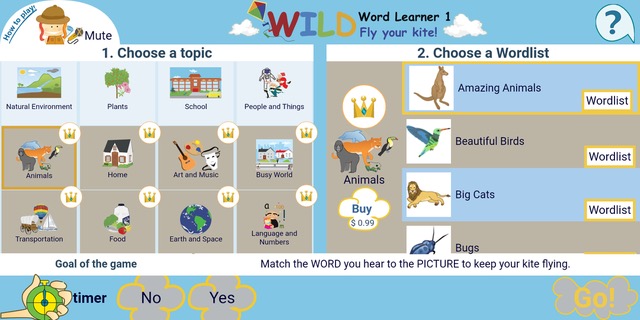
    In WILD Word Learner, children choose a topic and a wordlist and start off on a fun word-learning mission!

    The WILD Word Learner app, based on the Wordsmyth Illustrated Learner’s Dictionary, is designed to help young native speakers and non-native speakers (K to 2) build their vocabulary through engaging word games. WILD Word Learner 1 (Fly Your Kite) is the first app in the WILD Word Learner series. With this app, kids drag and drop icons to match a word’s sound with its picture. Future apps will focus on matching spelling to picture and sound to spelling.

    Carefully selected words

    Words chosen for the games are those most relevant to children’s everyday lives or to subjects children often study in school—things such as animals, land forms, types and parts of plants, foods, actions and activities, parts of the body, musical instruments, numbers, and shapes. In addition, the “Earth and Space” topic covers different planets in the solar system as well as named regions and geographical features of our Earth, such as its continents, major deserts, mountain ranges, and seas. In the “Language” topic, concepts described by prepositions and verbs are addressed. For fun as well as for enhanced understanding of the concepts involved, all words that are verbs or prepositions under this topic have animated illustrations.

    Every word in the Word Learner game is paired with a charming and child-friendly illustration, and all words have human-voiced pronunciation. Simple definitions and example sentences from the Wordsmyth Illustrated Learner’s Dictionary can also be accessed, at the child’s choosing, by clicking on the entry icon . This additional data makes the app a rich resource for the understanding of specific concepts as well as for the expansion of general knowledge. It also allows for greater adult-child interaction if the child needs or wishes to have the information read aloud by an adult. It can also serve as a source of simple and enjoyable reading practice and language-learning input.

    Engaging game design with positive feedback

    Based on the latest educational theory and research, the game app is designed so that young children can actively engage in their learning process. Kids can choose what they want to learn, which cultivates their motivation for further learning. Positive feedback at every interaction creates an encouraging learning environment that helps children persist with an activity even when they encounter difficulties.

    The game’s audio instructions, which can be turned on or off, gently guide kids in their understanding of how the game functions. The instructions can be heard in three languages: English, Chinese, and Spanish.

    Safe environment for kids

    No log-in is required, and we do not collect any personal data through the app. However, we would like to encourage parents and educators to use our website, kids.wordsmyth.net/wild, to expand their children’s learning through exploration of our 4000-word dictionary for young children—the Wordsmyth Illustrated Learner’s Dictionary (WILD). This interactive and highly engaging vocabulary learning resource includes all the data from the app and much, much more.

  • Wordsmyth’s online teaching resources

    Wordsmyth has always been a resource for online learning, but with so many K-12 teachers engaging in online instruction during this difficult time, we would like to offer a guide to Wordsmyth’s plentiful tools that can help out with the challenging task of teaching children remotely.

    For Grades K-2

    WILD, a rich and unique online resource with an interactive visual world, provides a charming and engaging means for children to learn both about words and about the real world. It even contains an interactive world map and short descriptions of all the world’s countries. Very young students can safely and enjoyably explore the WILD site by themselves, or they can use it in classroom activities with a teacher.

    For an overview of what WILD is and has to offer, we invite you to take a look at our introductory description of WILD on our blog. And for help in getting started using WILD with your class, check out our Quick-Start Guide or watch our WILD demo video. You can also download teaching materials and activities in pdf from the WILD site. Again, as WILD is a safe and easily navigable site for children, you can also have your students simply go to WILD and start exploring online.

    As you begin to use WILD and encounter more and more of its features, you may wish for further help or suggestions. Our collection of WILD supporting documents will be there to help guide you along your way. This collection of information on WILD will always be accessible on our blog under the category “WILD: Wordsmyth Illustrated Learner’s Dictionary.”


    For Grades 3-9

    Wordsmyth’s Children’s Dictionary is designed for upper elementary and middle school students. Like the WILD dictionary, the Children’s Dictionary is also well-suited to the needs of young ESL students. Click here to learn more about the Children’s Dictionary.

    Wordsmyth recently published its Children’s Dictionary app on both Android and App Store. This app can be used online or offline, which will accommodate the needs of students without consistent internet access.

    If you have a school or teacher subscription, you can assign vocabulary word lists for your students to practice online with our vocabulary center activities.


    For high school and college students

    Our comprehensive dictionary suite contains three levels: advanced, intermediate, and beginner. The linked levels support advanced students and struggling students alike, as users can, with one click, access simpler or more sophisticated definitions and example sentences for words they’ve looked up. The unique leveled structure also provides the best support for older or more advanced ESL students.

    In the comprehensive dictionary suite, users will find readable definitions on an uncluttered page, thousands of highly instructive example sentences to clarify the meaning and use of words, synonyms and antonyms, audio pronunciation, and thousands of photos and colorful illustrations. There is also access to glossary, quiz makers, and games in the vocabulary center. Below are links to descriptions of some additional unique features in our dictionary suite that you may find helpful for your students:

    Wordsmyth’s Student & ELL Dictionary app is now available on the App Store and Google Play. The app provides the full set of features of our Comprehensive Suite for better user experience on mobile phones or tablets. Once downloaded, it will always be available for you and your students even without internet. Check out the full app description.

    Follow us on Facebook, Twitter and Instagram for Wordsmyth Word of the Day and more information about our online teaching resources.