Author: Wordsmyth

  • Word Parts III: Intermediate level suffixes

    Word Parts III: Intermediate level suffixes

    The suffixes in the following list are extremely common suffixes but some have fairly specialized meanings. The suffixes “-ish,” “-en,” and “-less” derive from Old or Middle English. The rest derive from Latin or Greek.

    Additional example words for each suffix in the list below can be found by going to A-Z Word Parts under Search Tools in the Wordsmyth dictionaries, filtering the list there for “Suffixes,” and browsing through the list. One may also use the search box on the A-Z Word Parts page to search the list for a particular suffix. Click here to learn more about how to use our Word Parts database.

    suffixmeaningexample words
    -lessMiddle English adjective-forming suffix that means withoutendless, fearless, wireless
    -ance, -ence Latin noun-forming suffix that means state, quality, or act of;
    The suffix -ance is usually attached to whole English words, whereas -ence is usually attached to roots: compare eloquence and acceptance
    acceptance, admittance, residence, science
    -al Latin adjective-forming suffix that means pertaining tocultural, dental, manual, universal
    -istGreek noun-forming suffix that means person who does or believes in; Many words ending in -ist have a corresponding abstract noun form ending in -ism, and many have a corresponding adjective form ending in -ic (realistic, artistic).artist, chemist, dentist
    -itis Greek noun-forming suffix that means inflammationappendicitis, arthritis, poliomyelitis.
    -logy, -ology Greek noun-forming suffix that means study of, science of; written work; structure or principlebiology, ecology, geology
    -enOld English verb-forming suffix that means to cause to be or become or havedarken, enlighten, strengthen
    -fyLatin verb-forming suffix that means make, cause to be, becomeclarify, justify, satisfy
    -ize, -iseGreek verb-forming suffix that means to turn into or cause to becivilize, immunize, recognize
    -ous, iousLatin adjective-forming suffix that means full of, characterized bygracious, joyous, spacious
    -icsGreek noun-forming suffix that means science, study, or practice of; properties of; practices pertaining toeconomics, physics, politics
    -ishOld English adjective-forming suffix that means of, resembling; somewhatchildish, ticklish, foolish
    Download, save or print as PDF

    See the full list of roots, prefixes, and suffixes in the A to Z Word Parts feature at wordsmyth.net.

    See also:
    Word Parts I: basic roots
    Word Parts II: basic suffixes
    Word Parts IV: basic prefixes

    Learn more about the Wordsmyth word parts database and how this unique feature can be used in facilitating vocabulary learning and teaching.

  • Wordsmyth’s Word Parts Database

    Wordsmyth’s Word Parts Database

    The importance of learning Word Parts (roots, prefixes, and suffixes)

    Studying word parts equips us to do the following:

    • Identify the meaningful elements that make up words.
    • Learn the characteristics of roots and of affixes, their origin, meaning, and grammatical function.
    • Guess (or recall) the meaning of unfamiliar words from the clues given by word parts.
    • Recognize the relationship among words that share a common root or affix.
    • Recognize patterns among changing word forms (e.g., -cept, -ceive).
    • Improve spelling by gaining awareness of the internal logic of words.
    • Increase vocabulary, cultivate morphological awareness, and have fun discovering some of the interesting ways the English language works.

    For a general introduction to the terms and concepts used in our Word Parts database, see this downloadable pdf . Access to the Word Parts feature comes with your Wordsmyth subscription or a 15-day free trial.

    Three ways to view the Word Parts data

    1. Dictionary entries:

    More than 8000 Wordsmyth dictionary entries now display information about the word parts that make up the headword. In the new Word Parts section of the entry, the headword is broken down into its roots and affixes.

    Each significant word part is identified, and its origin, type, and meaning are provided. The user can also view here a list of other example words containing the word part and jump to those words’ dictionary entries to explore further. “More about this word part” notes explain in more detail how particular affixes combine with bases to form words.

    abstain wp

    2. A-Z Word Parts Page:

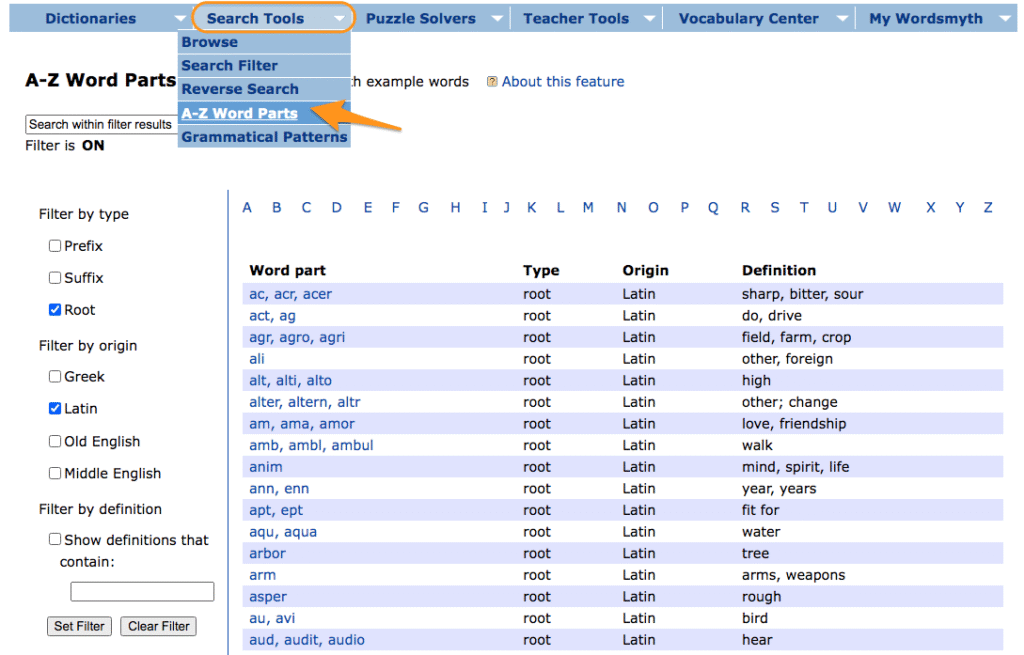
    In addition to the Word Parts feature appearing in individual dictionary entries, where the composition of a word can be studied in the context of looking up a particular word, the user can search, sort, and browse more than 600 roots and affixes on the A-Z Word Parts page. This page can be accessed from the Search Tools menu.

    3. Search Filters:

    Finally, for a list of all the words in the dictionary that contain word parts information, the user can go to the Search Filter page (under the Search Tools menu), select “Word parts information” under “Entries with special features,” and click “Set filter.”  This takes the user to a page that displays the list of words in an alphabetical, browsable format. 

    Word Parts Data in the Word Explorer Children’s Dictionary

    Users of the Word Explorer Children’s Dictionary have these same three modes of access to roots and affixes information but with the example words limited to the headwords in the Children’s Dictionary. To maximize flexibility, there are links to the complete Word Parts Database from any point in the Children’s Word Parts data. In the case of roots and affixes that have no example words in the Children’s Dictionary, the word part and information about it can still be found in the Children’s Dictionary A-Z Word Parts look-up. 

    See also:
    Word Parts I: basic roots
    Word Parts II: basic suffixes
    Word Parts III: Intermediate level suffixes
    Word Parts IV: basic prefixes

  • How do I print my wordlist?

    How do I print my wordlist?

    You can print any wordlist with the Glossary Maker activity.

    1. Select the list you want to print

      You can click the list from the Recent Wordlists sidebar. If you don’t see your desired list there, go to “My wordlist” under “My Wordsmyth.”

    2. Find the list you want to print and go back to the Activities page

      On the “My Wordlists” page, select the list you are looking for and then click the “more” option icon. From the options shown there, click on “Activities” to go back to Activities page with your target list selected.

    3. Choose Glossary on the Activities page

      The Glossary will be opened in a separate tab. Make sure the list is the one you want and click “GO”. Note here you can also decide how simple or detailed you want to make your glossary and what fields in the entries you would like to print out. If you would like a detailed glossary with example sentences and synonyms, for example, click “Custom Glossary” and then mark those items you’d like to see shown.

    4. Click the “Print” button inside the Glossary activity

      Your list will be downloaded as a PDF file. Now you can save it as a PDF and print it out with a printer anytime.

  • School URL and Class URL Explained

    With your Group Educational Subscription, Wordsmyth provides 2 services for you:

    (1) School URL: for example, www.wordsmyth.net/school/your_school_name/

    The school URL is an access point for dictionary services for your students. Using this URL, your students have access to all subscriber features available (including Ad Free pages). No login is required.

    (2) Class URL: for example, www.wordsmyth.net/school/your_school_name/class/class_name

    The class URL is used by students only to have access to activities assigned by the Teacher. Each student has to be logged in to the Class. But registration in a Class is much easier than normal Wordsmyth user registration. Only the name is a required field. Students can easily implement this kind of registration by themselves.


    The School URL is your students’ access point for all Wordsmyth dictionaries

    Each Wordsmyth Education Group subscription comes with a unique School URL, which will look similar to www.wordsmyth.net/school/your_school_name. This School URL is where you and all your students get access to full Wordsmyth premium features, ad-free.

    The school URL allows young students to use Wordsmyth to its full potential without requiring registration with an email address. This means that students are not required to log in on your School URL, and Wordsmyth doesn’t collect your students’ personal information. Only teachers need to register with Wordsmyth, in order to get access to the Teacher Tools.

    Please note:

    • Be sure to stay on your school URL all the time. When you or your students go to the main Wordsmyth URL (www.wordsmyth.net) instead of your school URL, you won’t have access to subscriber privileges.
    • For teachers, your personal data are all saved with your Wordsmyth account. When you are logged in, your look-up history and your wordlists are available for you wherever you are, on the main Wordsmyth website (www.wordsmyth.net) or on your school URL. If you move to a new school, your personal data will still be available on your new school URL as soon as you log in to your Wordsmyth account.

    The Class URL is for students to access their vocabulary assignments

    When you create a class, a Class URL is created. This Class URL is to be shared with your students. Please see this help document – Teacher Tools: classes – for more information about class creation. The Class URL is where your students view and complete their assignments. If you are a teacher using Teacher Tools on your school URL, your class URL will look something like this:

    www.wordsmyth.net/school/your_school_name/class/class_name

    Students have to log in to their respective classes. But registration for a class is very simple, and does not require an email address. The name is the only required field. If you want to register your students, please read this help document – Teacher Tools: Students – for more information.

    You can also share this Quick Start Guide for students to help your students to register themselves and get started on their assignments. The guide is written in simple language, with screenshots. Your students should be able to read it without too much trouble. 

    Relink class URLs to School URL

    Individual subscribers also have access to teacher Tools, which are often used by parents with their children. If an individual user creates a class on the Wordsmyth URL (www.wordsmyth.net), the class URL looks different:

    www.wordsmyth.net/teacher/your_user_name/class/class_name

    Sometimes, a teacher may try out Wordsmyth Teacher Tools with an individual subscription, and later decide to upgrade to an Education Group subscription. Sometimes, a teacher with an existing group subscription accidentally creates a class on the Wordsmyth URL, since the interface looks the same. In those cases, you can easily move your class to your school URL.

    1. Be sure you are on your school URL, logged in to your account.
    2. Go to the “Classes” page, clear the filter to see all the classes you created.
    3. click on the class you want to move to your school URL; inside the popup class information window click [edit]
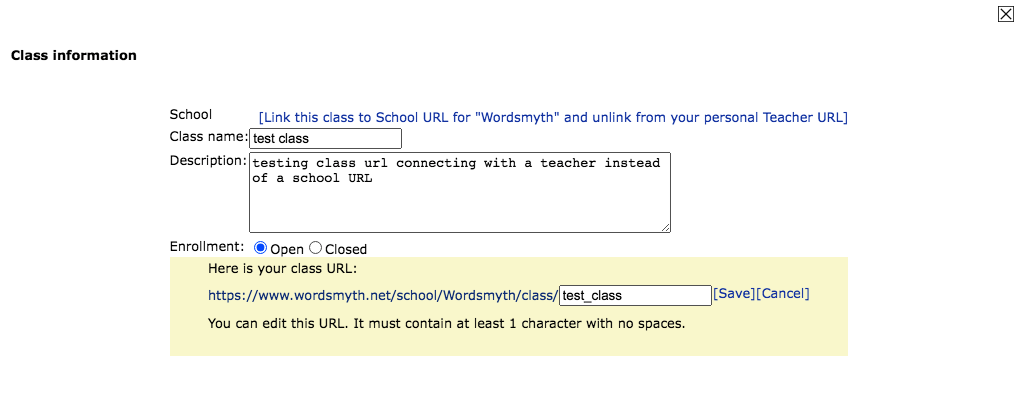
    4. Click the blue prompt text on the top: [Link the class to school URL for “Wordsmyth” and unlink from your personal Teacher URL], and your class will be moved to your school URL.

  • Where’s the Thesaurus?

    Where’s the Thesaurus?

    We’re often asked “Where’s the thesaurus in your dictionary?” What some users don’t recognize right away is that synonyms, similar words, and antonyms are matched with each sense of a word and appear directly under the appropriate definition for a particular headword.  A user doesn’t need to click anywhere to get thesaurus information and doesn’t need to leave the page in order to see it.  In other words, the thesaurus is not a separate entity, but something built into the dictionary entries themselves. This is why we call it an “integrated thesaurus.”

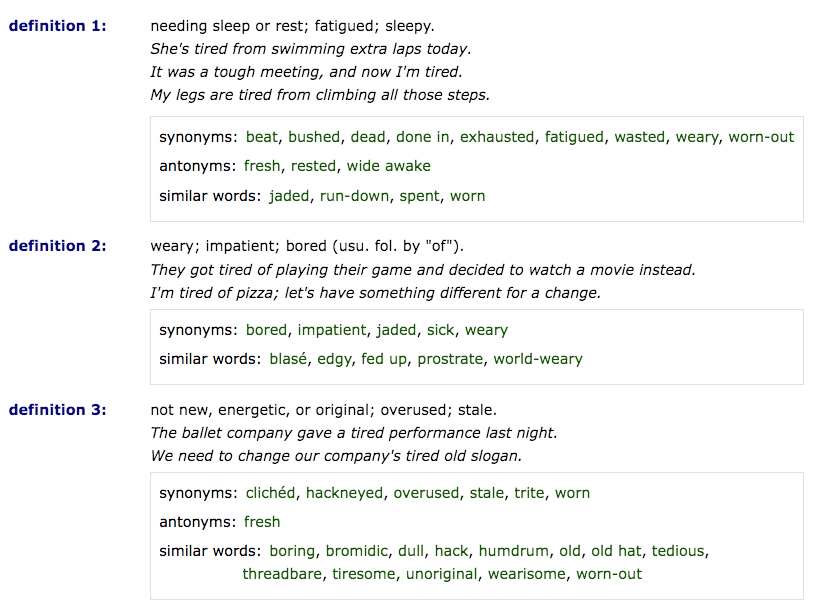
    Being integrated into the dictionary entries means that, if you look up the word “tired,” for example, you will see, in the resulting entry, synonyms, antonyms, and similar words listed right under each individual definition. For example, you’ll see that the definition of “tired” meaning “needing sleep” has synonyms including “exhausted,” “fatigued,” and “weary.” The definition meaning “not new, energetic, or original” (as in “a tired performance”), on the other hand, has synonyms including “hackneyed,” “stale,” and “worn-out.”

    Occasionally when a user asks about the thesaurus, that person is looking at an entry that simply contains no synonyms, similar words, or antonyms.  This can happen because the meaning of the particular word simply does not invite these concepts, or because related words do not meet our criteria to be included in the thesaurus.  What would share the same meaning or be the opposite of a “pencil,” for example?  Is “pen” an antonym for “pencil”?  Is it a synonym? We don’t think it’s either.  (To find words like “pen” that relate to the concept of a pencil, however, one can use our Word Explorer feature.  By clicking on the keyword “art” in the Word Explorer feature for “pencil” and then clicking on the highlighted word “pencil” in the Word Explorer listings for “art,” one can find words such as “brush,” “crayon,” “charcoal,” “enamel,” “pen,” “ink,” and “paint.”  Clicking on the keyword “tool” will also bring up words like “pencil,” “pen,” and many other words denoting implements.)

    Not finding thesaurus information for a particular word can also occur because our projects for adding synonyms, similars, and antonyms are still ongoing, and not every word that deserves this information has it yet.  In particular, words that are derived from other words, such as “paradoxical” from “paradox,” may be empty of thesaurus information because past projects focused on root forms only.  Despite our limitations, our built-in thesaurus has synonym coverage for over 16,000 academic and high-frequency words, and the fact that thesaurus information is matched with individual senses of each of these words rather than just headwords, makes the Wordsmyth thesaurus a particularly useful resource for writers and anyone looking for a better word or a better understanding of a word’s meaning and usage.

  • Wordsmyth Teachers Guide

    Wordsmyth Teachers Guide


    For upper elementary, middle school, and high school teachers

    The Wordsmyth Children’s Dictionary Suite and Wordsmyth Vocabulary Center are designed for upper elementary school to middle school teachers and students. 

    The Wordsmyth Comprehensive Dictionary Suite and Wordsmyth Vocabulary Center are designed for middle school students (and up) as well as for older ESL students at varying levels from beginner to advanced.

    Below are the links to introductory information about Wordsmyth dictionaries and Vocabulary Center:

    Dictionary special feature highlights:

    Teacher Tools are available on both dictionary sites (Children’s and Comprehensive). Teachers can use the tools to manage their classes, create vocabulary lessons, send assignments, and receive reports on students’ performance.

    Below are the links to Teacher Tools help pages:

    You can always find more help information that goes beyond description of the basic Wordsmyth features.


    For K-2nd grade teachers

    WILD, the Wordsmyth Illustrated Learner’s Dictionary, is designed for children in kindergarten through 2nd grade. The following links will give you a quick start.

    To learn more about the individual components of WILD:

    Special feature highlights:

    Help for using the WILD application to its full potential:

  • Lookup by Spanish or Chinese in WILD

    Lookup by Spanish or Chinese in WILD

    To help young learners whose native language is Spanish or Chinese, WILD allows some level of lookup by Spanish or Chinese directly in the lookup box.

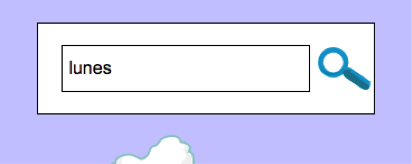
    For example, if you type in the Spanish word “lunes” and click the search button, the equivalent English entry will be displayed:

    The same lookup method works for Chinese support as well.

    Please note:

    1. Cognates in Spanish could trigger a spelling check in English. In other words, when a user tries to type in a Spanish word that has a similar spelling to an English word, the system will display auto-correct suggestions.

    2.  False cognates could also cause some confusion, but we hope that, in WILD, these kinds of words are rare.  

  • right away vs. right now

    Both of these expressions mean “immediately,“ but “right away” means “without delay” and tends to be used in situations where there is fear or worry, in situations where there is really not a moment to lose before some bad thing might happen.  

    We took him to the hospital right away.
    My grandmother said she was coming over in a few minutes, so I had to clean up right away.  

    “Right now,” on the other hand, is often used in angry imperatives, as in:  “Come here right now!”  If one said “Come here right away!” there would only be a sense of urgency implied, not a sense of annoyance. 

    Another very important difference between these expressions is that “right away” can be used for actions in the past or future whereas “right now” really means “right now.”  It wouldn’t make sense to say “We took him to the hospital right now.”  or “When you get to Boston tomorrow, please call me right now.”  These sentences would be illogical and incorrect.  However, both of these sentences would make perfect sense using “right away.”

    Sometimes “right away” and “right now” can overlap.  For example, it would be fine to say either “I have to go right now!”  or “I have to go right away!”  There is still a slight feeling of difference, though.  If we say “I have to go right now,” the emphasis is on the exact point in time when the leaving is necessary; i.e., NOW.  If we say “I have to go right away,” there is a sense of not being able to do some other thing before leaving or not being able to spend any more time doing what one is doing.  “Right now” also tends to be more argumentative, assertive, or insistent in tone.  “Right away” is more simply informative.

    I have to go right now or I’ll miss the bus.
    Oh, I’m so late!  I have to go right now!
    I have to go right away.  My son had a bad fall at school, and I have to pick him up.
    Thanks.  I’d love to stay, but I really have to go right away.

    Just interested in words? Looking for clear dictionary definitions and examples? Join our users and subscribers at wordsmyth.net or kids.wordsmyth.net.

  • few vs. a few / little vs. a little

    few vs. a few / little vs. a little

    The difference between “few” and “a few”

    Both “few” and “a few” indicate a small number of something. However, use of the little word “a” before the word “few” makes a very important difference in meaning.  Basically, “a few” communicates a positive idea concerning quantity, and “few,” without that little word, communicates a negative one.  If you say you have few friends, it sounds a bit sad because you consider the number of your friends to be very small, perhaps near zero.  If you say you have a few friends, the listener is given the impression that, although you may not have many friends, you have some friends at least. It’s probably not a sad situation.  Note, though, that the actual number of friends might in fact be the same. Choice of “few” or “a few” depends on the attitude of the speaker toward the quantity.

    Notice how “yes” and “no” are used with “few” and “a few” in answers to questions.  You can see that answering with “few” goes along with the basic answer of “no.”

    Did the students ask many questions about your presentation?
    No, they asked few questions.  They didn’t seem very interested.

    Did the students ask many questions about your presentation?
    Yes, they asked a few.  Generally they seemed pretty interested.

    Does your brother have pots and pans in the new apartment?
    No, he has few pots and pans, so I’m bringing him some for tonight’s dinner.

    Does your brother have pots and pans in the new apartment?
    Yes, he has a few.  He has enough for tonight at least.

     “Few” without “a” is somewhat close in feeling to “no” and “none.” So, for example, “They made few complaints” gives almost the same impression as “They made no complaints.”  By contrast, “a few” is somewhat close in feeling to “some” or  “a number of.”  It’s a small amount, but it has some significance.  So, for example, “There are a few forks on the table already” gives almost the same impression as “There are a number of forks on the table already.” 

    Note that “very few” intensifies the negative feeling of quantity of “few”: 

    • She made very few mistakes on her exam; in fact, it was almost perfect.
    • There were very few complaints about the service, so the banquet manager was pleased with her staff’s performance.

    In contrast, “a very few” is still on the plus side.  It’s a very small amount, even smaller than “a few,” but it still has some significance.  It cannot be ignored.

    • I’ve told this secret to only a very few people, but I still worry that others will find out.
    • Yes, it’s true that a very few people have complained, but we’re handling the problem now. 

    The difference between  “little” and “a little”

    The difference between “little” and “a little” is exactly the same as between “few” and “a few.”  Although both expressions refer to a small amount of something, “little” is basically a negative expression of quantity (close in feeling to zero) and “a little” is a completely positive expression.  (Both “little” and “a little” are used with uncountable nouns only.)

    • Do we ever go out for lunch?  No, we have little time for lunch so we eat at the office.
    • We have little money left in our savings, so we have to be very careful with our spending now.
    • There is very little gas in the car so we’d better stop and get some before we get on the highway.
    • Yes, I do have a little material left over from my project. You are welcome to it if you’d like.
    • My wife speaks a little Hindi, and it was very helpful when we were traveling in India.
    • The situation looks bad, but I still have a little hope that everything will be all right.

    It should be noted that if either of the expressions “a little ” or “a few” is modified by “only” or “just,” the expressions take on a slightly more negative feeling because these words signify an expectation that there could be or should be more. However, despite the possibility of being modified in this way, the two expressions remain positive rather than negative.

    • I was disappointed that only a few students showed up for my presentation. [Some showed up, but I wish there had been more.]
    • Was there any rain today? Well, I think we had just a little around noontime. [I feel as if it didn’t rain today, but I can’t deny that there was some rain around noontime.]

    Just interested in words? Looking for clear dictionary definitions and examples? Join our users and subscribers at wordsmyth.net or kids.wordsmyth.net.

  • fewer vs. less

    “Fewer” is traditionally used when comparing quantities of individually countable things or people—as for example, when we say “There are fewer shops downtown nowadays,” or “I eat fewer salads in the winter,” or “There were fewer people in the audience than I expected.” “Less” is traditionally used when comparing quantities of things that are considered uncountable, such as “flour,” “water,” “land,” “space,” and “convenience.”  We say “You should use less water” or “This machine makes less noise than the old one.”  

    Many consider it an error to use “less” rather than “fewer” when referring to nouns that are countable.  For example, some might criticize the use of “You bought less bananas this week” or “She has a lot less problems than I do.”  However, the reality is that the word “less” is beginning to take over the function of “fewer,” and many people do not feel that there is anything wrong when one says “I worked less hours last week than this week.”  Still, if you are writing in a formal style or want to sound traditionally “correct” in speaking, it’s probably best to stick with “fewer” if you are referring to countable nouns.

    Just interested in words? Looking for clear dictionary definitions and examples? Join our users and subscribers at wordsmyth.net or kids.wordsmyth.net.