Author: Wordsmyth

  • imply vs. infer

    imply vs. infer

    Imply” and “infer” have a relationship that is similar to the one between “talk” and “listen.”  “Imply” corresponds more closely to the talking side of the relationship, and “infer” corresponds more closely to the listening side. A talker can imply; a listener can infer.

    When you imply something, there is a meaning in what you are saying or projecting that may be understood by someone else but is not being communicated in a direct manner by you.  If you say “The floor is wet,” you may be implying that your listener shouldn’t walk across it.  If you say “I know where you went last night,” your tone may be implying that your listener was up to some mischief or even immoral activity.

    Sometimes, of course, we argue about what we said versus what we implied.  We say, “I didn’t say that!” and the other person says, “Yeah, but you implied it!”  It is possible for us to say something that can be interpreted in a way that we do not intend.  What’s really happening in many of these contentious cases, though, is that the listener is inferring a meaning that we did not intend to imply!

    When you infer something, you are on the receiving side of the communication.  Something is expressed to you, and you are finding inexplicit or hinted at meaning in it, or you believe you’ve uncovered some hidden meaning even if, in fact, it isn’t intended by the speaker.

    It should be said that both implication and inference are absolutely essential to communication.  It would be uncomfortable, difficult, or impossible to actually say everything that we mean when we say something.  Instead, we trust in our listener’s ability to understand what we’re implying or to infer information from what we say.   For example, if we say “My flight leaves at seven.  I guess I’ll set my clock for 4:00 a.m.,” we intend our listener to understand the connection between these two statements, and we don’t even question his or her ability to do so.  What we are not saying but that we trust our listener to infer from the above sentences, among other things, is that the flight leaves at seven in the morning, that the clock is an alarm clock, and that we need to wake up at the set time in order to have time to get to the airport for our flight.

    How would we function if we had to actually say everything we mean?!

    Finally, although the discussion here has focused on verbal communication, it should also be noted that both “imply” and “infer” can be used in other contexts.  Either can be used in reference to other ways that meaning can be signaled indirectly or can be deduced, as the following examples will show.

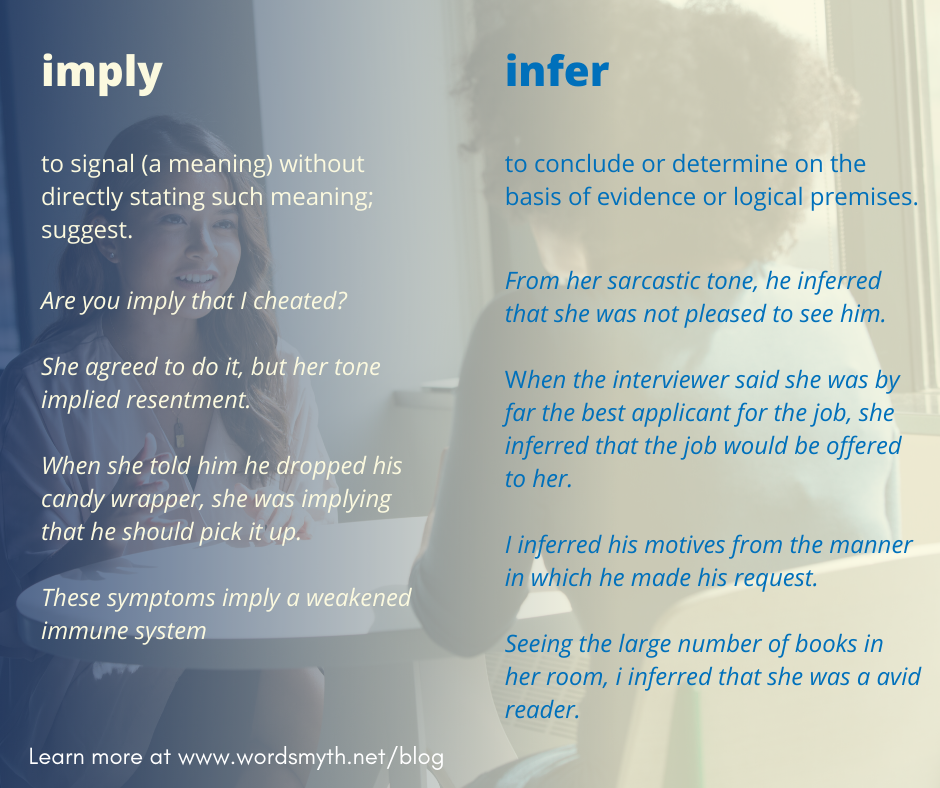
    imply

    to signal (a meaning) without directly stating such meaning; suggest.

    Are you implying that I cheated?

    She agreed to do it, but her tone implied resentment.

    When she told him he dropped his candy wrapper, she was implying that he should pick it up.

    These symptoms imply a weakened immune system.

    infer

    to conclude or determine on the basis of evidence or logical premises.

    From her sarcastic tone, he inferred that she was not pleased to see him.

    When the interviewer said she was by far the best applicant for the job, she inferred that the job would be offered to her.

    I inferred his motives from the manner in which he made his request.

    Seeing the large number of books in her room, I inferred that she was an avid reader.  

    Just interested in words? Looking for clear dictionary definitions and examples? Join our users and subscribers at wordsmyth.net or kids.wordsmyth.net.
  • Introducing WILD, Wordsmyth’s Dictionary for Young Readers and Pre-Readers!

    Introducing WILD, Wordsmyth’s Dictionary for Young Readers and Pre-Readers!

    Wordsmyth is for kids

    The Wordsmyth Illustrated Learner’s Dictionary (WILD) is Wordsmyth’s most exciting, colorful, and interactive dictionary. WILD is geared toward children in Grades K to 2 as well as to young English Language Learners.

    At the core of WILD is an abundantly illustrated dictionary that contains child-friendly, full-sentence definitions and example sentences for approximately 4,000 words.  The dictionary can, of course, be used by looking up a word in the search box, but a child may also explore the dictionary through the four distinct visual environments Wordsmyth has created: the World, the Collections, the Book, and the Picture Dictionary. All the environments are linked with each other in such ways that make it easy and fun to navigate from one environment to another. One may, for example, start by seeing the lobster in the Sea Animals collection, click to learn more about it in the Book, and jump from there to see it in the Ocean setting in the World—or, alternatively, go to see it in the Restaurant!

    WILD’s four visual environments

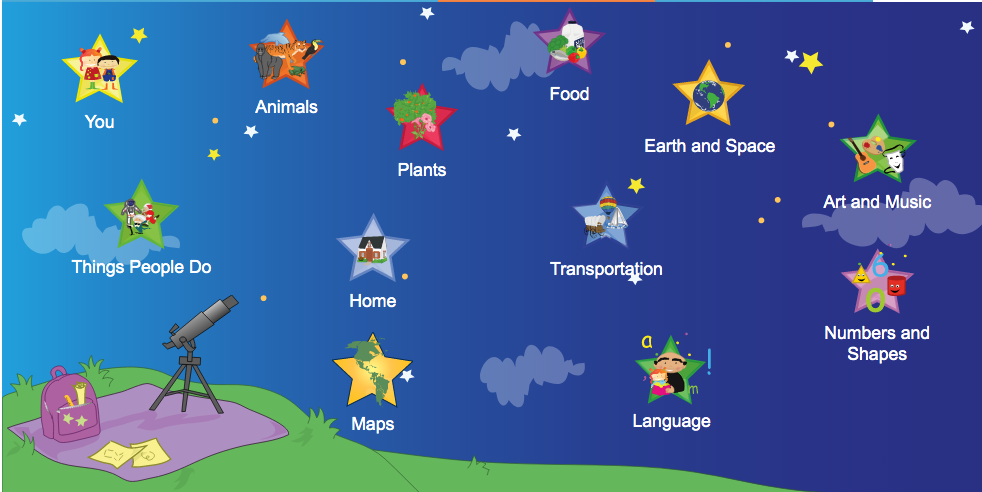
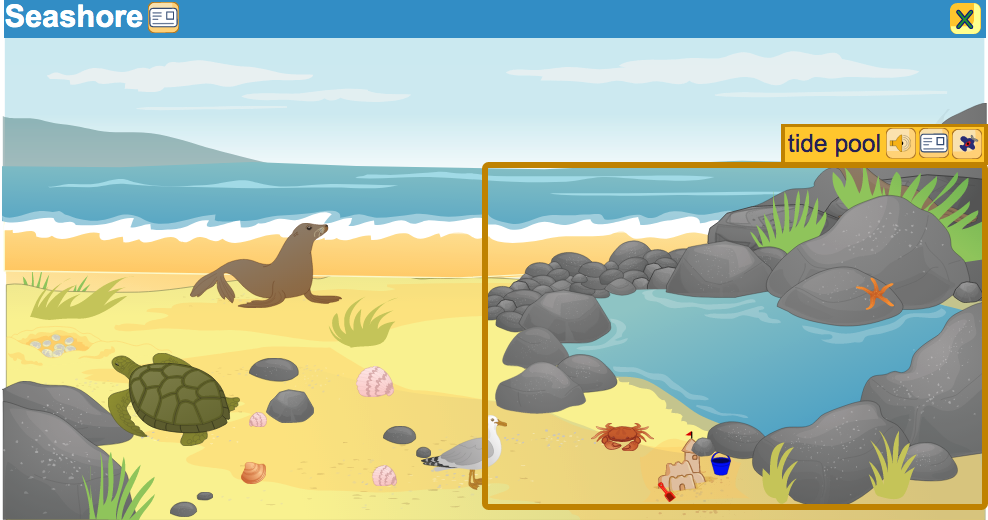
    In the WILD World, children can explore items as they appear in natural and human-made environments.  A child may choose to explore in Nature, seeing what plants and animals exist in a variety of surroundings, such as the Desert, the Seashore, or the Forest; or he or she may explore in the City, looking at what objects and types of people can be found in different settings such as the School, the Restaurant, the Hospital, or the Grocery Store.  In any setting, there are opportunities to explore on different levels.  Once in the Seashore setting, for example, a child can navigate into the Tide Pool or into the Ocean and see what creatures and plants might exist there. 

    Or, once in the Restaurant, a child can zoom in to look at the menu or navigate into the kitchen and open the refrigerator! 

    At any point, a user can see the objects in a setting with or without word labels and with or without Spanish or Chinese translation.  All word labels can be clicked on to access audio pronunciations as well as to link with a word’s dictionary entry.  Once in the entry, one can easily navigate back to the same item in the World.

    The WILD Collections allow children to explore words in categories, viewing artist renderings of hundreds of carefully selected and arranged items.

    The Collections include a wide range of categories and subcategories, such as plants, parts of plants, things people do, people in their jobs, animals, mammals, invertebrates, parts of the human body, actions of the body, emotions, foods, spices, art materials, colors, and shapes.  Included in the Collections is also a collection called Maps, which is where a child will gain access to an interactive map of the world.  From the top level, the World Map, a child can navigate to deeper levels while being able to link at any point to audio pronunciations and dictionary entries for more information on the regions and countries being explored.

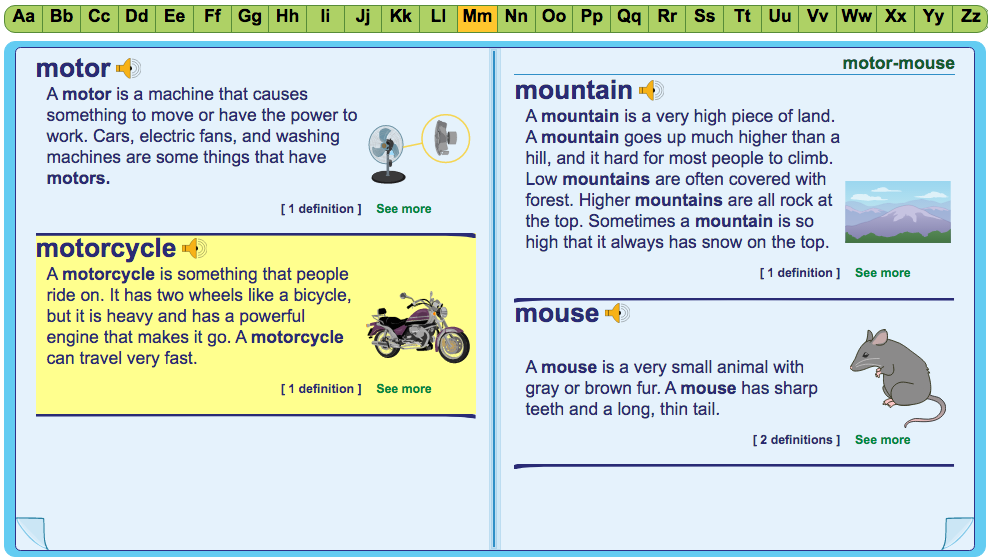
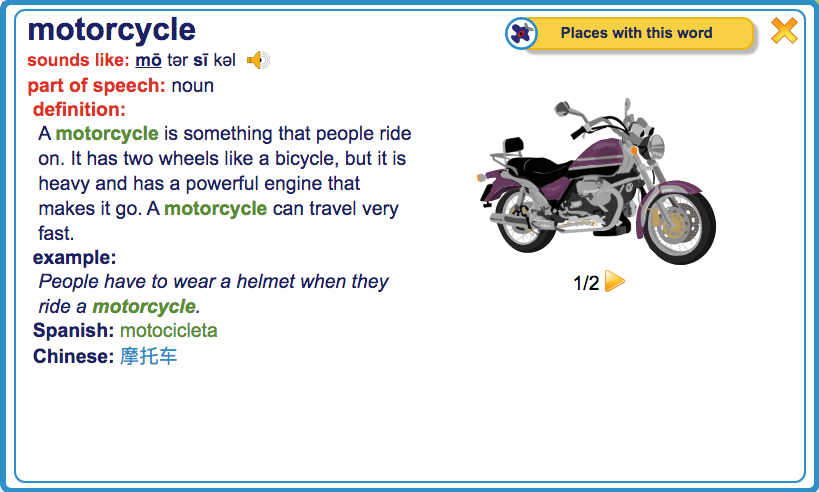
    In the WILD Book, concise versions of the dictionary entries are displayed almost as if on pages of a print dictionary, and clicking on any word will open up its full, expanded entry, which will then allow the user access to any additional meanings of the word, entertaining example sentences coupled with each definition, Spanish and Chinese translations of the word, and any additional illustrations and photos. Text and audio pronunciation, as well as part of speech information, can also be viewed in every full entry.

    The Book environment has been designed not only to look like a print dictionary but to resemble a print dictionary in the way the pages can be turned, allowing a user to browse page by page, looking at illustrations and photographs, and reading definitions of words that catch his or her interest. 

    In addition to the World, the Collections, and the Book, WILD also offers a Picture Dictionary. In the Picture Dictionary, words are defined by their illustration only. The word’s pronunciation can be heard by clicking on the provided audio icon. Each Picture Dictionary word is also linked to the word’s full entry in the Book, as well as to any other WILD environment in which the word appears. For example, from the entry for “snake” in the Picture Dictionary, the child can look under “Other places with this word” and see that the snake is also in the den in the Desert, in the cave in the Forest, and in the Reptiles and Amphibians collection. The child can then choose to go to any one of these places to see the items in these different environments.

    This post merely scratches the surface of what WILD has to offer, but we hope it conveys some of the excitement we feel about this vibrantly-engaging educational resource. 

  • About the Wordsmyth “Word Combinations” Feature

    The Word Combinations feature in Wordsmyth dictionaries displays words that are frequently used in combination with a particular headword. If you looked up “negotiate,” for example, you would be presented with words such as “accord,” “agreement,” “cease-fire,” “compromise,” “contract,” “deal,” “treaty,” and “truce.” You would also see words such as “actively,” “reportedly,” “safely,” and “successfully.”

    The sets of words that you are shown in the Word Combinations feature can help you find a word that is correct or appropriate to complete a particular meaning that you want to express. In addition, the words can help you refine your understanding of the word you looked up by showing you the pattern of general use for this word. For example, it may help to better understand the meaning of “apocryphal” if you know that it combines with words like “legend,” “tale,” “story,” and “account.”

    Seeing the words that combine with your word can also give you a sense of how this word may be differentiated from words with similar meanings. Even close synonyms combine with other words along different lines. For example, the words “obtain” and “acquire” have very similar meanings but combine with words somewhat differently. “Obtain” combines with “approval,” “patent,” “passport,” and “permission,” for example. “Acquire” does not typically combine with any of these but more often combines with words like “assets,” “wealth,” “competence,” “expertise,” “habit,” and “trait.”

    Combinations of words such as are shown in the Word Combinations feature are referred to by linguists as “collocations.” The term “collocation” actually refers to various types of word combinations ranging from fixed phrases and idioms, in which the words always go together in a certain way and cannot be interchanged with other words, to word combinations that occur frequently but are made up of words that can be easily interchanged with other words. The collocations that we display in the Word Combinations feature tend to be closer to the latter type. Most of them are “medium strength” collocations, such as “cool breeze,” “refreshing breeze,” “soft breeze,” and “gentle breeze.” Some of the collocations that we show, however, are “strong collocations” made up of words that seem to cling to each other, such as “commit” and “crime” and “tell” and “truth.” Some of the combinations that the data-gathering tool brings up in addition, such as “social + security” and “right + angle,” represent unique units of meaning in themselves and may also be found as dictionary headwords that have their own definitions.

    Word Combinations is a Wordsmyth subscription feature. If you are not currently a subscriber, try out the feature with a 15-day trial subscription. Then, under “Display Options” near the top of any entry, select “Word Combinations.” At the same time, why not try out our “Word Parts” or “Spanish support” features? The free subscription will also give you access to WILD, the Wordsmyth Illustrated Learner’s Dictionary designed for very young readers and language learners.

  • damp vs. moist

    damp vs. moist

    Damp” and “moist” are words with similar meaning.  They both describe things that contain a small amount of moisture—not so much moisture as to say something is “wet,” but nonetheless an amount that is tangible, an amount that we can physically feel. 

    Although the two words are close in meaning, they are not exactly the same and tend to be used quite differently.  First of all, “damp” often describes a condition that is unpleasant or unwanted (“damp bedsheets,” “a damp basement.” “a damp hotel room”), whereas “moist” more often describes a pleasant or desired condition (“moist skin,” “moist cake,” “moist soil”).  This is not to say that there are no exceptions to these tendencies, but, in general, when dryness in a thing is something we want, then it is not good when it’s damp (“a damp carpet”).  When dryness in a thing is not what we want, then it’s good when it’s moist (“a moist cupcake”).

    It’s also important to note that a “moist” thing is generally a little more saturated with liquid than something that is just “damp.”   Wiping something with a “moist” cloth would leave tiny droplets of water on it, whereas a “damp” cloth would leave no visible droplets.  Something that is “damp” is not completely dry; something that is “moist” is nearly, but not completely, wet.  

    Another interesting difference is that we rarely, if ever, use “damp” to describe something we can eat.  You can say “moist cookies,” but you can’t say “damp cookies.”  Well, you can, but it’s a little hard to imagine why you would!  This is because we generally feel dampness of an object by touching the outside of it, and we’re generally not interested in how the outside of a cookie feels.  With cookies, we’re mostly interested in what’s inside.  Moreover, dampness is something we sense with the outside of our bodies.  It’s not something we sense with the inside of our mouths!

    One last tendency to mention is that “damp” tends to be linked with coldness in our minds, whereas “moist” tends to be linked with warmth or a neutral temperature.  “Moist climate,” for example, would be linked with places that are warm and rainy, as in “the moist climate of the tropics.”  “Damp weather” is associated with places that get abundant rain along with cool temperatures. “Damp weather,” like many other things that are called “damp,” is often considered uncomfortable and something justifiable to complain about.  “Moist weather,” on the other hand, does not seem to be as common a cause for complaint—either that or it is not experienced as frequently by the majority of English speakers.  In fact, the combination tends to be used mainly in weather forecasting rather than in ordinary conversation.  Interestingly, when we complain about warm weather that has some degree of moisture, it is “humid weather” that gets the gripes.

    The following are some of the most common word combinations for “moist” and “damp”:

    MOIST:  moist cake, moist muffins, moist brownies, moist lips, moist air, moist towelettes, moist soil, moist skin, moist eyes

    DAMP:  damp basement, damp cloth, damp laundry, damp cellar, damp weather, damp fur, damp hair, damp room, damp washcloth, damp sheets, damp mop

  • How to add a word that is not in Wordsmyth to your activities

    When you create a wordlist in the Wordlist Maker, you can add more words to the list, even when the word is not in the Wordsmyth dictionaries. And you can use those words in activities.

    Click “Customize” and add the word in the “Add a word” box. 

    You can also click “Preview and Save” and then click “Select/Add words” under the “Customization” menu. This will take you to the page with the “Add a word” box.

    On the Activities page, if you have a wordlist open, you can click “Preview” and this will take you to the Preview page where you can click the “Add/Select words” item under the “Customize” menu, which will take you to the page with the “Add a word” box.

    Since the word you added is not in Wordsmyth, it will be shown in light blue. Since we will not have definitions and examples ready to use in your activities, you will need to click “Customize definition and example” to add your own definition and example.

    In order to use your word in an activity, you need to first add a Part of Speech. Then you can add a definition. And, finally, after you have added a definition, you can add an example sentence. You can do this by clicking “Customize Definition and Example” in the top-right side of the page. Then hover over the 3 dots (…) and select “Add Part of Speech.” 

    In the pop-up box that appears, select a Part of Speech. This is required before adding a definition. 

    If you wish to add a definition, you can hover over the 3 dots after the part of speech you selected and an option to “add a definition” appears. Select this option and a text input box will appear, where you can type your definition.

    After the definition has been added, click “save.”  The definition will be saved in your personal dictionary, for use in your activities.

    If you wish to add an example, hover over the 3 dots after the definition you added and select “Add example.”

    After you add an example sentence and save it, the sentence will be available for use in the activities you make.

  • In addition…. Moreover…, and furthermore…!

    In addition…. Moreover…, and furthermore…!


    All three of these conjunctive adverbs are used to indicate that you have something more to say than what you’ve just said.  They are a little like conversational traffic signs that say “Wait!  I’m not done yet!  I’ve got something more to say on this subject.”  Often, the three expressions are interchangeable.


    JUST ADDING INFORMATION

     “In addition” might be said to be the most neutral and least assertive of the three expressions.  It’s used mainly just to add one piece of information on a subject to another piece of information on the same subject.  “Furthermore” does the same thing, but it is more emphatic in tone.  It sends out a little bit stronger signal to the listener or reader that says:  “Stay with me!  There is more that you need to know!”    

    • The new state park will open next June with numerous hiking trails to explore.  In addition, a boat marina is being constructed at the north end of the lake.
    • All residents are advised to evacuate the building.  Furthermore, they are advised not to return to their homes until city officials say it is safe to do so.
    • India is one of the most populous countries of the world with three official languages and numerous others spoken.  Most of the population are adherents of Hinduism, though there is a large Muslim minority.  Furthermore, a small but significant percentage of Indians are Christians and Sikhs.


    BEING PERSUASIVE

    All three adverbs can be used when trying to persuade the reader or listener of something, to make one’s current argument stronger by adding additional supports.  However, “furthermore” and  “moreover” have a more forceful or authoritative tone than “in addition” and may therefore be preferred for bolstering one’s argument.  In the example below, the argument concerns the need to exercise more.  The second sentence gives two supporting statements for this argument, and the sentence beginning with “furthermore” gives yet another one.

    • It’s clear that we all need to exercise more:  Exercise improves one’s strength and can reduce one’s risk of chronic disease.  Furthermore, new evidence is suggesting that it is important for one’s mental fitness as well.

    The word “moreover” is the most assertive in tone of the three adverbs and may suggest that what follows carries more weight than what the speaker has just said before.  The information in the statement may be something that the speaker feels strongly about or is something that will likely surprise the listener or make a strong impact.  Additionally, the statement introduced by “moreover” tends to contain a different kind of information from what has come before.  “Furthermore,” on the other hand, simply signals that one is about to say something that will give additional support for one’s argument.  It may be information along the same lines or it may be information of a different type.

    • I don’t agree that she’s overrated as a singer.  Moreover, I think you’re just jealous of her talent!
    • I’m not surprised they’re firing him.  His work is substandard, and his attitude is poor; moreover, he’s always late to meetings.
    • There was no way they could have won the battle.  They were outnumbered by thousands of enemy troops.  They were exhausted and demoralized from earlier fighting.  Furthermore, they were insufficiently armed.

    Because of their assertive or authoritative nature, the adverbs “moreover” and “furthermore” tend to be used more often in heated arguments, fiery speeches, and in scolding than the more neutral expression “in addition.”  One can easily imagine hearing “moreover” and “furthermore” during a hard-hitting debate or, say, when a school principal or instructor scolds a group of students for unacceptable behavior.

    • Your deplorable behavior toward this boy will be punished, and, furthermore, you will have to have to apologize both to the boy and his parents.
    • I will accept no more late papers in this class.  Moreover, students who are not in their seats when class begins will be marked absent.

    In speaking, both “moreover” and “furthermore” tend to be pronounced with strong emphasis.  The words are pronounced slightly louder and with higher pitch (on their stressed syllable) than the words coming before or after them.  The expression “in addition” may or may not be pronounced with strong emphasis.

    The three expressions being discussed here can all be used in an extension of the same discussion or argument.  It simply depends on how many additional pieces of information or supports one wants to provide in making one’s point or covering a small topic.  In general, however, whenever “furthermore” is used in conjunction with either or both of the others, it tends to introduce the final element.  In fact, “furthermore,” whenever it is used, tends to bring with it the final piece of information on a subject or final point of an argument.  One can image a lengthy argument that goes like this:

    • Blah, blah, blah.  Blah, blah, blah….  Moreover, blah, blah, blah…  And, furthermore, blah, blah, blah.

    Now that’s a compelling argument!

    Finally, all three expressions share a certain formality of tone. “In addition” and “furthermore,” in particular, have a rather academic or official sound to them.  While all three certainly can be used in informal conversation, they are more often used in relatively formal writing and speaking.  In informal speaking, the expression “not only that, but…” serves the same function as “moreover,” and a strongly stressed “also” at the beginning of one’s sentence can serve the function of any of the three.  The expression “plus” is also gaining ground as an even more informal and emphatic alternative to “also.”

    Just interested in words? Looking for clear dictionary definitions and examples? Join our users and subscribers at wordsmyth.net or kids.wordsmyth.net.
  • Wordsmyth Features: Lookup History

    The Lookup History feature records every dictionary entry a user has recently looked up. Going back through your recent Wordsmyth searches is a great way to keep track of words you’ve learned or inquired about. Forget what a word means? Know the definition but not the word? Check your Lookup History!

    View Lookup History

    You can access your Lookup History from the “My Wordsmyth” menu. To view your Lookup History from a dictionary entry:

    1. In the Lookup History box on the right-hand side of the screen, you will see the last five words you’ve looked up.
    2. Click “See more” at the bottom of the  “Lookup History” box.

    Lookup Search Features

    To make finding old lookups easier, Wordsmyth offers search methods. You can search for words you’ve looked up by checking your searches during a specific time period, looking for the word itself, or finding words you’ve looked up on a specific date.

    Search By Time Period

    You can review your Lookup History over a period of one day, one week, or one month, as well as over your entire search history. If you’d like to browse words you’ve searched over the past week:

    1. Go to “Show words looked up” and click the dropdown menu
    2. Click “last 7 days”
    3. Click “Find”

    Search By Word

    To search for a specific word you’ve looked up:

    1. Go to the “Find a word or date” search bar at the top of the “Look-up History” screen.
    2. Type in a word.
    3. Click “Find.”
    4. The specific word will appear alphabetically in a list of your recently searched words.

    Search By Date

    If you’re looking for words you’d looked up on a specific date:

    1. Enter the date you’d like to search in a month/day/year format (i.e. 05/15/19) in the “Find a word or date” search bar.
    2. Click “Find”
    3. The words looked up on the date you entered will be displayed in the list below.

    Words searched by date are displayed in descending order.

    Clear Lookup History

    When you use the dictionary frequently, you will accumulate searched entries quickly. This makes finding old searches difficult, so it’s helpful to clear your Lookup History sometimes. To do so, click the [Clear] link on the right side of the screen.

    To get started, check out our tutorial video!

    All registered users have access to their Lookup History and search tools. But a free registration only goes so far. Subscribers can search their entire Lookup History at any time. Why not subscribe and make the most out of your Wordsmyth account?

    Want to keep up with all things Wordsmyth? Check out our Facebook, Twitter, and blog. Get in touch with us on our feedback page if you have any questions or concerns.

    Until next time, Happy Wordsmything!

  • Wordsmyth Features: Search Filters

    Wordsmyth Dictionary’s Search Filters focus your dictionary search using specific search parameters. Using Search Filters, you can search through all of Wordsmyth’s assets, including:

    • Entries with images or animations
    • Entries with attached Word Histories, Language Notes, Word Builder features, or Word Parts (roots and affixes)
    • Homophone entries
    • Words of particular parts of speech
    • Word Explorer categories
    • Words at a particular Wordsmyth Vocabulary Inventory (WVI) level
    (more…)
  • Wordsmyth Features: Display Options

    The Display Options menu shows and hides different features in Wordsmyth’s dictionary entry display. This menu is available at the top of every entry and can be used to make changes at any time. 

    (more…)
  • historical vs. historic

    historical vs. historic

    “Historical” and “historic” are obviously related. Both pertain to history or the potential to be remembered in history. However, they rarely overlap in usage. 

    historical

    “Historical” is the most straightforward term. It simply refers to a connection with history.  


    1. of or relating to history or to the past.
      I’m particularly interested in historical subjects such as the causes of war.
      The Boston Massacre was an historical event that took place in 1770.
    2. representing or based upon history.
      Shakespeare wrote historical plays in addition to comedies and tragedies.
    3. based on or relating to the records of history, as opposed to the stories of legend or myth.
      The historical Pocahontas differs greatly from film versions.

    historic

    “Historic” in its most common senses has more to do with importance or significance.  A “historical” museum presents things about history. It might be a modern building recently erected that features exhibits relating to Napoleon Bonaparte.  A “historic” museum is one that has played a part in history itself or has some significance as an old and important structure. A ”historic” museum could be an art museum and have nothing to do with describing events occurring in history.


    1. significant in history.
      The historic Treaty of Versailles brought a formal end to war between Germany and the Allied Powers.
    2. of very great significance or importance and therefore likely to be remembered in history; momentous.
      Today’s opening of the new bridge is a historic event.
    3. established or recorded in the past.
      Historic temperatures for this day show an all-time high of 102 °F.
    4. dating from the distant, or relatively distant, past.
      This historic ship is on display in the harbor museum.
      The residents of the community came together to protect their historic library.


    Just interested in words? Looking for clear dictionary definitions and examples? Join our users and subscribers at wordsmyth.net or kids.wordsmyth.net.