Author: Wordsmyth

  • Teaching kids to be good digital citizens

    Teaching kids to be good digital citizens

    As schools have increasingly moved to internet instruction, teachers are now in greater need of excellent and reliable online resources than ever before. In WILD, the Wordsmyth Illustrated Learner’s Dictionary, they will find some of the best materials to help young children learn and explore in the online world. In addition, with the recognition that children are to an even greater extent using online resources by themselves, both teachers and caregivers will appreciate the guide provided in WILD that can assist them in teaching kids how to navigate the internet safely and respectfully so that they can become “Good Digital Citizens!”

    Go to WILD and click on the Passport in the toolbar to use the interactive infographic. Or click the link below to download the printable PDF version.

  • Coronavirus glossary:  a guide to the meaning of the most common terms

    Coronavirus glossary: a guide to the meaning of the most common terms

    The following is a small collection of terms that have been in the news in connection with the pandemic that is now affecting us all.  These terms can be confusing, and we hope this short glossary will help to clarify the meanings of these items and sort out the puzzling aspects.

    coronavirus

    A coronavirus is technically a type of virus.  The term does not refer specifically to the virus causing the current pandemic, although the term is being used in this way as a shorthand for the term “novel coronavirus,” the specific name of the virus we are dealing with now.  Viruses that have infected populations in the recent past such as SARS and MERS are also coronaviruses.  Coronaviruses are so-named because the outer perimeter of each round virus particle resembles a spiky crown similar in shape to the sun’s corona.  (“Corona” comes from a Latin word meaning “garland” or “crown.”)

    novel coronavirus

    The current virus that humans are grappling with is called the “novel coronavirus.”  The adjective “novel” differentiates this particular, NEW virus from previous coronaviruses.  Typical symptoms of the virus include fever, cough, shortness of breath, and loss of taste and smell.  The virus spreads very easily from person to person through droplets expelled into the air by a person who is infected.  If the droplets are breathed in by another person or taken into the nose, mouth, or eyes in some other way, this new person can become infected.  Currently there is no cure for the disease caused by the novel coronavirus and no vaccine to prevent people from becoming infected.  The majority of people who catch the virus may become ill but will recover on their own, similar to the way many people recover from the flu.  Hospital treatment for the disease focuses on helping patients with severe symptoms to survive while fighting the disease with their own immune systems.

    Covid-19

    The term Covid-19 (or “COVID-19”) refers to the disease caused by the novel coronavirus. “Co” in Covid stands for “corona,” “vi” stands for “virus,” and “d” stands for “disease.” The number 19 refers to the year 2019, the year in which the initial outbreak of the disease occurred. 

    respirator

    In the current crisis, the term “respirator” refers to a type of face mask used to both protect the wearer from breathing in droplets of the virus expelled by someone with Covid-19 and to protect other people from catching the virus if the wearer is infected.  However, the term is most often used in connection with protecting doctors, nurses, and other medical personnel from the possibility of catching the virus from infected patients.  The term “respirator mask” is also used.

    The word “respirator” has another meaning, which refers to a mechanical device.  This type of “respirator” is a machine that assists a patient with breathing.  In this sense, the word is similar to the word “ventilator.”  (See below.)  Currently, the term “respirator” seems to be used exclusively to refer to the protective face masks rather than breathing machines.  The term “ventilator” refers only to the mechanical device.

    ventilator

    A ventilator is a machine used in hospitals to help patients breathe.  Because the coronavirus can cause severe damage to the lungs, ventilators may be required to assist patients in breathing. 

    intubation

    “Intubation” refers to the process of inserting a tube through a patient’s mouth and into their upper respiratory tract so that they can be put on a ventilator.

    PPE

    PPE stands for “personal protective equipment.”  This is equipment that helps protect medical personnel from catching illnesses from patients.  Because the novel coronavirus spreads very easily from person to person, use of personal protective equipment is particularly critical at this time.  PPE typically includes face masks, gloves, goggles, and surgical gowns.  “Face shields” are also PPE.  These are clear plastic shields that extend from the forehead over the entire face.

    epidemic

    An epidemic is an outbreak of a disease wherein many individuals become infected over a wide area.

    pandemic

    A pandemic is a type of epidemic.  It is an epidemic that has spread to various parts of the world.  “Pan” is a word part that means “all.”  The term “Pan-American,” for example, refers to all the Americas—South America, North America, and Central America.  A “pantheon” is a temple dedicated to all the gods of a people.

    community spread

    During the early days of the coronavirus outbreak in the United States, the virus was being seen only in people who had visited other countries where there was an ongoing outbreak of the virus or in persons who had close contact with such people.  However, the virus quickly began to be seen in people who had not been overseas and who had not had close contact with such persons.  The original source of these new infections could not be discovered.  “Community spread” refers to the spread of a disease in a community where the source of the infection is not known.

    asymptomatic

    When a person is asymptomatic for Covid-19, they are carrying the coronavirus but they are not displaying any of the symptoms.  Although an asymptomatic person does not feel sick at all, they are capable of passing the disease on to other people.

  • Wordsmyth Children’s Dictionary Mobile App

    The Wordsmyth Children’s Dictionary-Thesaurus is a thoughtfully-written dictionary–a tool for exploration of words and meanings– designed for upper elementary and middle school students (grades 3 to 8).  The display includes, among other features, audio pronunciations, forms of the headword, definitions, example sentences, photos, and colorful illustrations.   The app can be used with or without an internet connection.

    Child-friendly definitions

    Definitions for the Children’s Dictionary-Thesaurus are written specifically for children, in a clear and uncomplicated style, for native speakers as well as ELLs.  Definitions use a controlled vocabulary and simple sentence structure.  In addition, thousands of easy-to-understand example sentences, photos, and illustrations enhance understanding of the meanings of words and make learning fun.

    Spanish and Chinese support for ELLs

    Wordsmyth Children’s Dictionary provides special support for English Language Learners whose native language is Spanish or Chinese.  All 14,000 headwords in each of their senses have been translated into Spanish and Chinese. In cases where a headword cannot be translated with equivalent words, a liberal translation is provided in addition to a literal one. In addition, every example sentence accompanying a definition has been translated. This gives a child a clear understanding of exactly which meaning the word has in his or her own language and also a strong sense of how it is used in the world and its importance for learning.

    Synonyms, Antonyms, and Similars:  Wordsmyth’s Integrated Thesaurus

    One unique feature of Wordsmyth Dictionaries is the integration of a thesaurus into the dictionary presentation.  Wordmyth’s thesaurus includes synonyms, antonyms, and words that are similar in meaning to the headword. The thesaurus words are matched with individual senses of a word rather than just presented as a “pot of words” under the headword.  In Wordsmyth, synonyms, antonyms, and similar words appear along with their corresponding definitions. For example, synonyms for the headword “hot” referring to high temperature, “hot” referring to spiciness of food, and “hot” referring to an angry temper are matched with and appear along with their appropriate definitions in the entry for “hot.” 

    Another great feature of the thesaurus is that the words are linked with their own entries so that one click on a synonym, for example, will let a child view the meaning of that synonym in that word’s own entry.  Going back to the original entry is as simple as an additional click.

    Word Explorer

    Unique to our Children’s Dictionary is the Word Explorer:  a word-finding and knowledge-exploration feature. It is an index of related words that allows a child to find words connected with multiple topics and to explore whole networks of words and their meanings.  So, for example, under the Topic “Communication,” the keyword “art” is listed. Clicking on “art” leads the child to discover words that describe types of art, people who make art, things used in art, places where art can be found, and many other categories of information relating to the topic. With the help of the Word Explorer, a child can learn new concepts and make new connections among ideas, make many new words part of his or her vocabulary, and start to discover how words are key to an understanding of the world.

    Vulgar words filter

    Our Children’s Dictionary includes words that are essential for children’s vocabulary development—fourteen thousand of them!  However, words that are used primarily to cause offense or are generally considered very offensive in our society are not included in this dictionary intended for children.  Vulgar words tend to be learned through natural exposure, and we feel it is within the province of caregivers and educators to decide when and how to help children shape their view of these words.  For our part, we are more concerned with giving children the necessary words and concepts to succeed in school and to become good readers and communicators.

    If you want to purchase the app for your whole school, it is available with an educational discount through Apple School Manager or Managed Google Play.

  • Wordsmyth Dictionaries

    Wordsmyth Dictionaries

    You may already be very familiar with our dictionaries, but if you’re new to us or want to understand us better, we’d like to give you an overview.  Wordsmyth currently has dictionaries at four levels, with three of the levels found in the Comprehensive Dictionary Suite at wordsmyth.net and the fourth level, Wordsmyth Illustrated Learner’s Dictionary (WILD), at kids.wordsmyth.net/wild.

    Advanced Dictionary

    The highest level of our dictionaries is called the “Advanced Dictionary.” The Advanced Dictionary is suited to the needs of adults and students from middle-school age and up. It currently contains 60,000 headwords, with example sentences for nearly 17,000 words, adding up to a total of nearly 50,000 examples.  Like all of our dictionaries, the Advanced Dictionary has both text and audio pronunciations for all words, as well as thousands of photographs and artist-created illustrations.

    It was for the Advanced Dictionary that the Wordsmyth team developed its integrated thesaurus, a source for synonyms, antonyms, and similar words.  We call it an “integrated”  thesaurus because thesaurus information is matched with individual senses (meanings) of words so that, for example, synonyms for the headword “hot” referring to temperature, “hot” referring to spiciness of food, and “hot” referring to popularity are matched with their appropriate definitions in the entry for “hot.”  The synonyms appear directly under each pertinent definition in the dictionary entry.  There is no need to click to go to a different page to access the thesaurus information.

    Intermediate Dictionary

    The next level down from the Advanced Dictionary is the “Intermediate Dictionary.”   As in the Advanced Dictionary, thesaurus information is built in and matched with particular senses of words.  The Intermediate Dictionary was written for children at the upper elementary level.  The definitions are written with simpler vocabulary and sentence structure than those written for the Advanced Dictionary.  The Intermediate Dictionary contains approximately 14,000 headwords and contains 23,000 full-sentence examples.   Additionally, all the headwords for the Intermediate Dictionary, as well as all the example sentences for headwords, have been translated into Spanish and Chinese.  (Note also that each sense of every headword is individually translated.) These translations are available to our subscribers and appear in the entries when the feature is selected by the user.   (Spanish and Chinese headword translations also appear in the other Wordsmyth dictionaries for these same words.)

    Beginner’s Dictionary

    The “Beginner’s Dictionary” is a dictionary that is geared toward adult literacy and adult ESL.  The Beginner’s Dictionary contains approximately 5000 headwords written in a concise but simple style.  The dictionary contains over 8,000 example sentences. 

    A feature developed specifically for the Beginner’s Dictionary is the Word Builder.  Word Builder displays words that are built on the headword that is looked up.  For example, with the headword “cool,” we list the words “cooler” (a type of refrigerator) and “coolant” in the Word Builder along with a short definition of each of these additional words.  While derivations of headwords (e.g., “coolly” and “coolness”) are listed for entries at all dictionary levels, the Word Builder, developed for the Beginner’s Dictionary, goes a step further, particularly in defining the additional words.

    Comprehensive Dictionary Suite

    The three dictionaries just described–Advanced, Intermediate, and Beginner’s–compose the Comprehensive Dictionary Suite.  Within the suite, the user may easily move up or down between the levels to find simpler or more advanced definitions and example sentences for particular words.

    Wordsmyth Illustrated Learner’s Dictionary (WILD)

    WILD, our introductory level dictionary, is a resource for very young children (grades K-2).  WILD is also geared toward the needs of young English Language Learners, although even adult learners may enjoy and benefit from its highly comprehensible definitions and example sentences.  WILD is accessed at kids.wordsmyth.net/wild, or through our homepage at wordsmyth.net, or by going to the “Dictionaries” tab at the top left of any higher level dictionary page and then clicking on WILD in the drop-down menu.

    WILD contains close to 4000 headwords, all written with simple, full-sentence definitions and kid-friendly example sentences. Text and audio pronunciations accompany all headwords. Words in WILD are richly and charmingly illustrated with artist-rendered illustrations as well as photographs.  Moreover, there are animated illustrations for action verbs and many abstract concepts (e.g., “more,” “part,” “through,” “into”) that are fundamental to an understanding of the language in general as well as to comprehending the writing in the dictionary entries. 

    In addition to the “Book,” where all the standard dictionary information is found, WILD contains the visual environments called “World” and “Collections.”  In World, children view objects labeled in city or nature settings, such as Home, School, the Forest, the Seashore, the Farm.  In Collections, children view things and actions within categories.  In Collections, one might view, for example, types of plants, people in their jobs, sea animals, birds, mammals, outdoor activities, places where people live, emotions, and maps of the world.  In addition to Book, World, and Collections, WILD contains the Wordsmyth Picture Dictionary, which contains a subset of the WILD headwords.  The words are defined here by picture only.  Each word receives audio pronunciation and links to where the word can also be found in other parts of WILD. 

    We hope you enjoy all our Wordsmyth dictionaries!  There is so much to explore!

  • create vs. produce

    create vs. produce

    Both “create” and “produce” have the meaning of making a new thing or bringing a new thing into the world.  One might expect the words to be close synonyms, yet, surprisingly, they do not generally overlap in usage.  The first important difference is that creating tends to require imagination, or something like a divine or magical spark, whereas producing tends to come about through a mechanical process or through natural processes that are part of the way plants and animals function biologically:  Chickens produce eggs; they don’t create them.  You produce a loud noise with your tuba; you don’t, in general, create one.  You can, however, create a new and unique sound with your tuba if you’ve been working on it and exploring different possibilities.

    The second difference is that creation tends to focus on a thing being made for the first time ever, while production often suggests making a new thing in just the same way as similar things have been made before, or it suggests multiple things being made at the same time and in the same way as each other.  Consequently, “create” can sometimes have an inspired, even poetic, feeling to it whereas “produce” often has a more prosaic, mechanical feeling to it:  The task of an artist is to create.  The task of a manufacturer is to produce

    “Create” also tends to be used more often in combination with abstract words than “produce.”  With abstract ideas, “create” is a slightly more formal or academic way of saying “make” or “cause,” as when we say “create a dilemma,” “create a disturbance,” “create an illusion,” “create a nurturing environment,” “create a relaxing atmosphere.”  “Produce” can be used instead of “create” in combination with abstract words, but “create” tends to be the more frequent choice.

    One final, and perhaps most important, difference between these words is that “produce” is rather narrowly focused on the sending out of something into the world, the delivery of a thing as a finished product.  It is not very much concerned with the process of making or putting something together, even if a great deal of effort—even creativity– actually goes into a thing’s production.  “Create” is more focused on the piece-by-piece crafting of something, especially when that process requires imagination or a unique set of actions, decisions, and materials.  Looking at artists and manufacturers again, it should be noted that a very fast-working artist can produce more works of art than a slow-working one.  In this example, “produce” is used because the focus is just on the putting out of finished products.  On the other hand, a manufacturer can create a design for a new product.  In this example, “create” is used to focus on the process of putting together a new and unique thing and to suggest the use of thought and imagination going into that process.

    create

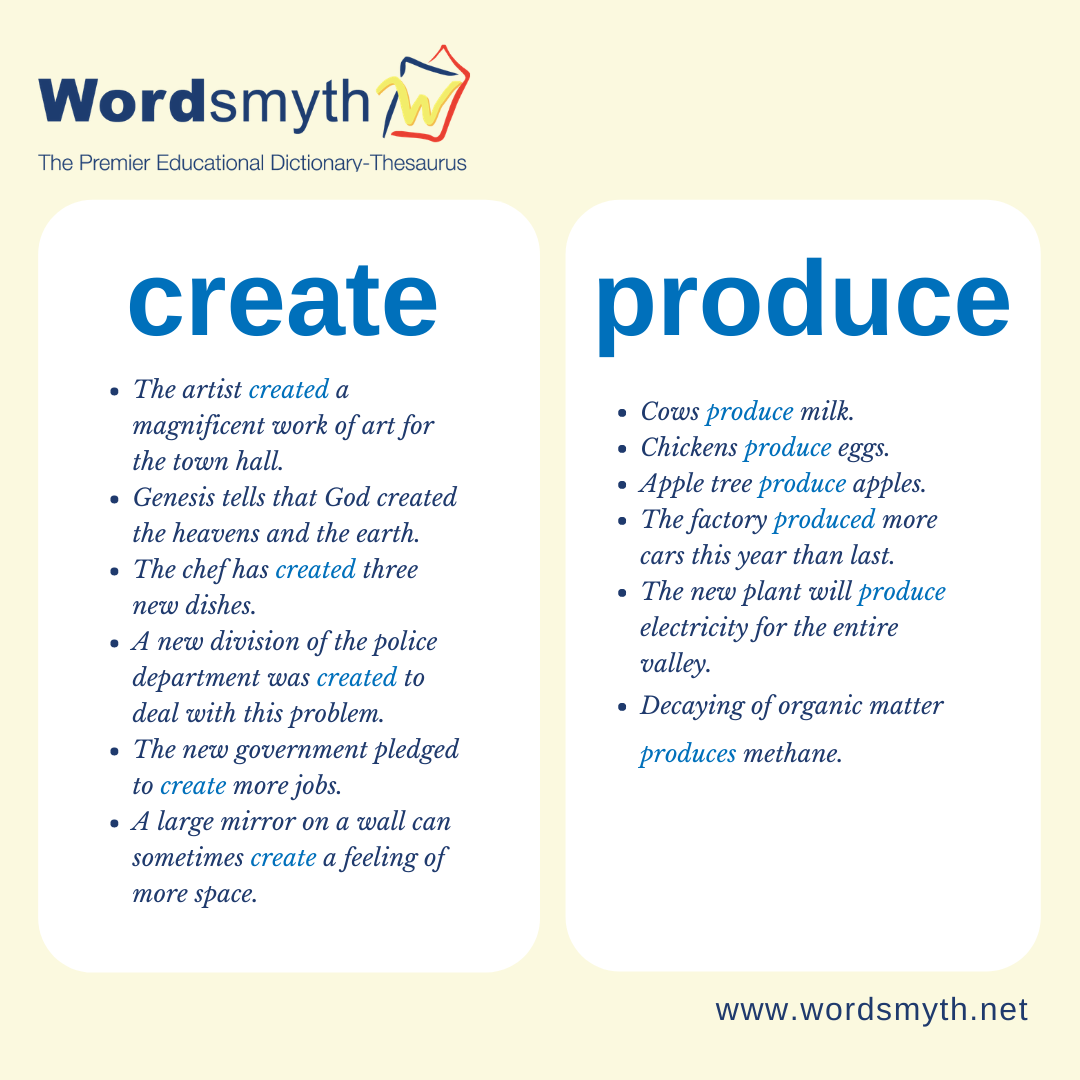
    • The artist created a magnificent work of art for the town hall.
    • Genesis tells that God created the heavens and the earth.
    • The chef has created three new dishes.
    • A new division of the police department was created to deal with this problem.
    • The new government pledged to create more jobs.

    produce

    • Cows produce milk.
    • Chickens produce eggs.
    • Apple trees produce apples.
    • The factory produced more cars this year than last.
    • The new plant will produce electricity for the entire valley.
    • Decaying of organic matter produces methane.

    Just interested in words? Looking for clear dictionary definitions and examples? Join our users and subscribers at wordsmyth.net or kids.wordsmyth.net.

  • What does the “unsaved” icon mean?

    When you edit an existing word list but didn’t click the “preview and save” button, you will see this button next to your list in “My Word Lists.”

    It means that we noticed you made some changes but you didn’t directly confirm the changes. To be cautious, we saved your changes temporarily, just in case. The icon is to remind you to make a decision.

    So, if you go to “preview,” you will see your options: discard the changes, or save them.

    Clicking on either of the buttons will bring the green check mark back. Your word list will now be good to use with any activities.

  • What are collocations?

    In recent years, Wordsmyth has offered a feature called “Word Combinations” that lists words that typically combine with the headword that one has looked up. A more technical term for “word combinations” is “collocations.” The notion of collocation refers to the tendency of words to be located in close proximity to certain others; that is, where you find one word, you often find a certain other word or particular group of words.  Where you find “logical,” for example, you will often find the word “solution,” “conclusion,” or “explanation.”  Two or more words that are found together with a relatively high frequency are called “collocations.”

    Here is a simple test of your knowledge of some typical collocations in English.  See if you can guess some of the words (“collocates”) that most frequently follow or precede the listed words.

    1. a loyal      ___________

    2. an ancient ___________

    3. a nasty     ___________

    4. _________  a crime

    5. _________  a scheme

    6. _________  a role

    7. break a      __________

    8. propose a  __________

    9. offer a       __________

    If you said “fan” and “customer” for “loyal,” you determined two of the most frequent collocates for that word.  If you said “commit” for “crime,” you found the most frequent collocate by far.  The most common collocates for all the other words are listed below.*

    For many adult native speakers, especially those who have had a lot of exposure to written language, it can be a fairly simple task to predict what words typically follow or precede others.  This is, after all, the basis of many word games and the reason that old television game shows such as Password, Match Game, and Family Feud were able to be successful.  However, learners of a language, whether they are young native speakers or adult second language learners, cannot always predict what words tend to go together or need to be used together in order to sound native and “correct.”  English speakers do not generally say “do a crime” or “perform a crime,” for example.  They say “commit a crime,” “carry out a crime,” or “perpetrate a crime.”   Even highly literate native speakers do not always know what verb is the most appropriate for a certain subject in a sentence or what kind of object is used with a certain verb.  Is it acceptable to say that havoc arises, for example (yes!) or that something assuaged one’s worry? (yes!)

    Listing high-frequency collocations is a method that some dictionaries are now using to help users decide what words may go together appropriately in their own speech and writing.  Collocations can be helpful in another important way as well.  By seeing what kinds of words are frequently paired with a certain word, one can get a closer idea of that word’s meaning and a sense of what context the word is used in.  In this way, one can better decide if it is truly the right word for one’s purpose.

    One problem that learners of a language constantly face is the choice between synonyms.  The words “acquire” and “obtain,” for example, have basically the same meaning, and, in many contexts, they are interchangeable.  And yet these words are not used in exactly the same way.  We don’t usually say “acquire feedback,” or “acquire a divorce.”  For these objects, we generally use “obtain.”  By the same token, we don’t typically say “obtain a habit” or “obtain an understanding.”  By seeing the collocates of the two words “acquire” and “obtain,” we can see that “obtain” tends to be used more often when an outside source is involved and when there is not much emphasis on a process that the subject goes through or undertakes.

    Knowledge of collocation also allows for a certain level of predictability in the processing of language that one hears, thus easing the burden of catching the sounds of individual words with one’s ears.  Whereas non-native speakers are often straining to hear every sound that comes out of the mouth of their interlocutor, native speakers can limit the possibilities of what a speaker may say next because of their knowledge of what words typically follow others.

    The exploration of collocation is relatively new within the areas of language teaching and lexicography.  It has been greatly advanced, however, by the ability to search large electronic corpora for examples of frequent combinations of words.  Until recent years, lexicographers have focused largely on the precise meanings of individual words and have given less attention to how words combine with others and how individual words are distinct from other, similar words.  The presentation of collocations within headword entries is an advance that should be very helpful, not to mention of interest, to learners at all levels.

    __________________________________

    * 1. loyal: friend, fan, customer, following

    * 2. ancient: civilization, city, ruin, rite

    * 3. nasty: gash, bruise, habit, surprise

    * 4. crime: commit, perpetrate

    * 5. scheme: devise, develop

    * 6. role: play, assume, define, perform

    * 7. break: law, heart, record, rule, spell, monotony, deadlock

    * 8. propose: plan, tax, compromise

    * 9. offer: congratulations, condolence, rebate, discount, reassurance

  • aesthetic vs. ascetic

    aesthetic vs. ascetic

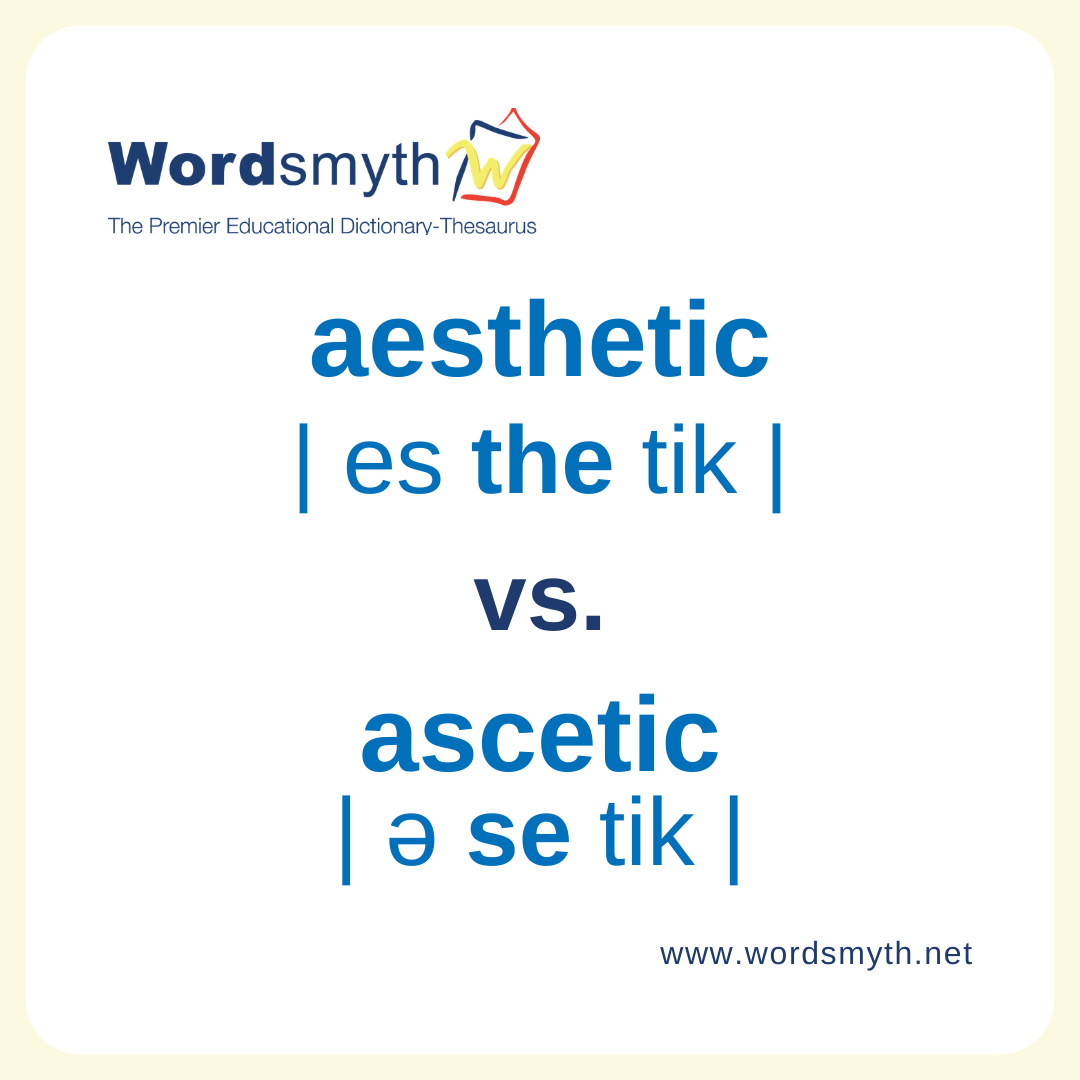
    aesthetic |es the tik|
    vs.
     ascetic | ə se tik|

    These words have similar pronunciations and spellings, but quite different meanings.  The word “aesthetic” –with the “th” sound in the middle–has to do with beauty, so if you’re talking about beauty or the arts, “aesthetic” is probably the word you’d want to use rather than “ascetic.”  “Ascetic” refers to self-denial, self-discipline, and austerity.  It’s a word often used when referring to the monastic life or something similar to it.

    aesthetic:  of or relating to beauty or to the study of beauty and its forms.
    Her aesthetic sensibility was offended by the gaudy decor of the banquet hall.
    Each culture has its own aesthetic traditions.

    ascetic:  rigorously simple and disciplined; austere; self-denying.
    The nuns lead an ascetic life in the convent.
    It was necessary to adopt an ascetic way of life during the war.
    Their new stepfather imposed an ascetic regimen on the family.

    It’s also easy to confuse “aesthetic” or “ascetic” with “acetic,” which refers to acid or vinegar.  Besides the difference in meaning, the pronunciation of “acetic” has the “e” vowel sounding like the “e” in “bee,” whereas the “e” sound in the other two is like the “e” in “pet.”

    Just interested in words? Looking for clear dictionary definitions and examples? Join our users and subscribers at wordsmyth.net or kids.wordsmyth.net.

  • Wordsmyth Vocabulary Inventory (WVI)

    An example of a WVI word in the Wordsmyth dictionary

    Headwords labeled with a number from 1 to 5 belong to the Wordsmyth Vocabulary Index (WVI). The WVI is a list of what we consider to be the 10,000 most important academic vocabulary words. They are grouped into five levels of difficulty, with level 1 words being the least difficult and level 5 the most difficult. The five levels correspond approximately to five grade-level bands:

    • level 1 grades K-2
    • level 2 grades 3-6
    • level 3 grades 7-9
    • level 4 grades 10-12
    • level 5 grades 12+

    The WVI words can be viewed alphabetically at the Search Filters page (under the Search Tools menu). The WVI words were selected by analyzing the Educator’s Word Frequency Guide, which provides grade-specific data on word frequency for words taken from a 17-million-word corpus of texts used in K-12+ education. Words used across the curriculum were given precedence over domain-specific vocabulary. This general academic vocabulary corresponds with the “Tier 2 words” emphasized as important in the Common Core State Standards for literacy. Additional established vocabulary resources, such as Coxhead’s Academic Word List (AWL), Elfriede Hiebert’s Word Zones, and the Corpus of Contemporary American English, were also consulted in order to both narrow down and validate our initial reservoir of vocabulary words.

  • Defining Words in WILD: Descriptive Definitions

    Definitions for the Wordsmyth Illustrated Learner’s Dictionary (WILD) are written in what is called a “descriptive,”  or “explanatory,” style.  This type of defining uses full sentences as opposed to the sentence fragments traditionally used in dictionaries and is a style that is well-suited to the needs of young readers and language learners.

    Because many of the words in WILD are nouns, a large proportion of the definitions are simply of the form “An A is a B”—“A garden is a place where people grow flowers, fruits, or vegetables,” for example.  However, many of the definitions in WILD are written in a format that is unique to descriptive defining; that is, they define by using the headword in an initial clause beginning with “If” or “When”  (e.g., “When you gather things…) and describing in the clause that follows the communicative impact of using that word (“….you bring them together into one place.”)

    Defining “cozy” and “growl”

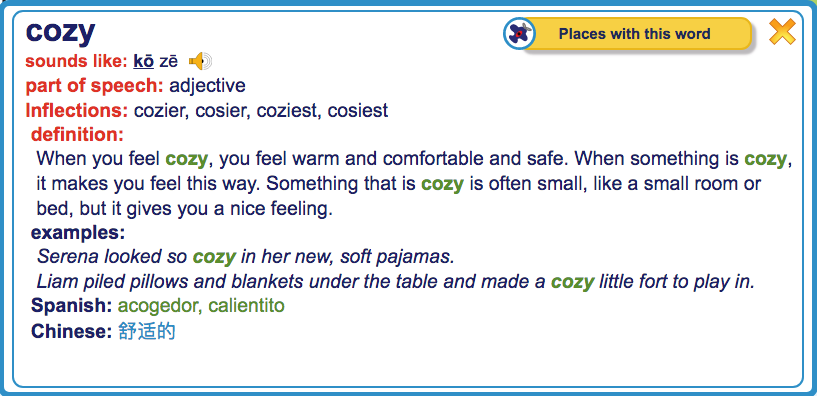
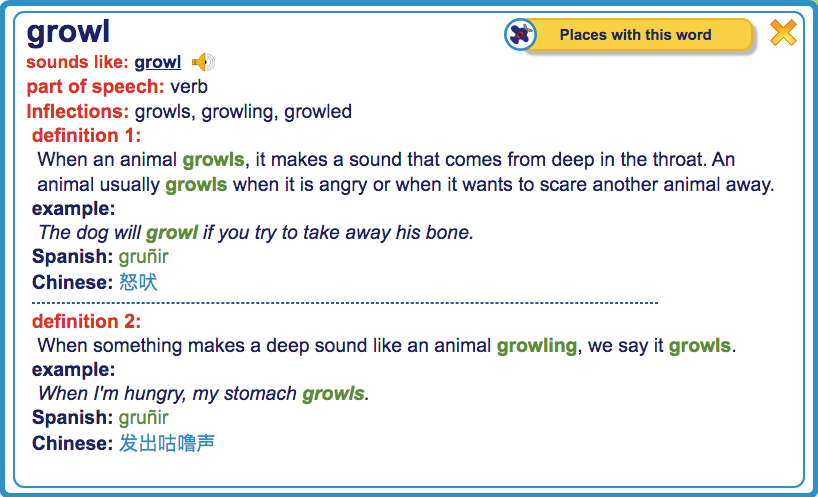
    To define the word “cozy,” for example, we begin with the clause “When you feel cozy” and finish with the defining information: “you feel warm and comfortable and safe.”  Similarly, to define the verb “growl,” we begin with the clause “When an animal growls” and end with the defining information: “it makes a sound that comes from deep in its throat.”

    Less is not always more in dictionary writing for kids

    In defining words for young children in WILD, we have taken an attitude that does not generally characterize dictionary writing.  While lexicographers typically aim for conciseness in defining, we don’t operate under the assumption in WILD that less is always more.  In fact, we’ve taken the attitude that more is more, as long as what is contained in the definition field is simple and useful.  We believe that even full-sentence, descriptive definitions can still be remarkably opaque and incomplete in describing meaning, and we want our users to understand the meaning of the headword described and even enjoy the experience of grasping it through reading.  To this end, we very often go beyond the core defining sentence and add more information that we hope will make the meaning clear and make the experience of reading the definition both enlightening and entertaining. For “cozy,” for example, we give a sense of what kinds of things make us feel cozy. For “growl,” we explain why an animal might growl. This kind of information is often what truly brings the meaning of a word home for the reader.