Category: News & Announcements

  • Wordsmyth News

    Wordsmyth News

    First 1000 words for young learners

    Our new educational game app—WILD WORD LEARNER—is now available in Apple’s App Store and in Google Play. Included in the app are close to 1000 carefully selected words from WILD spread over 12 great topics. The app is free with the first 4 topics (over 200 words) preloaded. It’s a perfect game for your kindergarten or first grade class—both for learning new words and for having fun!

    The app’s thoughtful illustrations and animations will help young learners grasp the meaning of words at a glance. The audio pronunciations will create and strengthen the link between the sound of each word and its meaning. For more advanced learners, the simple but descriptive full-sentence definitions and examples will get them started in reading for meaning.

    A more expansive resource for word-learning is, of course, our interactive WILD dictionary itself. It can be used alongside the app or as the next step once your students have mastered the 1000 words presented in the app.

    This month’s highlight: teaching resources contributed by our teachers

    We often receive requests for new features from our users. Sometimes, users simply find creative solutions by using Wordsmyth resources with other online tools. The highlight of this month is a Youtube video created by Ms. Michelle Austin. In this video, she demonstrates how she uses Wordsmyth content to create a Kahoot! Check it out!

    Also, check out our newly updated Vocabulary Center, with more activities. And don’t forget that we have WILD for K-2 and our Children’s Dictionary for upper elementary school students.

    Working together. Have any questions? We’ll try to answer them here. Your requests, feedback, and creative ideas will help us to improve our resources and tools. Contact us and share your ideas with the Wordsmyth community.

    Word Awareness

    Our mission is to increase word awareness, and to enrich our relationship with words and their meanings.  We believe this is crucially important in education and in life. But often it isn’t clear why or how words can be so important. Do they really deserve more than a dutiful effort to memorize new words and meanings?   

    In an Edutopia article, Rebecca Alber offers three quotes as reminders of the importance of vocabulary study:

    • Vocabulary is the best single indicator of intellectual ability and an accurate predictor of success at school. — W.B. Elley

    • Because each new word has to be studied and learned on its own, the larger your vocabulary becomes, the easier it will be to connect a new word with words you already know, and thus remember its meaning. So your learning speed, or pace, should increase as your vocabulary grows. — Johnson O’Connor

    • We think with words, therefore to improve thinking, teach vocabulary. — A. Draper and G. Moeller

    Searching for inspiration: Please send us your favorite quote about words and vocabulary.  We’ll share the results in our next Newsletter.

    Thank you!

    The Wordsmyth Team

  • Wordsmyth Newsletter

    Wordsmyth Newsletter

    Get your Teacher Tools ready for the new school year!

    As schools are set to begin this new year, Wordsmyth invites you to try out the beta version of our new Teacher Tools. It’s easy to set up. With the Teacher Tools, you can manage your students and classes, give vocabulary assignments, and receive reports on student vocabulary growth.

    As you use the Teacher Tools, please share with us your experience and feedback. We hope to release the official version of Teacher Tools next year. With your help, the new version will provide a better user experience for you and your students. Thank you in advance!

    First 1000 words for beginning learners–Introducing WILD Word Learner

    Wordsmyth is proud to announce a new app, WILD Word Learner, for young learners K to 2. This is the first app in a series of vocabulary game apps for beginning learners. With close to 1000 carefully selected words in total, users can play games matching the sound of a word with its image. The next in the series calls for matching a spelled word with its image, and the third app calls for matching a word’s sound with its spelling. The app is free and comes loaded with a generous number of free wordlists. Additional wordlists that are purchased can be used in all game apps in the WILD Word Learner series.

    The app is a companion to the Wordsmyth Illustrated Learner’s Dictionary (WILD), but it is not a replacement, as WILD contains a great many more words and features. Please subscribe to Wordsmyth to fully utilize the rich content in WILD, as well as to take advantage of our general subscriber features.

    WILD for PreK-2 Vocabulary learning

    The Wordsmyth Illustrated Learner’s Dictionary (WILD) is organized into four sections that facilitate children’s vocabulary learning in two ways: (a) learning new words for concepts the child already has, and (b) learning new concepts and new words that add new ways of organizing the child’s thinking.  During the crucial early years, this process changes children’s understanding of how meanings work — their concept of definition. WILD’s unique organization reflects the challenges involved in these changes and provides the resources a child needs to move among the new words and new concepts.  Each component of WILD focuses on a particular type of word and concept learning. The components of WILD — and the word learning focus for each of them — are:

    1. PICTURE DICTIONARY: for word-object naming;
    2. WORLD: for thematic relations among things in their usual environments;
    3. COLLECTIONS: for topical relations (“loose categories”) and taxonomic categories;
    4. BOOK: for an alphabetical organization of words, outside of their connections with the world.

    Read more…

  • Wordsmyth Newsletter

    Wordsmyth Newsletter

    Set up Teacher Tools for the new school year

    Our users have told us that setting up student accounts is one of the places where the most friction occurs in trying out new educational software tools. We want to make the process of using our Teacher Tools as easy as possible. So we have taken two steps to make your life easier. First, we have implemented SAML (Security Assertion Mark-up Language) for schools using this technology for data federation, identity management or single sign-on (SSO). If your school uses single sign on service with SAML, teachers and students can use their school account info with Wordsmyth Teacher Tools. Read the help document to learn more about SAML setup.

    Second, we are also exploring possible integration with Google Classroom, Canvas, and other learning systems. . Please let us know what Learning Management System your school is using, And please help us understand your specific needs in student account management, so we can decide which classroom integration we should prioritize.

    Vocabulary learning through reading support

    From users’ feedback, we realized that some users have difficulty understanding and making full use of our Wordlist Maker. So we have updated the Wordlist Maker, adding help information on the page and a linking to a Wordlist Maker User Guide. We have also improved the algorithm for wordlist extraction.

    The Wordlist Maker can automatically extract vocabulary words from any text. There are two types of words that support reading and vocabulary learning. First, readings on many topics contain low frequency words that students are less likely to know. And some of them are important to the topic of the text. We call these “Challenge Words”. Second, the Wordsmyth Vocabulary Inventory was developed from an analysis of The Educators Word Frequency Guide. The WVI identifies Academic Vocabulary words and sorts them into 5 levels. These words are frequently used in educational texts across many different topics, rather than being related mostly to a particular topic.

    • Challenge wordlist: Pre-reading: Research suggests the value of going over those words before reading. Reading the text will help to reinforce the word knowledge students acquire from pre-reading review. And your students will be able to enjoy a smoother reading experience, without being interrupted by having to look up words.
    • Academic vocabulary (WVI) wordlist: Practice and assess these vocabulary words before and after reading. They will be important tools for learning content across the curriculum. You can help students improved their vocabulary through reading and improve their reading through vocabulary.

    Vocabulary Notes & Quotes

    Here is a quote from one of the more important books about teaching vocabulary: Isabel L. Beck, Margaret G. McKeown and Linda Kucan Bringing Words to Life: Robust Vocabulary Instruction 2nd Ed., The Guilford Press, 2013.

    “A rich vocabulary supports learning about the world, encountering new ideas, enjoying the beauty of language. A rich vocabulary enhances an interview, allows one to see the humor in wordplay, shores up what an individual wants to say, and, especially, wants to write. It is clear that a large and rich vocabulary is the hallmark of an educated individual. Indeed, a large vocabulary repertoire facilitates becoming an educated person to the extent that vocabulary knowledge is strongly related to reading proficiency in particular and school achievement in general.”

    In this edition of our newsletter, we’d like to invite all of our users – especially teachers – to tell us about your interest in vocabulary. For some people, “vocabulary” may mean a weekly challenge to learn the meanings of new words, making reading less of a burden. For others, “vocabulary” may mean learning words important for a new job – opening the doors to a new profession or career. And some may want to focus on the deeper meaning of the most important words in our language – perhaps kindness or joy, justice or forgiveness, love or solitude. All of these are possible ways to relate to “vocabulary”.

    We hope to hear from you about your interests in words. Write to support@wordsmyth.net and your thoughts may appear in one of the future editions of this newsletter.

  • Wordsmyth newsletter

    Wordsmyth newsletter

    Teacher tools beta testing

    Here’s the great news! We have completed the first version of our Teacher Tools, with the basic functions needed to manage student accounts and classes, create and assign vocabulary lessons, and review vocabulary reports. However, this current version of our Teacher Tools lacks the finishing touches of “user experience” design. That’s where you come in. We would like to ask you to participate in our design research and help us to work out the best user experience for you. Since you and your students are receiving a free subscription to Wordsmyth resources, we hope this is a fair deal – a win-win arrangement.

    Learn more about Wordsmyth Teacher Tools

    New vocabulary words added in our dictionary database

    In the academic year 2020-2021, we’ve updated our dictionary database to include Covid pandemic related vocabulary words, in addition to our regular update based on the requests from Wordsmyth users, including both language learners and educators.

    Here are a few sample entries you might check it out:

    Word limit in Wordlist Maker has been expanded

    At users’ request, we’ve increase the limit of words in a wordlist from 50 to 100 words. We understand each user has their own unique way of learning vocabulary or managing their students’ assignment. A large list gives users more flexibility to accommodate various learning habits and strategies. While a very long list might be desirable for making glossaries, it can make some activities, like the games or quizzes, very hard to navigate. So you can create both short and long lists on the same topic.

    Learn more about Wordsmyth Wordlist Maker

  • Wordsmyth’s online teaching resources

    Wordsmyth has always been a resource for online learning, but with so many K-12 teachers engaging in online instruction during this difficult time, we would like to offer a guide to Wordsmyth’s plentiful tools that can help out with the challenging task of teaching children remotely.

    For Grades K-2

    WILD, a rich and unique online resource with an interactive visual world, provides a charming and engaging means for children to learn both about words and about the real world. It even contains an interactive world map and short descriptions of all the world’s countries. Very young students can safely and enjoyably explore the WILD site by themselves, or they can use it in classroom activities with a teacher.

    For an overview of what WILD is and has to offer, we invite you to take a look at our introductory description of WILD on our blog. And for help in getting started using WILD with your class, check out our Quick-Start Guide or watch our WILD demo video. You can also download teaching materials and activities in pdf from the WILD site. Again, as WILD is a safe and easily navigable site for children, you can also have your students simply go to WILD and start exploring online.

    As you begin to use WILD and encounter more and more of its features, you may wish for further help or suggestions. Our collection of WILD supporting documents will be there to help guide you along your way. This collection of information on WILD will always be accessible on our blog under the category “WILD: Wordsmyth Illustrated Learner’s Dictionary.”


    For Grades 3-9

    Wordsmyth’s Children’s Dictionary is designed for upper elementary and middle school students. Like the WILD dictionary, the Children’s Dictionary is also well-suited to the needs of young ESL students. Click here to learn more about the Children’s Dictionary.

    Wordsmyth recently published its Children’s Dictionary app on both Android and App Store. This app can be used online or offline, which will accommodate the needs of students without consistent internet access.

    If you have a school or teacher subscription, you can assign vocabulary word lists for your students to practice online with our vocabulary center activities.


    For high school and college students

    Our comprehensive dictionary suite contains three levels: advanced, intermediate, and beginner. The linked levels support advanced students and struggling students alike, as users can, with one click, access simpler or more sophisticated definitions and example sentences for words they’ve looked up. The unique leveled structure also provides the best support for older or more advanced ESL students.

    In the comprehensive dictionary suite, users will find readable definitions on an uncluttered page, thousands of highly instructive example sentences to clarify the meaning and use of words, synonyms and antonyms, audio pronunciation, and thousands of photos and colorful illustrations. There is also access to glossary, quiz makers, and games in the vocabulary center. Below are links to descriptions of some additional unique features in our dictionary suite that you may find helpful for your students:

    Wordsmyth’s Student & ELL Dictionary app is now available on the App Store and Google Play. The app provides the full set of features of our Comprehensive Suite for better user experience on mobile phones or tablets. Once downloaded, it will always be available for you and your students even without internet. Check out the full app description.

    Follow us on Facebook, Twitter and Instagram for Wordsmyth Word of the Day and more information about our online teaching resources.

  • Wordsmyth Word of the Year 2020: social distancing

    Wordsmyth Word of the Year 2020: social distancing

    We are proud to announce Wordsmyth Word of the Year 2020, selected by the votes of members of the Wordsmyth community.

    Here are a selection of the comments from our users who voted for the word social distancing.

    This is a common theme – what most people must do or do not want to do. And truly feel! How social distancing impacts our whole society and world is key to what is happening- causing many economic, health snd mental social  effects. All or most of the other terms were here before, have various meanings and will last after the pandemic. A missing term is pandemic –  plus the term is new in 2020. The others are not. 

    I personally would have chosen the word “triggered” to represent 2020, but since that was not an option, I picked social-distancing. This word/term went from zero to worldwide household use this year. Not only does it apply physically, but here in the USA, after so many people let their unfiltered, true colors fly on social media regarding many of the other nominees on this list (Quarantine, patriotism, racism, climate change, as well as politics) many of us have had to figuratively and mentally socially-distance ourselves from more than a few acquaintances.

    When I first heard “social distance” used, I thought it was a crazy, made-up, politically-correct way of normalizing the bureaucratic handling of COVID-19 and the life-altering restrictions and control that surprised us. Now, I use it regularly because these changes—mask-wearing and the six-feet rule—have indeed invaded my life, and it’s the best word I know to communicate the absurdity of this new normal.

    It’s added a significantly new and odd importance to our lives. That’s why I’ve chosen this word . Maybe , it’ll be one of the most radical changing word that humanity has ever seen in its history so far.

    Although several other words have taken on significance this year, they are generally familiar and could be or have been applied to several years. I did not choose “essential worker” or “contact tracing.” Both have meanings specific to 2020, but contact tracing, while not familiar to most people, existed before 2020. Essential workers has become a noteworthy category in 2020, but still seems fuzzy and context-specific. As a number of people have argued, what is “essential” work depends on who is using the term. By process of elimination, I chose “social distancing” as a term that, I believe, was coined for the pandemic (though maybe not), that has a very clearly defined meaning, and that represents a substantial burden and painful experience of 2020.

    “Social distancing” describes a type of community behavior, now formally recognized, and recommended, by all governments seeking to slow or stop the spread of COVID-19. It applies to people of the world who appreciate, either by government education, or knowledge gained during life events, that keeping a minimum distance between people limits the transmission of viruses between them. As far as I know, this combination of English words had not been used before the year 2020, or before the start of the current pandemic. It describes a behavior, which to many people is instinctive during influenza and common cold outbreaks. Formal and widespread floor marking as a means of encouraging social distancing is, to my knowledge, a first in tangible signs to remind people of a newly named community practice.

    “Social distancing” received the largest number of votes of the 10 words that were nominated as WOTY 2020 candidates. Here is a chart showing how they ranked, based on the votes of our community:

    To recognize everyone who participated. we made a word cloud using all the comments we received, including those we voted for other words.

    Thank you very much!

    We’re looking forward with hope to the new year – 2021!

  • Progress update on WOTY 2020

    Progress update on WOTY 2020

    The Wordsmyth educational mission is to foster awareness of how words work in communication, and our WOTY nominations this year have drawn attention to the way words work in society.  This has been such an extraordinary year—bringing many new words and concepts to our attention—that Oxford Dictionaries couldn’t choose one word as their word of the year.

    We are pleased with the responses to our nomination of 10 words. But if you haven’t voted yet, please vote soon. Our voting period ends on Dec. 15, 2020.

    When you see some of the comments people have made, you will want to add your voice. So… here is a selection of the comments supporting the choice of each of our WOTY nominations.

    climate Change

    It is a perfect metaphor for a too-often conflictual relationship between science and politics. Scientists make measurements and say “Watch out, the climate is changing”;, then predict possible outcomes based on current mathematical models. Politicians project scientists’ recommendations onto their electoral base and then, depending on the magnitude of the estimated loss of consensus, become either stark negationists or vociferous supporters.

    contact tracing

    I chose this word because i’ve been quarantined twice this year so i’ve been out of school almost as much as i’ve been in school.

    essential worker

    Our media and educational system often praise people who have jobs that are powerful, even if they don’t make a significant contribution to society. For example, people who inherit wealth or Wall Street stock traders often make millions of dollars without having significant knowledge, moral virtue, or a valuable skill. Workers who have knowledge, virtue and skill often go unrecognized and unappreciated, because they don’t have power. Calling them “essential” can make us more aware of this injustice.

    Furlough

    Thousands of working people have been in furlough in this Covid-19 year.

    Hero

    Heroes make many selfless decisions and sacrifices to protect others. “Ordinary people” now find themselves living in uncertain and dangerous times among the pandemic and the political landscape of division. Trusting instincts and science, unsuspecting people have stepped up to become front-line healthcare soldiers, vaccine volunteers, quarantined nursing home residents, essential workers (grocery shoppers, tradespeople, small business owners, etc.), First Responders, neighbors, friends and family members who social distance, wear a mask, and patronize threatened local small businesses, are the heroes of 2020.

    Patriotism

    The real patriots have come out to support the country and not destroy and loot it.

    Quarantine

    So many people have been quarantined or know someone who has been this year due to the pandemic (which would have been my first choice for WOTY).

    Racism

    It is at the heart of many of our problems including higher COVID-19 mortality rates for Blacks. There is a lack of understanding about what ot is and how it operates, particularly at the systemic level. It drove protests across the country both on the Left (against it) and on the Right (for it, though they’d deny that). A lot of people think it’s an overt act and not a way of life or way of thinking.

    Social distancing

    Although several other words have taken on significance this year, they are generally familiar and could be or have been applied to several years…. I chose “social distancing” as a term that, I believe, was coined for the pandemic (though maybe not), has a very clearly defined meaning, and that represents a substantial burden and painful experience of 2020.

    Other words on this list reflect the unique stress the Covid pandemic put on the world, but this introduced a new concept we are all acutely aware of now.

    Structure

    Saying that “structural” change  is needed points to deeper changes than just changing attitudes or even policies. We have begun to talk about changing our institutions, not just our policies – and hopefully making them more “democratic”. There are Republicans and Democrats who want more democracy.

  • You are invited to participate in choosing Wordsmyth Word of the Year 2020

    You are invited to participate in choosing Wordsmyth Word of the Year 2020

    We were first to include you!  In 2018, Wordsmyth launched the first participatory Word of the Year (WOTY) process.  There are a number of organizations that announce WOTY selections each year — including most of the major dictionaries of English.  Different criteria are used to select a WOTY, depending on the internal deliberations of the organization.  The Wordsmyth process is different. We want to involve our users in the WOTY process each year. And we want to make the discussion of WOTY candidates an interesting and educational process. 

    Everyone can participate — students and teachers, friendship and work groups, and families can all take up the discussion of what words have been most important in 2020.  Sometimes these may be definitional discussions – when the changing meanings of a word become significant. For example, among this year’s nominations is the word “racism,” whose meaning garnered much attention this year.  Or there may be significant importance in the discussion of which word to use in discussing some part of our society and culture. For example, some states with conservative constituencies who are skeptical of “climate change” have been searching for other terms to use in applying for financial relief from the damage from recent storms.

    Our 10 nominations! This year we are launching our participatory WOTY selection process by presenting our nomination of 10 words that have been significant in this most unusual and challenging year.  Some of these words have been noted already in our “About these words” blog posts. (See “contact tracing” and “essential worker”)  We have nominated words with attention to four criteria:

    1. The word is significant in important events or movements, raising important questions about our cultural values and beliefs.
    2. The meanings or uses of the word have been discussed in various cultural media, fostering public awareness of the importance of the word and its uses.
    3. The word is open to multiple interpretations, inviting dialogues about their meanings.
    4. The questions raised are of interest and value in the pursuit of lifelong education.

    If you are a teacher, we would like to provide some activities to get your students excited about picking a Word of the Year.

    Don’t forget to review our nominations in detail, and vote for Wordsmyth Word of the Year 2020.

  • ReadWorks vocabulary widget powered by Wordsmyth

    ReadWorks vocabulary widget powered by Wordsmyth

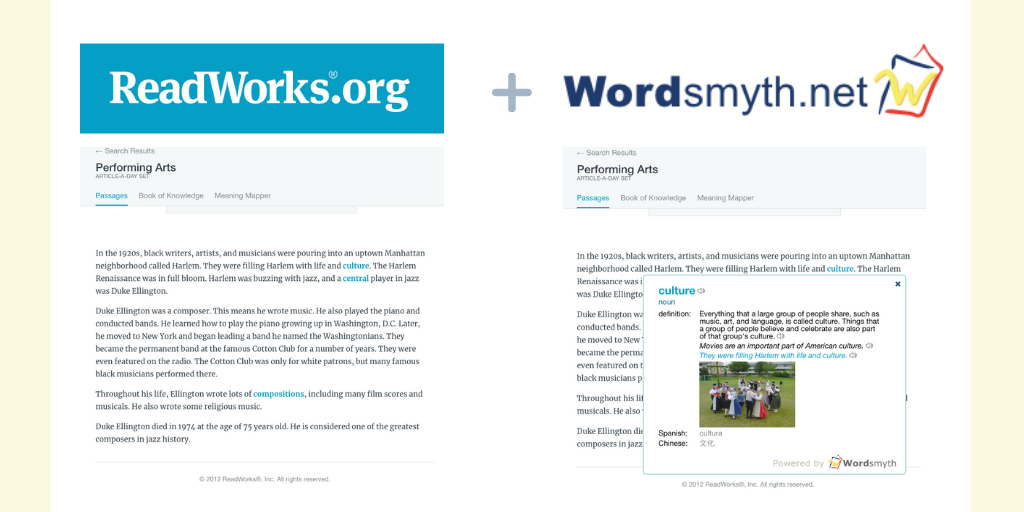
    Working in partnership with the acclaimed ReadWorks reading program, Wordsmyth is powering the new “ReadWorks Vocabulary Widget,” now live at www.readworks.org.

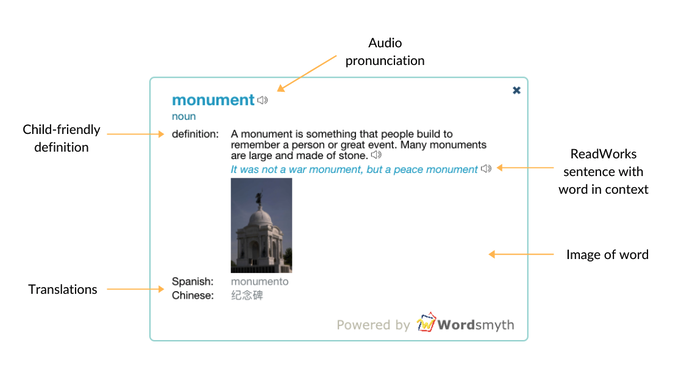
    The new vocabulary widget is automatically available for students to use during reading on the ReadWorks site. ReadWorks pre-selected vocabulary words appear in bold and in blue in their reading passages, and students can click on any of these vocabulary words to open the widget. From there, they can listen to a human-voiced audio pronunciation of the word, see images and varying word forms, and read a child-friendly Wordsmyth definition aligned to how the word is used in the reading passage. Translations of the word into Spanish and Mandarin Chinese are also provided.

    Learn more about the ReadWorks vocabulary widget powered by Wordsmyth on the ReadWorks help page.

    Using your own text in the Wordsmyth Vocabulary Center

    If the idea of adding a vocabulary learning component to a text of your own choosing appeals to you, you can get good results by coming to the Wordsmyth Vocabulary center. Here, you can:

    • extract vocabulary automatically from any text to create vocabulary lists
    • use your vocabulary lists in Wordsmyth activities for practice and assessment
    • save and share your word lists with your students or learning partners

    If you have any questions, read more about Wordsmyth Vocabulary Center.

    The Wordsmyth widget travels anywhere

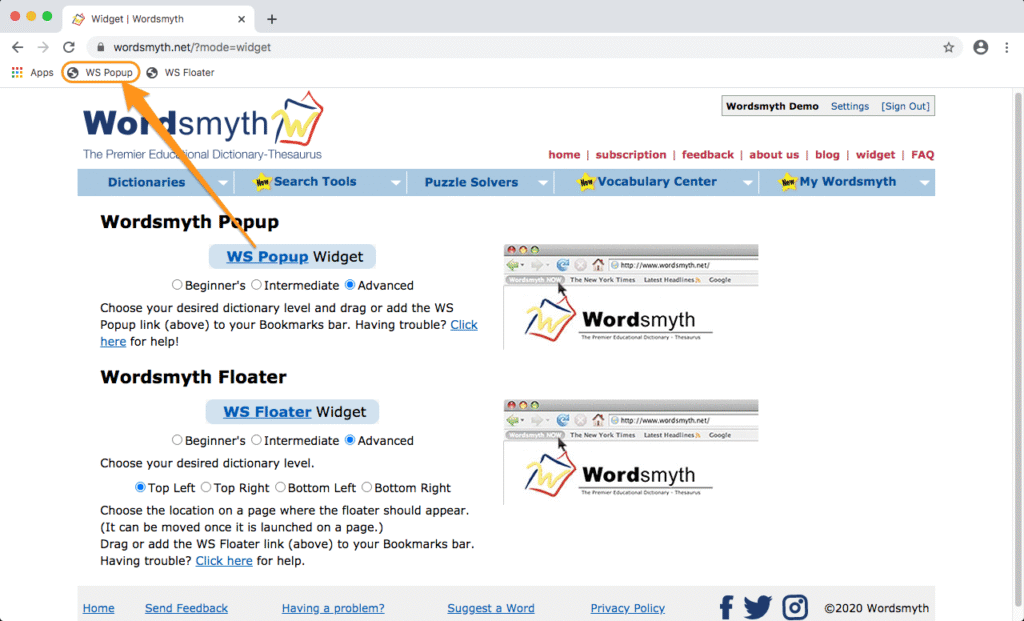
    Wordsmyth’s own vocabulary widget, available from its website, allows you or your students to look up words on any web page with any browser. If you are using ReadWorks, your students can use the Wordsmyth widget to look up words other than the ReadWorks pre-selected ones. (You can even compose or paste a text of your own in Google docs and have your students use it with our widget.) Simply drag and drop our widget icon to your browser toolbar from our widget page. Then click on words you want to look up while reading. It’s easy, and it’s free!

    If you have any questions, read more about Wordsmyth’s free widget.

  • WILD has gotten a great update and a new look!

    WILD has gotten a great update and a new look!

    Yes! As part of our recent update, we’ve adopted a new logo for WILD. In addition to the logo change, we’ve made many improvements to the dictionary that will make it even better at supporting the online education of learners in grades K to 2. We are aware that teaching young children online can be extremely challenging. With our recent update, we hope to make that task not only easier but a bit more fun.

    More illustrations and animations

    We’ve added a whole host of new illustrations and animations to WILD. Check out the new Parts of a Flower collection, for example, or the expanded Weather collection—complete with the sound of thunder! Discover our new set of World Maps showing geographical features such as rivers, mountain ranges, and seas. And take a look at some of our new animations for action verbs in the Language collections to see a sample of newly enriched illustrations in the WILD interactive learning environment.

    Improved navigation system

    Part of the uniqueness and beauty of WILD lies in the connections between its four environments:  World, Collections, Book, and Picture Dictionary. A child may, for example, start by seeing the spider inside the Den in the Desert setting (or inside the Barn in the Farm setting), click to learn more about what a spider is in the Book, and jump from there to see it in the Insects and Invertebrates collection among its fellow creeping and crawling animals. Navigating between these different environments is not only fun for children but allows them to quickly and easily expand their knowledge set for a word while building up the memory store they have for it. Navigating in WILD has always been simple, but our current update has made it even smoother and more intuitive.

    Subscription to WILD offers more than you think!

    As a stand-alone Wordsmyth product, WILD offers tremendous value to the user—and our new update has added even more to that value—but did you know that when you subscribe to WILD, you also get full access to all of Wordsmyth’s upper level dictionaries and vocabulary tools? This includes, among other resources, its Children’s Dictionary, which was written for upper elementary students and includes Spanish and Chinese translations for all its words and example sentences. This is a truly extraordinary value!

    Educators, please check out our Educational Group Subscription options. With subscription, your young students will have direct access to all of WILD’s features without the hassle of registration and logging in. It couldn’t be simpler!