Tag: word parts

  • Word Parts III: Intermediate level suffixes

    Word Parts III: Intermediate level suffixes

    The suffixes in the following list are extremely common suffixes but some have fairly specialized meanings. The suffixes “-ish,” “-en,” and “-less” derive from Old or Middle English. The rest derive from Latin or Greek.

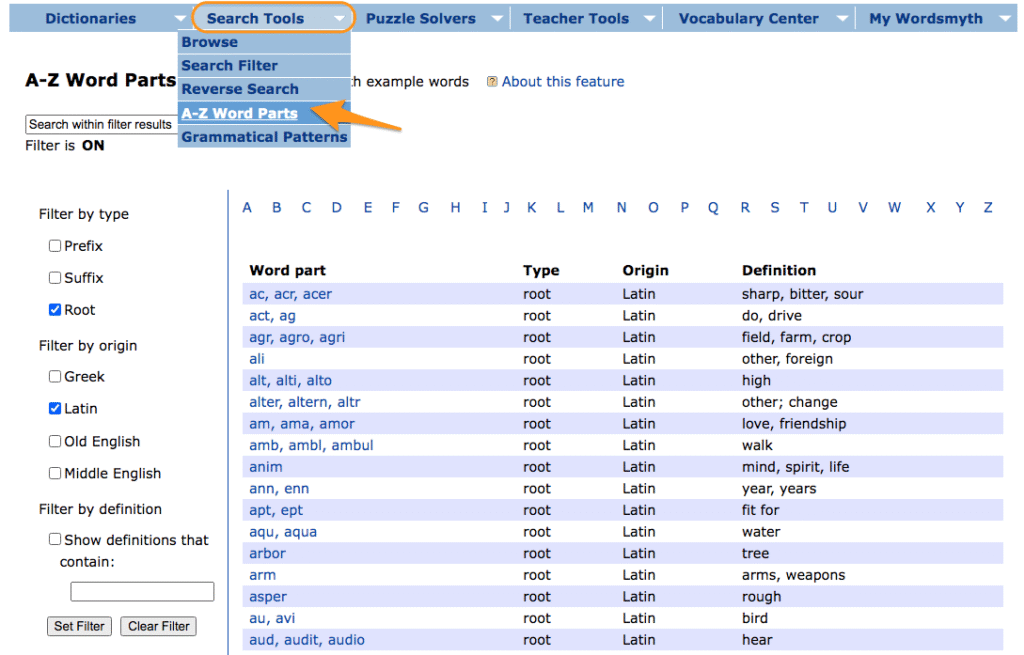
    Additional example words for each suffix in the list below can be found by going to A-Z Word Parts under Search Tools in the Wordsmyth dictionaries, filtering the list there for “Suffixes,” and browsing through the list. One may also use the search box on the A-Z Word Parts page to search the list for a particular suffix. Click here to learn more about how to use our Word Parts database.

    suffixmeaningexample words
    -lessMiddle English adjective-forming suffix that means withoutendless, fearless, wireless
    -ance, -ence Latin noun-forming suffix that means state, quality, or act of;
    The suffix -ance is usually attached to whole English words, whereas -ence is usually attached to roots: compare eloquence and acceptance
    acceptance, admittance, residence, science
    -al Latin adjective-forming suffix that means pertaining tocultural, dental, manual, universal
    -istGreek noun-forming suffix that means person who does or believes in; Many words ending in -ist have a corresponding abstract noun form ending in -ism, and many have a corresponding adjective form ending in -ic (realistic, artistic).artist, chemist, dentist
    -itis Greek noun-forming suffix that means inflammationappendicitis, arthritis, poliomyelitis.
    -logy, -ology Greek noun-forming suffix that means study of, science of; written work; structure or principlebiology, ecology, geology
    -enOld English verb-forming suffix that means to cause to be or become or havedarken, enlighten, strengthen
    -fyLatin verb-forming suffix that means make, cause to be, becomeclarify, justify, satisfy
    -ize, -iseGreek verb-forming suffix that means to turn into or cause to becivilize, immunize, recognize
    -ous, iousLatin adjective-forming suffix that means full of, characterized bygracious, joyous, spacious
    -icsGreek noun-forming suffix that means science, study, or practice of; properties of; practices pertaining toeconomics, physics, politics
    -ishOld English adjective-forming suffix that means of, resembling; somewhatchildish, ticklish, foolish
    Download, save or print as PDF

    See the full list of roots, prefixes, and suffixes in the A to Z Word Parts feature at wordsmyth.net.

    See also:
    Word Parts I: basic roots
    Word Parts II: basic suffixes
    Word Parts IV: basic prefixes

    Learn more about the Wordsmyth word parts database and how this unique feature can be used in facilitating vocabulary learning and teaching.

  • Wordsmyth’s Word Parts Database

    Wordsmyth’s Word Parts Database

    The importance of learning Word Parts (roots, prefixes, and suffixes)

    Studying word parts equips us to do the following:

    • Identify the meaningful elements that make up words.
    • Learn the characteristics of roots and of affixes, their origin, meaning, and grammatical function.
    • Guess (or recall) the meaning of unfamiliar words from the clues given by word parts.
    • Recognize the relationship among words that share a common root or affix.
    • Recognize patterns among changing word forms (e.g., -cept, -ceive).
    • Improve spelling by gaining awareness of the internal logic of words.
    • Increase vocabulary, cultivate morphological awareness, and have fun discovering some of the interesting ways the English language works.

    For a general introduction to the terms and concepts used in our Word Parts database, see this downloadable pdf . Access to the Word Parts feature comes with your Wordsmyth subscription or a 15-day free trial.

    Three ways to view the Word Parts data

    1. Dictionary entries:

    More than 8000 Wordsmyth dictionary entries now display information about the word parts that make up the headword. In the new Word Parts section of the entry, the headword is broken down into its roots and affixes.

    Each significant word part is identified, and its origin, type, and meaning are provided. The user can also view here a list of other example words containing the word part and jump to those words’ dictionary entries to explore further. “More about this word part” notes explain in more detail how particular affixes combine with bases to form words.

    abstain wp

    2. A-Z Word Parts Page:

    In addition to the Word Parts feature appearing in individual dictionary entries, where the composition of a word can be studied in the context of looking up a particular word, the user can search, sort, and browse more than 600 roots and affixes on the A-Z Word Parts page. This page can be accessed from the Search Tools menu.

    3. Search Filters:

    Finally, for a list of all the words in the dictionary that contain word parts information, the user can go to the Search Filter page (under the Search Tools menu), select “Word parts information” under “Entries with special features,” and click “Set filter.”  This takes the user to a page that displays the list of words in an alphabetical, browsable format. 

    Word Parts Data in the Word Explorer Children’s Dictionary

    Users of the Word Explorer Children’s Dictionary have these same three modes of access to roots and affixes information but with the example words limited to the headwords in the Children’s Dictionary. To maximize flexibility, there are links to the complete Word Parts Database from any point in the Children’s Word Parts data. In the case of roots and affixes that have no example words in the Children’s Dictionary, the word part and information about it can still be found in the Children’s Dictionary A-Z Word Parts look-up. 

    See also:
    Word Parts I: basic roots
    Word Parts II: basic suffixes
    Word Parts III: Intermediate level suffixes
    Word Parts IV: basic prefixes

  • Word Parts II: basic suffixes

    Word Parts II: basic suffixes

    Suffixes are word parts that are added to a root to create a word (e.g., “dent” + “-al” = “dental”) or to a root word to create a new word (e.g., “soft” + “ness” = “softness”). Suffixes often change a root word’s part of speech and sometimes they make a significant change in the meaning too. For example, the suffix “-less” changes a noun to an adjective and also changes the meaning a great deal. Compare “tooth” and “toothless,” for instance! Some suffixes add grammatical information to a root word without changing the part of speech. The past tense marker “-ed” is an example of this type of suffix. “Talk” and “talked” are both still verbs despite the change in forms.

    The suffixes listed below are very basic suffixes that, when added to a root word, change its part of speech. In this list are included a number of suffixes—“-y,” “-th,” “-ly,” and “-ful”—that come from Old English. As the suffixes become more specialized in their meaning, or if they tend to combine with more sophisticated words, they are more likely to derive from Latin or Greek.

    Additional example words for each suffix in the list below can be found by going to A-Z Word Parts under Search Tools in our dictionary, filtering the list there for “Suffixes,” and browsing through the list. One may also use the search box on the A-Z Word Parts page to search the list for a particular suffix. Click here to learn more about how to use the Wordsmyth Word Parts database.

    Rudimentary suffixes:

    suffixmeaningexample words
    -ationLatin noun-forming suffix that means the act, process, or result ofeducation, translation, vacation
    -ion (tion, sion) Latin noun-forming suffix that means the act, process, or result ofaction, permission, confusion
    -er, -or, -arLatin noun-forming suffix that means a person or thing that doesdriver, actor, computer, liar
    -ableLatin adjective-forming suffix that means capable of being, doing, or undergoingadorable, movable, drinkable
    -abilityLatin noun-forming suffix that means ability to do, be, or undergocapability, reliability
    -mentLatin noun-forming suffix that means act, process, or instance ofmovement, agreement, measurement
    -fulOld English adjective-forming suffix that means full ofbeautiful, successful, useful
    -nessOld English noun-forming suffix that means state or quality offitness, kindness, business
    -th Old English adjective- and noun-forming suffix that means in the position in a series indicated by the base numberfourth, fifth, sixth
    -y Old English adjective-forming suffix that means characterized by; full of; tending tochewy, itchy, lucky, messy
    -anLatin adjective- and noun-forming suffix that means 
    in adjectives: from (a place) or pertaining to or following (a figure or school of thought);
    in nouns: person or thing from (a place) or associated with (an activity or school of thought).
    American, European, historian
    Download, save or print as PDF

    See Word Parts I: basic roots

    See also:
    Word Parts I: basic roots
    Word Parts III: Intermediate level suffixes
    Word Parts IV: basic prefixes

    Learn more about the Wordsmyth word parts database and how this unique feature can be used in facilitating vocabulary learning and teaching.
  • Word Parts I: A handy list for introducing Greek and Latin roots to your students

    Word Parts I: A handy list for introducing Greek and Latin roots to your students

    As educators, we are all aware that learning words parts, particularly Greek and Latin roots, prefixes, and suffixes can help students guess the meaning of new words as well as help them recall the meaning of words that they have previously been exposed to.  Such learning can be of vast benefit to vocabulary acquisition. In addition, learning suffixes, such as the Latin suffixes “-ness” and “-ment” and the suffix “-ly” from Old English, can help students understand the grammatical meanings attached to words and see how different forms of words are related to each other.

    As you may know, Wordsmyth has a word parts database integrated within its dictionaries. The Word Parts feature is displayed within relevant dictionary entries and is designed to support both native-speaking students and English Language Learners in their understanding of roots and affixes and to help them make use of word parts information to expand their vocabulary.  The word parts data as a whole can be viewed by looking under Search Tools in our dictionary and clicking on A-Z Word Parts. Here you will find a comprehensive, alphabetical listing of roots and affixes that is searchable. (Word Parts can be accessed with your Wordsmyth subscription or with a 15-day free trial. Don’t forget to turn on the feature in your settings.)

    Below is a special list we’ve created from information in our word parts database that teachers may find helpful in introducing Greek and Latin roots in grades 3 to 5. (Download as PDF). Additional example words for each root in the list below can easily be found by going to A-Z Word Parts, filtering the list there for “Roots,” and browsing through the list. One may also use the search box on the A-Z Word Parts page to search the list for a particular root. The A-Z Word Parts list contains, of course, many more roots (as well as other affixes) than are listed below.

    rootsmeaningexample words
    agrisoil, earth, fieldagriculture, agronomy
    aquwateraquarium, aqua, aquaculture
    astrostarastronaut, astronomy, astrology
    autoselfautomatic, autograph, autobiography
    centhundredcentury, cent, centipede
    capheadcaptain, capital, capitalize
    dentteethdentist, dental
    dicttelldictionary, predict, dictator
    gramwritetelegram, diagram, grammar
    graphwritetelegraph, geography, graphics
    mob, motmovemobile, motion, motor
    pedfootpedal, pedestrian, centipede
    phonsoundtelephone, microphone, symphony
    photlightphotograph, photosynthesis
    portcarrytransport, import, portable
    ruptbreakerupt, interrupt, disrupt
    scrib, scriptwritescribble, prescription, script
    solsunsolar system, parasol
    solalonesolo, solitaire
    spectlookinspect, spectator, spectacles
    spherballspherical, hemisphere
    stellstarconstellation, stellar
    structbuildconstruct, structure
    teledistancetelephone, telescope, television
    Download, save, or print as PDF

    See also:
    Word Parts II: basic suffixes
    Word Parts III: Intermediate level suffixes
    Word Parts IV: basic prefixes

    Learn more about the Wordsmyth word parts database and how this unique feature can be used in facilitating vocabulary learning and teaching.