We’re excited to introduce a new customization option in the Wordsmyth Illustrated Learner’s Dictionary (WILD), designed to make learning even more adaptable for young learners, teachers, and parents!
What’s New?
Now you have the power to choose which dictionary fields to display or hide within WILD. With a simple selection process in the settings, you can tailor the learning experience to best fit your students’ or children’s needs.
Fields You Can Show or Hide:
✅ Syllabify Headword – Break down words into syllables for easier reading. ✅ Text Pronunciation – Display phonetic text to help with pronunciation. ✅ Part of Speech – Identify whether a word is a noun, verb, adjective, etc. ✅ Word Form – Show different forms of a word when applicable. ✅ Examples – Include example sentences for context. ✅ Images – Display visual representations of words. ✅ Spanish Translation – Provide Spanish-language support. ✅ Chinese Translation – Provide Chinese-language support.
Why This Matters
WILD is already a rich, interactive, and engaging dictionary for young learners in Kindergarten to 2nd grade. This new feature empowers educators and parents to customize the learning experience, ensuring that students get exactly the level of support they need—whether focusing on vocabulary development, pronunciation, or multilingual learning.
Unlock the Full WILD Experience
While WILD offers free access to looking up words, a Wordsmyth subscription unlocks even more tools to enhance vocabulary learning. Subscribing gives you full access to World, Collections, interactive activities, and additional customization options that make learning even more effective and engaging.
How to Use It
Click on the Settings icon on the footer in WILD.
Check or uncheck the fields you want to display or hide.
Enjoy a personalized, distraction-free learning experience!
At Wordsmyth, we’re always working to enhance our tools to better support young learners. We hope this update makes WILD even more useful in your classroom or at home!
Yes! As part of our recent update, we’ve adopted a new logo for WILD. In addition to the logo change, we’ve made many improvements to the dictionary that will make it even better at supporting the online education of learners in grades K to 2. We are aware that teaching young children online can be extremely challenging. With our recent update, we hope to make that task not only easier but a bit more fun.
More illustrations and animations
We’ve added a whole host of new illustrations and animations to WILD. Check out the new Parts of a Flower collection, for example, or the expanded Weather collection—complete with the sound of thunder! Discover our new set of World Maps showing geographical features such as rivers, mountain ranges, and seas. And take a look at some of our new animations for action verbs in the Language collections to see a sample of newly enriched illustrations in the WILD interactive learning environment.
Improved navigation system
Part of the uniqueness and beauty of WILD lies in the connections between its four environments: World, Collections, Book, and Picture Dictionary. A child may, for example, start by seeing the spider inside the Den in the Desert setting (or inside the Barn in the Farm setting), click to learn more about what a spider is in the Book, and jump from there to see it in the Insects and Invertebrates collection among its fellow creeping and crawling animals. Navigating between these different environments is not only fun for children but allows them to quickly and easily expand their knowledge set for a word while building up the memory store they have for it. Navigating in WILD has always been simple, but our current update has made it even smoother and more intuitive.
Subscription to WILD offers more than you think!
As a stand-alone Wordsmyth product, WILD offers tremendous value to the user—and our new update has added even more to that value—but did you know that when you subscribe to WILD, you also get full access to all of Wordsmyth’s upper level dictionaries and vocabulary tools? This includes, among other resources, its Children’s Dictionary, which was written for upper elementary students and includes Spanish and Chinese translations for all its words and example sentences. This is a truly extraordinary value!
Educators, please check out our Educational Group Subscription options. With subscription, your young students will have direct access to all of WILD’s features without the hassle of registration and logging in. It couldn’t be simpler!
Definitions for the Wordsmyth Illustrated Learner’s Dictionary (WILD) are written in what is called a “descriptive,” or “explanatory,” style. This type of defining uses full sentences as opposed to the sentence fragments traditionally used in dictionaries and is a style that is well-suited to the needs of young readers and language learners.
Because many of the words in WILD are nouns, a large proportion of the definitions are simply of the form “An A is a B”—“A garden is a place where people grow flowers, fruits, or vegetables,” for example. However, many of the definitions in WILD are written in a format that is unique to descriptive defining; that is, they define by using the headword in an initial clause beginning with “If” or “When” (e.g., “When you gather things…) and describing in the clause that follows the communicative impact of using that word (“….you bring them together into one place.”)
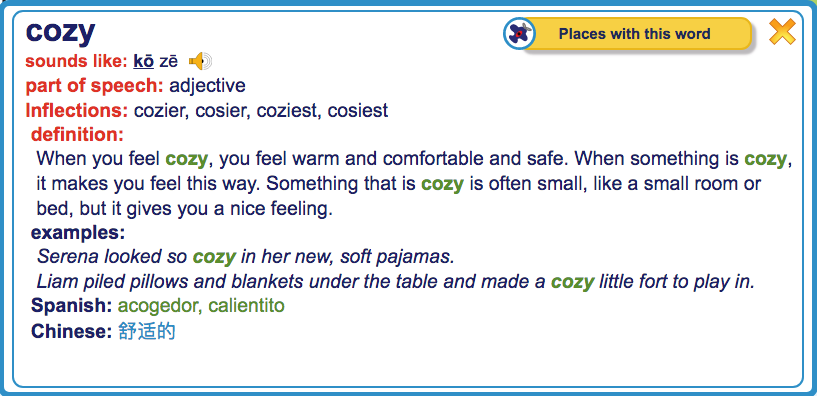
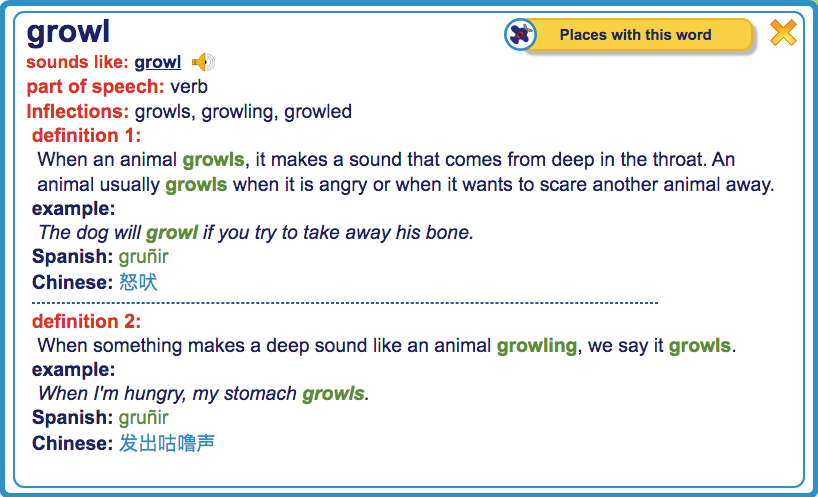
Defining “cozy” and “growl”
To define the word “cozy,” for example, we begin with the clause “When you feel cozy” and finish with the defining information: “you feel warm and comfortable and safe.” Similarly, to define the verb “growl,” we begin with the clause “When an animal growls” and end with the defining information: “it makes a sound that comes from deep in its throat.”
Less is not always more in dictionary writing for kids
In defining words for young children in WILD, we have taken an attitude that does not generally characterize dictionary writing. While lexicographers typically aim for conciseness in defining, we don’t operate under the assumption in WILD that less is always more. In fact, we’ve taken the attitude that more is more, as long as what is contained in the definition field is simple and useful. We believe that even full-sentence, descriptive definitions can still be remarkably opaque and incomplete in describing meaning, and we want our users to understand the meaning of the headword described and even enjoy the experience of grasping it through reading. To this end, we very often go beyond the core defining sentence and add more information that we hope will make the meaning clear and make the experience of reading the definition both enlightening and entertaining. For “cozy,” for example, we give a sense of what kinds of things make us feel cozy. For “growl,” we explain why an animal might growl. This kind of information is often what truly brings the meaning of a word home for the reader.
At the core of WILD is an abundantly illustrated dictionary that contains child-friendly, full-sentence definitions and example sentences for approximately 4,000 words. The dictionary can, of course, be used by looking up a word in the search box, but a child may also explore the dictionary through the four distinct visual environments Wordsmyth has created: the World, the Collections, the Book, and the Picture Dictionary. All the environments are linked with each other in such ways that make it easy and fun to navigate from one environment to another. One may, for example, start by seeing the lobster in the Sea Animals collection, click to learn more about it in the Book, and jump from there to see it in the Ocean setting in the World—or, alternatively, go to see it in the Restaurant!
WILD’s four visual environments
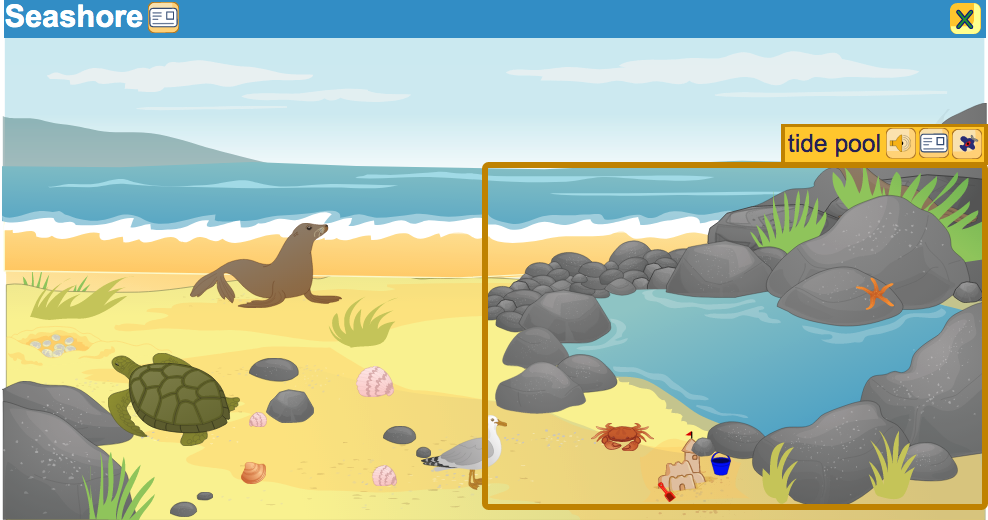
In the WILD World, children can explore items as they appear in natural and human-made environments. A child may choose to explore in Nature, seeing what plants and animals exist in a variety of surroundings, such as the Desert, the Seashore, or the Forest; or he or she may explore in the City, looking at what objects and types of people can be found in different settings such as the School, the Restaurant, the Hospital, or the Grocery Store. In any setting, there are opportunities to explore on different levels. Once in the Seashore setting, for example, a child can navigate into the Tide Pool or into the Ocean and see what creatures and plants might exist there.
Or, once in the Restaurant, a child can zoom in to look at the menu or navigate into the kitchen and open the refrigerator!
At any point, a user can see the objects in a setting with or without word labels and with or without Spanish or Chinese translation. All word labels can be clicked on to access audio pronunciations as well as to link with a word’s dictionary entry. Once in the entry, one can easily navigate back to the same item in the World.
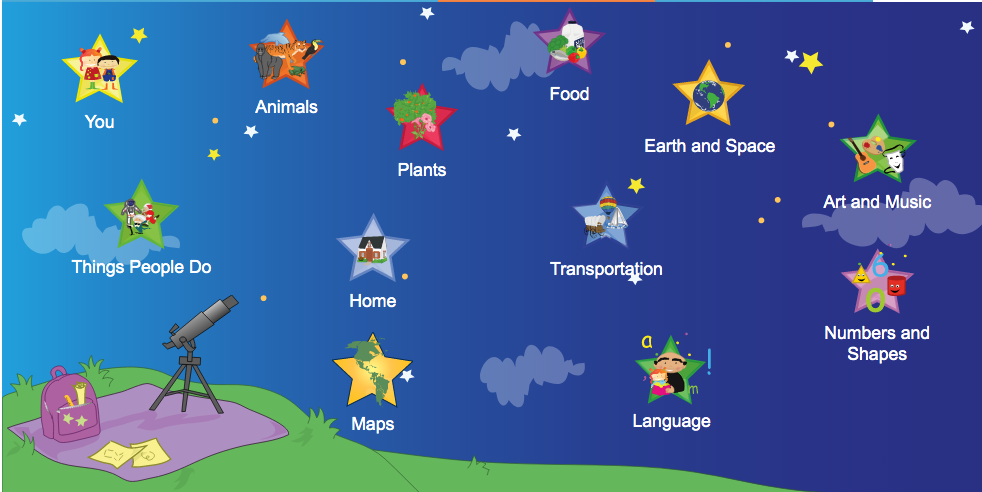
The WILD Collections allow children to explore words in categories, viewing artist renderings of hundreds of carefully selected and arranged items.
The Collections include a wide range of categories and subcategories, such as plants, parts of plants, things people do, people in their jobs, animals, mammals, invertebrates, parts of the human body, actions of the body, emotions, foods, spices, art materials, colors, and shapes. Included in the Collections is also a collection called Maps, which is where a child will gain access to an interactive map of the world. From the top level, the World Map, a child can navigate to deeper levels while being able to link at any point to audio pronunciations and dictionary entries for more information on the regions and countries being explored.
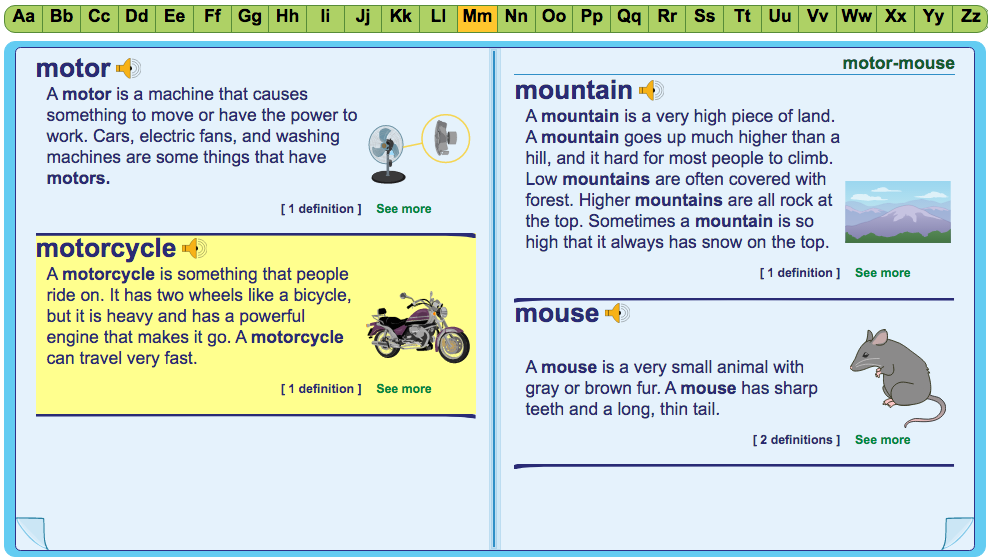
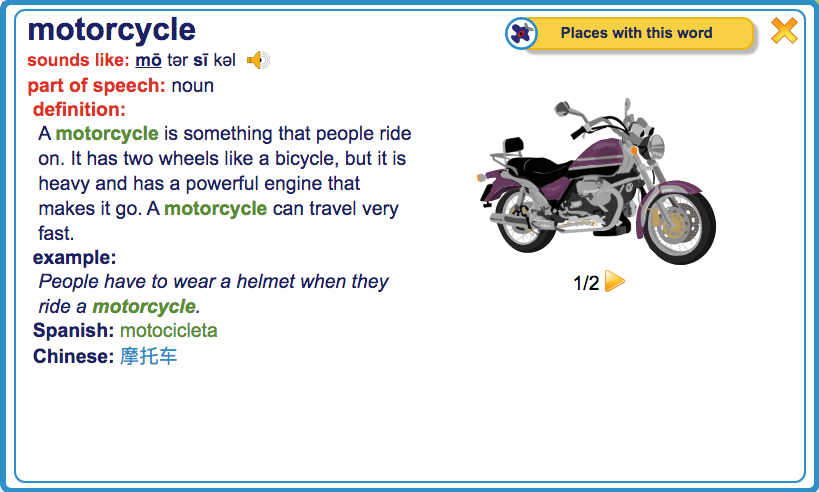
In the WILD Book, concise versions of the dictionary entries are displayed almost as if on pages of a print dictionary, and clicking on any word will open up its full, expanded entry, which will then allow the user access to any additional meanings of the word, entertaining example sentences coupled with each definition, Spanish and Chinese translations of the word, and any additional illustrations and photos. Text and audio pronunciation, as well as part of speech information, can also be viewed in every full entry.
The Book environment has been designed not only to look like a print dictionary but to resemble a print dictionary in the way the pages can be turned, allowing a user to browse page by page, looking at illustrations and photographs, and reading definitions of words that catch his or her interest.
In addition to the World, the Collections, and the Book, WILD also offers a Picture Dictionary. In the Picture Dictionary, words are defined by their illustration only. The word’s pronunciation can be heard by clicking on the provided audio icon. Each Picture Dictionary word is also linked to the word’s full entry in the Book, as well as to any other WILD environment in which the word appears. For example, from the entry for “snake” in the Picture Dictionary, the child can look under “Other places with this word” and see that the snake is also in the den in the Desert, in the cave in the Forest, and in the Reptiles and Amphibians collection. The child can then choose to go to any one of these places to see the items in these different environments.
This post merely scratches the surface of what WILD has to offer, but we hope it conveys some of the excitement we feel about this vibrantly-engaging educational resource.